

Governance Proofs
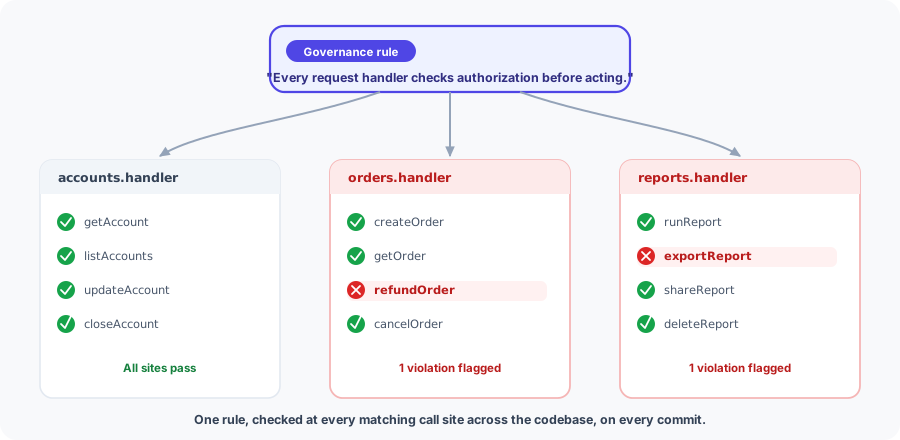
Governance proofs are project-wide properties checked against every relevant call site in your codebase. Unlike per-function annotations that verify one function at a time, governance proofs are universally quantified: every X in the codebase must satisfy Y. This is how you close the gap where a passing test suite coexists with a real hole, because a test only looks where you pointed it and a governance proof looks everywhere.
After this page you will be able to attach a governance property to a project, understand the categories the platform library covers, read and triage violations, set severity, suppress an intentional exception with a recorded reason, and map results to the compliance frameworks your auditors care about.
Governance proofs are part of Backbuild Prove, which is launching soon. Join the waitlist to get access at launch.
What Governance Proofs Are
A governance proof is a formally stated property that applies across your entire project. When attached to a project, Backbuild Prove identifies every relevant call site and verifies that each one satisfies the property. A single governance theorem can generate hundreds of verification checks across a large codebase.
Examples of governance proofs:
- Every authenticated request validates the session before reading user data
- Every multi-tenant data query is scoped to the calling tenant
- Every password comparison uses a constant-time comparison function
- Every PII field is encrypted before storage
- Every state-changing request validates an anti-forgery token
- Tenant data is isolated so one tenant’s records are never returned to another
- Every write operation emits an audit log entry
How It Works
- Backbuild Prove publishes governance theorems. The platform team maintains a library of formally stated governance properties covering security, compliance, and architectural patterns.
- You attach theorems to your project. From the Governance screen in the Backbuild dashboard, select the theorems that apply to your project.
- Verification runs on every
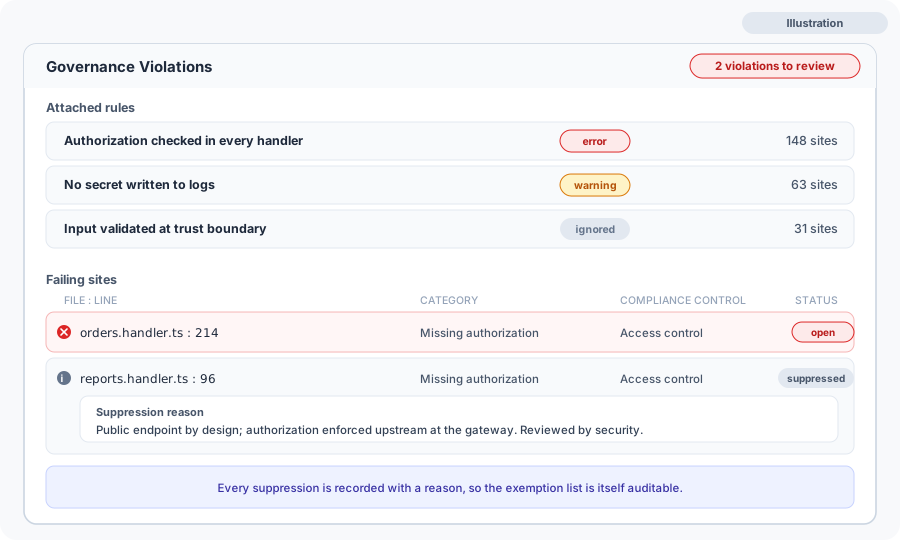
backbuild prove run. The kernel reads each attached theorem, identifies matching call sites in your codebase, translates them to the kernel's term language using the language parser, and verifies each one against the governance property. - Violations are recorded. Any call site that fails verification is recorded and surfaced in the Governance Violations tab of the Prove dashboard.
What a Governance Proof Establishes
A governance proof establishes its stated property at each matching call
site given the assumptions cited at trust boundaries. It is not pattern
matching and it is not a promise that a whole category of vulnerability is
impossible everywhere; it is a proof that, at each site the check applies
to, the property holds under the stated assumptions. The curated theorem
library defines precisely what each category checks and what it assumes, so
the result is auditable rather than a black box. Where a call site uses a
construct the parser cannot translate, the check reports
parser_skip for that site rather than silently passing it, so
coverage is visible.
Library Categories
Governance theorems are organized into categories. Each category covers a specific domain of security or compliance concern.
| Category | Description |
|---|---|
auth | Authentication and session validation |
rls | Row- and record-level access control enforcement |
tenant_isolation | Multi-tenant data separation |
crypto | Cryptographic best practices |
sql_injection | SQL injection prevention |
xss | Cross-site scripting prevention |
csrf | Cross-site request forgery prevention |
pii | Personally identifiable information handling |
audit_logging | Audit trail completeness |
rate_limiting | Rate limit enforcement |
memory_safety | Memory safety guarantees |
concurrency | Thread safety and race condition prevention |
compliance | Regulatory compliance requirements |
Compliance Framework Coverage
Governance theorems map directly to specific controls in major compliance frameworks. When you attach a theorem, the dashboard shows which compliance controls it satisfies.
PCI DSS 4.0
| Control | Description |
|---|---|
| 3.5 | Render stored cardholder data unreadable (PAN protection) |
| 6.2.4 | Software defenses against injection (SQL injection, XSS, CSRF) |
| 7.2.1 | Access control to system components for authorized individuals |
| 8.3.1 | Strong cryptography for authentication credentials |
| 10.2.1 | Audit logs for access to cardholder data |
SOC 2
| Control | Description |
|---|---|
| CC6.1 | Logical access security over information assets |
| CC6.7 | Restriction of data transmission and removal |
| CC7.2 | Monitoring of system components for anomalies |
ISO 27001:2022
| Control | Description |
|---|---|
| A.8.3 | Information access restriction |
| A.5.17 | Authentication information |
| A.8.24 | Use of cryptography |
| A.8.15 | Logging |
HIPAA
| Control | Description |
|---|---|
| 164.312(a)(1) | Access control |
| 164.312(b) | Audit controls |
| 164.312(e)(2)(ii) | Encryption of ePHI in transit |
Additional Frameworks
| Framework | Controls |
|---|---|
| GDPR | Article 32: Security of processing |
| OWASP | A01: Broken Access Control, A03: Injection |
| CWE | 79 (XSS), 89 (SQL Injection), 352 (CSRF) |
Severity Override
Each governance theorem attachment has a configurable severity level that determines how violations are treated:
| Severity | Behavior |
|---|---|
error | Violations fail the verification run. The backbuild prove run command exits with a non-zero status. |
warning | Violations are reported but do not fail the run. Useful during gradual adoption. |
ignored | The theorem is attached but not enforced. Violations are not checked or recorded. |
Suppressing Individual Violations
Individual governance violations can be suppressed when a call site is intentionally exempt from the governance rule. Suppression requires a reason, which is recorded in the audit trail for compliance purposes.
Suppressions are visible in the Governance Violations tab and can be reviewed, approved, or revoked by project administrators. The suppression reason is included in compliance reports and formal proof printouts.
Custom Governance Theorems
In the initial release, governance theorems are curated and maintained by the Backbuild Prove platform team. This ensures that every theorem in the library is formally sound and correctly matches the intended code patterns.
Enterprise custom theorems are planned for a future release. Enterprise customers will be able to author custom governance theorems specific to their organization’s policies and architectural standards.
Limitations
- Parser support required. The language
parser must support the constructs used at each call site. If the
parser cannot translate a construct, it is reported as
parser_skipand the governance check does not apply to that call site. - Static analysis only. Governance proofs verify code statically at verification time. They do not monitor runtime behavior. Use runtime monitoring and observability tools alongside governance proofs for complete coverage.
- Library grows over time. New governance theorems are added to the platform library regularly. The set of available theorems expands as the Backbuild Prove team formalizes additional security and compliance patterns.
Can I assert a property holds at every call site, not just where a test looked?
Yes. That is the whole point. A governance theorem is universally
quantified, so Prove identifies every matching call site and checks each
one. A single theorem can generate hundreds of checks, and a site that is
missing the required control is flagged as a violation with its file and
line.
How is a proof of "no injection here" actually grounded? What is assumed versus proved?
The proof establishes the category's stated property at each site given
the assumptions cited at trust boundaries; it is not a pattern match and
not compliance theater. The curated library defines exactly what each
category checks and assumes, so a reviewer can see the basis of every
result. See What a Governance Proof Establishes.
Can I author my own governance theorems for my threat model?
Not yet. At launch the library is curated and maintained by the platform
team, so every theorem is formally sound and matches the intended
patterns. Enterprise custom theorems are planned for a future release;
they are not available today, and this page does not describe them as
live.
Does this replace runtime monitoring?
No. Governance proofs verify code statically at verification time. Keep
your runtime monitoring and observability for behavior that only exists
at runtime; use governance proofs to prove the static property holds
everywhere.
Next Steps
- Writing pf2 Annotations: per-function proof annotations
- Certifications: formal proof certificates for compliance audits
- Pre/Post Contracts: precondition and postcondition verification
- Project Settings: configuring governance attachments and severity