
Backbuild Prove
Backbuild Prove is formal verification that lives in your source code. You write proof annotations in ordinary documentation comments, a higher-order-logic (HOL) kernel verifies them mathematically, an independent Lean 4 engine cross-checks the result, and you ship with a cryptographically signed certificate that anyone can verify for free.
This overview explains what Prove is, who it is for, how it differs from testing and linting, and exactly what you are trusting when the kernel says a proof holds. By the end you will know whether Prove fits your work and which guide to read next.
Backbuild Prove is launching soon. These docs describe the product as it will work at launch. Join the waitlist and we will let you know the moment it is live. Free public verification of signed certificates is part of every plan; see the pricing page for plans and language tiers.
What Backbuild Prove Is
Most tools that check code sample it: a test runs the cases you thought of, a linter matches patterns it was taught. Backbuild Prove instead establishes that a property holds for every input and state a function can reach, by constructing a mathematical proof and checking it against a small, fixed logical foundation. A proof does not find bugs the way a test does; it rules out an entire class of bug.
You express what a function guarantees (its preconditions,
postconditions, and the reasoning that connects them) as a
prove:pf2 annotation inside a documentation comment, directly
above the code. Nothing about your program changes: annotations live in
comments and add zero runtime overhead. When you verify, the kernel reads
the annotation, reads a formal translation of the code, and confirms the
proof is consistent with both. If the proof claims something the code does
not do, the kernel rejects it.
Prove has two faces that share one kernel:
- Per-function proofs. Prove one function at a time against its own contract: this parser never reads out of bounds, this division is always defined, this sort returns a sorted list. Start on Writing pf2 Annotations.
- Project-wide governance proofs. Prove a property holds at every matching call site across the whole codebase: every handler checks authorization, every tenant query is scoped, every write is audit-logged. See Governance Proofs.
Is this just fancier testing, or a fancy linter? Does it replace my tests?
No. Tests check the finite cases you wrote down; a proof establishes a
property over all inputs and states, so it eliminates a class of bug
instead of sampling for it. A linter matches syntactic patterns; a proof
reasons about meaning. Prove complements your tests, it does not
replace them. Keep testing everything a proof does not cover: user
experience, performance, hardware and environment assumptions, and the
correctness of the assumptions you cite at trust boundaries. The right
mental model is an additional gate on your critical paths (auth, money,
concurrency, parsing), not a substitute for your suite.
How long until my first real result?
A first verified annotation on a simple function takes minutes inside
your own editor or one CLI command; the Getting Started guide walks it end
to end. Fluency with richer proofs takes longer than an afternoon, which
is why an AI agent can draft proofs for you (below) and why the kernel
returns precise, instructive errors rather than a bare pass or fail.
Who It Is For
Application and backend engineers
Catch logic bugs before merge without leaving your editor or learning a separate proof language. Verify-on-save shows failures as inline squiggles, and one CLI command gates your pipeline. Start with Getting Started.
Security and AppSec teams
Prove a security property holds at every call site, not just where a test happened to look, and map the result to OWASP, CWE, and compliance controls. See Governance Proofs.
Safety and certification engineers
Produce machine-checkable proof artifacts, cross-checked by a second independent engine and tied to specific source by hash, to support a certification conversation. See Certifications.
Mathematicians and researchers
Write proofs in the natural style of published papers with a handful of extra macros. See the Modified amsthm Format and Backbuild Science.
Proofs That Keep AI Agents Honest
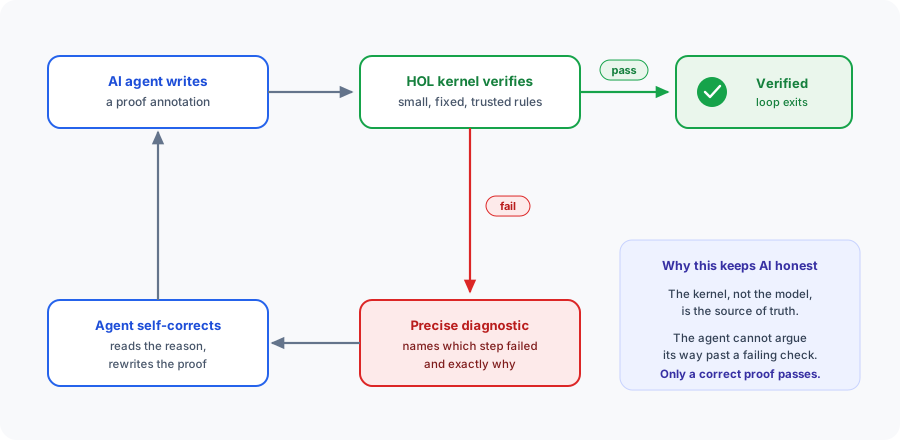
Backbuild Prove was designed for a world where AI coding agents write much of the code. An agent can draft the proof annotation just as it drafts the function, then iterate against the kernel until it verifies. What makes an AI-drafted proof trustworthy is that the checker, not the model, is the source of truth: an agent cannot talk its way past a mathematical proof obligation the way it can talk its way past a code review.
- The agent writes the annotation. It learns the format from examples and documentation during normal tool use. No special training or fine-tuning is required.
- The kernel verifies. Every step must follow from the foundation and previously proven theorems. A false step is rejected.
- The editor shows the diagnostic. A failed proof is a red squiggle with a precise message, exactly like a type error.
- The agent self-corrects. It reads the message and fixes the code or the proof, with no human follow-up prompt. The loop closes only when the property actually holds.
What You Are Trusting
The first question a serious reviewer asks is: if the prover says "proved," what exactly am I trusting? The honest answer is a small, auditable foundation, and a second engine that re-checks the result.
- A small trusted core. The kernel rests on a handful of foundational axioms and a fixed set of primitive inference rules. Every theorem in the standard library and every proof you write is reduced to those primitives. There is no path that accepts a result without deriving it. This small core is the entire trusted computing base for primary verification.
- An independent second checker. After the HOL kernel accepts a proof, it is exported to Lean 4, a proof assistant built by a different team on different mathematical foundations, which re-derives the result on its own. For a false result to survive, both engines would need compatible bugs that accept the same invalid proof. Lean 4 cross-check is included on Business and Enterprise plans.
- Explicit assumptions at the edges. Where code cannot be translated (foreign functions, inline assembly, hardware, third-party libraries), you record the boundary as a cited assumption the reader can see, rather than pretending it was proved. What is assumed versus proved is always visible.
Who verifies the verifier?
Two things reduce that risk to a minimum. First, the trusted core is
deliberately small and fixed, so it is small enough to audit and it does
not grow as your proofs do. Second, an independent engine with a
different implementation and different foundations re-checks every
result. Agreement between two differently-built checkers is far stronger
evidence than either one alone.
What happens with code it cannot translate (foreign functions, inline assembly, syscalls, external libraries)?
Those boundaries become explicit, cited assumptions recorded in the
proof, so a reader sees exactly what was assumed and what was proved. The
kernel still verifies every step that builds on the assumption. See Documenting External Dependencies.
Two Ways to Write a Proof
Prove accepts two input formats, and the same kernel verifies both:
- pf2, a dense, machine-first notation the kernel consumes directly. Best for engineers annotating functions. See Writing pf2 Annotations.
- Modified amsthm, the natural mathematical style of published papers plus about five extra macros, which translates deterministically to pf2. Best for mathematicians. See the Modified amsthm Format.
The Verification Workflow
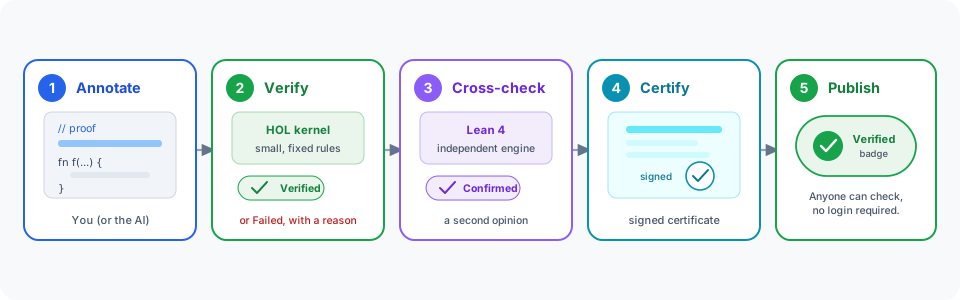
However you write proofs, they flow through four stages:
- Annotate. Write a
prove:pf2annotation in a documentation comment: the contract and a proof that the implementation satisfies it. - Verify. Your editor or the CLI sends the annotation to the kernel, which checks every step. Unchanged annotations return from cache instantly, so re-verification is cheap.
- Review. Results appear inline in the editor and in CLI output: verified, failed (with a precise reason), cached, or skipped. You or an agent fix any failure.
- Certify. When proofs pass, publish a signed certificate that anyone can verify, with no Backbuild account, at a public URL.