

Google Sheets alternative: Backbuild Sheets vs Google Sheets
Google Sheets is the free-form collaborative spreadsheet inside Google Workspace; Backbuild Sheets is the spreadsheet and structured-data grid inside the Backbuild workspace, with a real formula engine of more than 500 functions, LAMBDA, spill arrays, and an in-cell QUERY language, plus in-cell LaTeX math and SQLite export that Google Sheets does not have, inside a full workspace with single sign-on and a tamper-evident audit log on every plan including Free. Google Sheets still leads today on its deeper formula and function library, interactive pivot tables, roughly thirty chart types, the Apps Script ecosystem, live web-import functions, offline editing, and its mature mobile apps.
The short answer
Google Sheets is the free-form collaborative spreadsheet inside Google Workspace; Backbuild Sheets is the spreadsheet and structured-data grid inside the Backbuild workspace, alongside Docs, Slides, Mail, Calendar, Finances, and the rest, with a zero-knowledge secrets vault, an AI and Model Context Protocol surface, a public REST API, and single sign-on with a tamper-evident audit log on every plan. Choose Backbuild Sheets if you want a spreadsheet with in-cell LaTeX math and SQLite export, an agent-drivable tool surface, governance included from the first seat, the option to bring your own AI provider, and a workspace that also holds mail at your own domain, double-entry accounting, a help desk, and a secrets vault in one subscription. Choose Google Sheets if the deciding factors are its larger function library and live web-import functions, its interactive drag-and-drop pivot tables, its chart-type breadth, the Apps Script automation ecosystem, Connected Sheets to BigQuery, offline editing, mature mobile apps, or near-universal adoption and a free consumer tier.
Backbuild Sheets vs Google Sheets: feature by feature
Prices and limits below are quoted from each vendor’s own pages, observed 2026-07-19. The highlighted column is Backbuild. Row notes name the Backbuild surface each capability lives in.
| Backbuild Sheets Spreadsheet and structured-data grid inside a full workspace Workspace free up to 50 seats, including Backbuild Sheets, the AI assistant, and the REST API, with single sign-on, SCIM, and audit logging on every plan and no per-seat minimum. Paid plans run $19 to $149 per seat; Pro adds the SaaS Builder. Get Started Free | Google Sheets Free-form collaborative spreadsheet inside Google Workspace Free for individuals with any Google account. For a custom domain and admin controls, Google Workspace starts at $7 (Business Starter), $14 (Standard), and $22 (Plus) per user per month, billed annually. Admin single sign-on, retention, and the Google Vault audit surface are Workspace, paid and higher tiers. | |
|---|---|---|
| Price and limits | ||
| Free to use | Workspace free up to 50 seats | Free for individuals with a Google account |
| Cost for a custom domain and admin controls | $0 on Free; $19 to $149 by plan | $7 to $22 per user (Google Workspace) |
| Per-seat minimum | No minimum | No minimum on Workspace plans |
| Cell or capacity ceiling | No packaged cell cap; capacity scales with storage credits | 10 million cells (20 million in beta) |
| Version history | ||
| Spreadsheet core | ||
| Grid editing, number formats, and cell styling | ||
| Conditional formatting | ||
| Data validation (lists, checkboxes, reject or warn) | ||
| Filters, filter conditions, and sorting | ||
| Named ranges, merge, freeze panes, and find and replace | ||
| Multiple sheets or tabs per workbook | ||
| In-cell LaTeX and KaTeX math (via Backbuild Sheets rich cells; Google Sheets has no in-cell math typesetting) | ||
| Formulas and functions | ||
| Function library | More than 500 functions | Larger catalog, several hundred functions |
| XLOOKUP, INDEX and MATCH, SUMIFS, XIRR, and REGEXEXTRACT | ||
| Dynamic-array spill (UNIQUE, SORT, FILTER, SEQUENCE) | ||
| LAMBDA with LET, MAP, REDUCE, SCAN, BYROW, and BYCOL | ||
| In-cell SQL-style QUERY language | QUERY with a PIVOT clause | QUERY function |
| Live web-import functions (IMPORTRANGE, IMPORTHTML, GOOGLEFINANCE, GOOGLETRANSLATE) | ||
| Cross-sheet and cross-tab formula references | Single-sheet references today | References across tabs |
| Data analysis and reporting | ||
| Interactive drag-and-drop pivot tables | QUERY PIVOT clause; no drag-and-drop pivot | |
| GETPIVOTDATA | ||
| Charts | 6 chart types (line, bar, column, area, scatter, pie) | About 30 chart types |
| Live-binding charts that repaint as data changes | ||
| Connected data warehouse (BigQuery class) | Connected Sheets to BigQuery | |
| Collaboration and sharing | ||
| Real-time co-editing with presence | ||
| Threaded cell comments | ||
| Scoped, expiring, revocable sharing | User, group, department, and organization scopes | Link and per-person sharing |
| Sharing ubiquity (nearly everyone already has a Google account) | Newer product; growing base | Near-universal reach |
| AI and agents | ||
| Built-in AI assistant grounded in the sheet | Gemini in Sheets | |
| AI builds a whole sheet from a prompt | Via the assistant or an agent over MCP | Help me organize |
| Native Model Context Protocol tool surface for the grid (27 sheet tools, so an agent authors a sheet end to end) | ||
| Bring your own AI provider and model | ||
| Automations that operate a real computer (a container with a browser, desktop, and terminal, on usage credits) | ||
| Automation and extensibility | ||
| In-cell macro or scripting language (Google: Apps Script; Backbuild: automations, MCP, and the REST API instead) | Apps Script | |
| Event and schedule automations without a runtime cap | Automations on every plan; no 6-minute execution wall | Apps Script, 6-minute run and daily quota |
| Vault secrets injected into automated work by grant (zero-knowledge vault; the model never sees a plaintext value) | ||
| Import, export, and API | ||
| Import CSV, TSV, XLSX, and ODS | ||
| Export CSV, TSV, and XLSX | ||
| XLSX export preserves formulas | Values-only snapshot today | Exports formulas |
| SQLite export (Google Sheets has no SQLite export) | SQLite export on paid plans | |
| Public REST API for the grid | On every plan | Google Sheets API |
| Security, identity, and governance | ||
| Single sign-on (SAML) | Every plan, including Free | Google Workspace admin, paid plans |
| SCIM provisioning | SCIM 2.0 user provisioning | Workspace (higher tiers) |
| Role-based access control | Every plan | Workspace admin roles |
| Tamper-evident audit log | Every plan, including Free | Google Vault (Business Plus and up) |
| Zero-knowledge, post-quantum secrets vault in the same workspace | ||
| Bring your own AI provider so inference runs under your own agreement | ||
| Offline editing | Not the model today | Offline editing in Chrome |
| Native desktop apps (Windows and macOS installers) | Web plus a Chrome offline app | |
| Native mobile apps in the app stores today | In development; coming soon | |
| Workspace apps in the same subscription | ||
| Backbuild Mail (Google’s similar offering: Gmail in Google Workspace) | Gmail | |
| Mail at your own domain from a real mail server on the free plan | Own domain needs a paid Workspace plan | |
| Backbuild Calendar (Google’s similar offering: Google Calendar) | Google Calendar | |
| Backbuild Contacts (Google’s similar offering: Google Contacts) | Google Contacts | |
| Backbuild Docs (Google’s similar offering: Google Docs) | Google Docs | |
| WYSIWYG with a raw LaTeX source mode and live math | ||
| Export to LaTeX, DOCX, ODT, HTML, Markdown, RTF, and EPUB | PDF, DOCX, ODT, and more | |
| Backbuild Slides (Google’s similar offering: Google Slides) | Google Slides | |
| Backbuild Files (Google’s similar offering: Google Drive) | Google Drive | |
| Backbuild Chat (Google’s similar offering: Google Chat) Soon | On the roadmap | Google Chat |
| Backbuild Meetings (Google’s similar offering: Google Meet) Soon | On the roadmap | Google Meet |
| Public intake forms (Google’s similar offering: Google Forms) Soon | On the roadmap | Google Forms |
| Backbuild Photos (albums, slideshows, and a non-destructive layer editor) | ||
| Backbuild Finances (double-entry accounting, invoicing, bills, and bank reconciliation) | ||
| Help desk (tickets, workflow states, assignment, and replies as a built-in product) | 20 tickets/mo Free; unlimited paid | |
| Training course system (build and publish courses, quizzes, and certificates) | ||
| Backbuild Studio (screen-demo training videos narrated from a script) | Every plan; cloud rendering on paid plans | |
| Remote desktop (browser-based access to your own machines and cloud desktops) | ||
| Secrets vault (zero-knowledge, post-quantum password and secrets manager) | ||
A cross means the platform does not offer the feature today. Soon means the feature is on the Backbuild roadmap and not shipped yet. In the workspace apps group, each row is one app in the Backbuild subscription; where Google Workspace has a similar offering, the row note names it and the indented rows beneath list the features that differ. Google Sheets prices and limits are quoted from the Google Workspace pricing page, the Google Sheets product page, its function list, and its developer documentation, observed 2026-07-19. Backbuild capabilities are cited to the verified documentation for formulas and functions, charts, sort, filter, and validation, collaboration and sharing, import and export, and the API reference.
Google Sheets and the Backbuild surfaces that do the same job
Google Sheets is a free-form collaborative spreadsheet: a grid with a large formula and function library, dynamic arrays, LAMBDA, the QUERY function, interactive pivot tables, roughly thirty chart types, real-time co-editing, offline editing in Chrome, and the Apps Script automation ecosystem, all inside Google Workspace next to Gmail, Google Docs, Google Slides, Google Drive, Google Calendar, and Google Meet. On the Backbuild side the same spreadsheet job is done by Backbuild Sheets: a real formula engine with more than 500 functions, LAMBDA, spill arrays, and an in-cell QUERY language, real-time co-editing and comments, charts, conditional formatting, and validation, and in-cell LaTeX math. Backbuild Sheets sits in the wider Backbuild workspace, with the whole grid drivable through a public REST API and a native Model Context Protocol tool surface that Google Sheets answers with Apps Script and the Google Sheets API.
The Backbuild surfaces that answer Google Sheets
A reader coming from Google Sheets will recognise the grid; a few surrounding surfaces are worth naming plainly: the structured-data grid, the AI and Model Context Protocol surface, and the governance that rides along on every plan.
The grid, structured data, and saved views
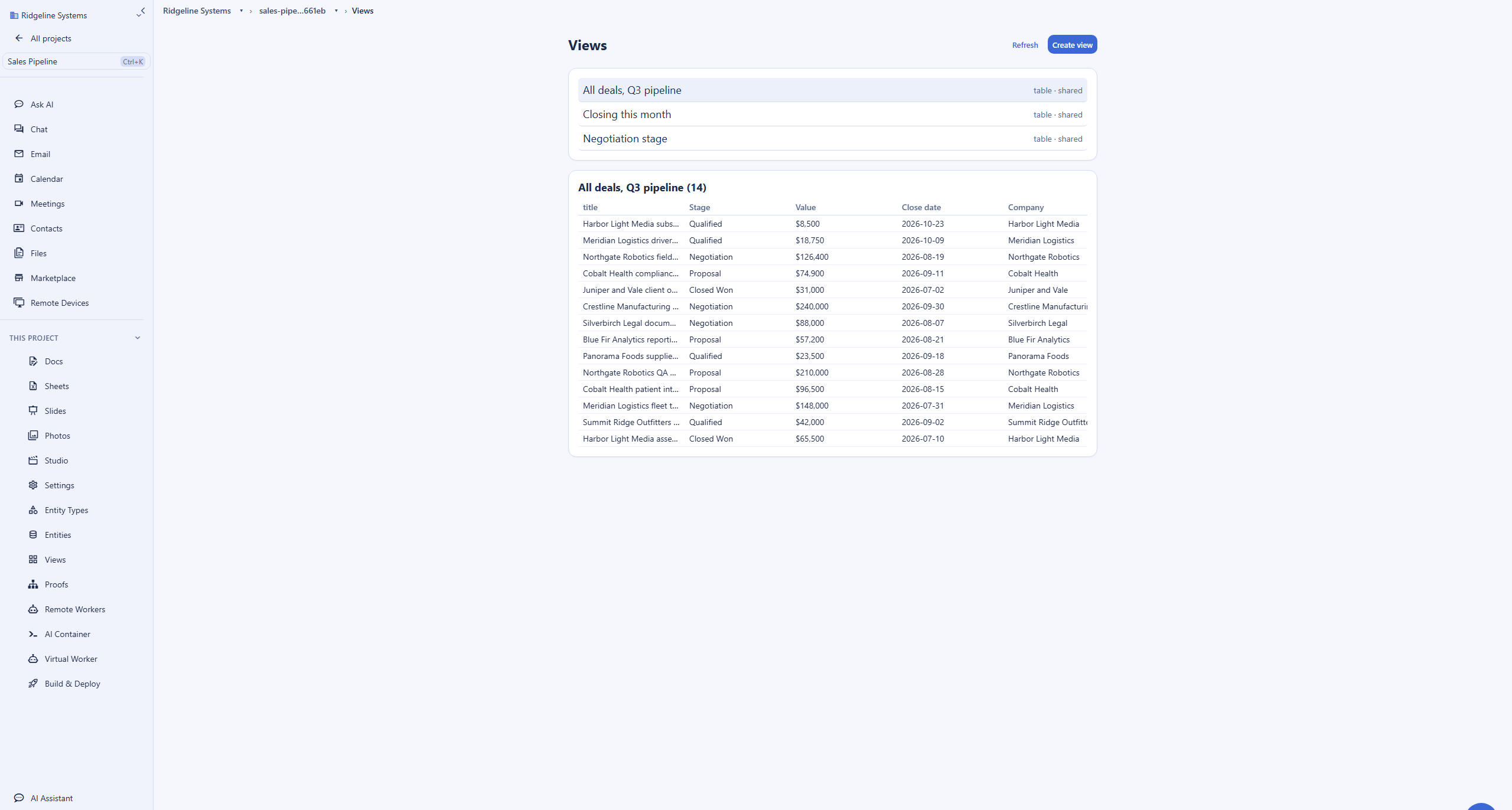
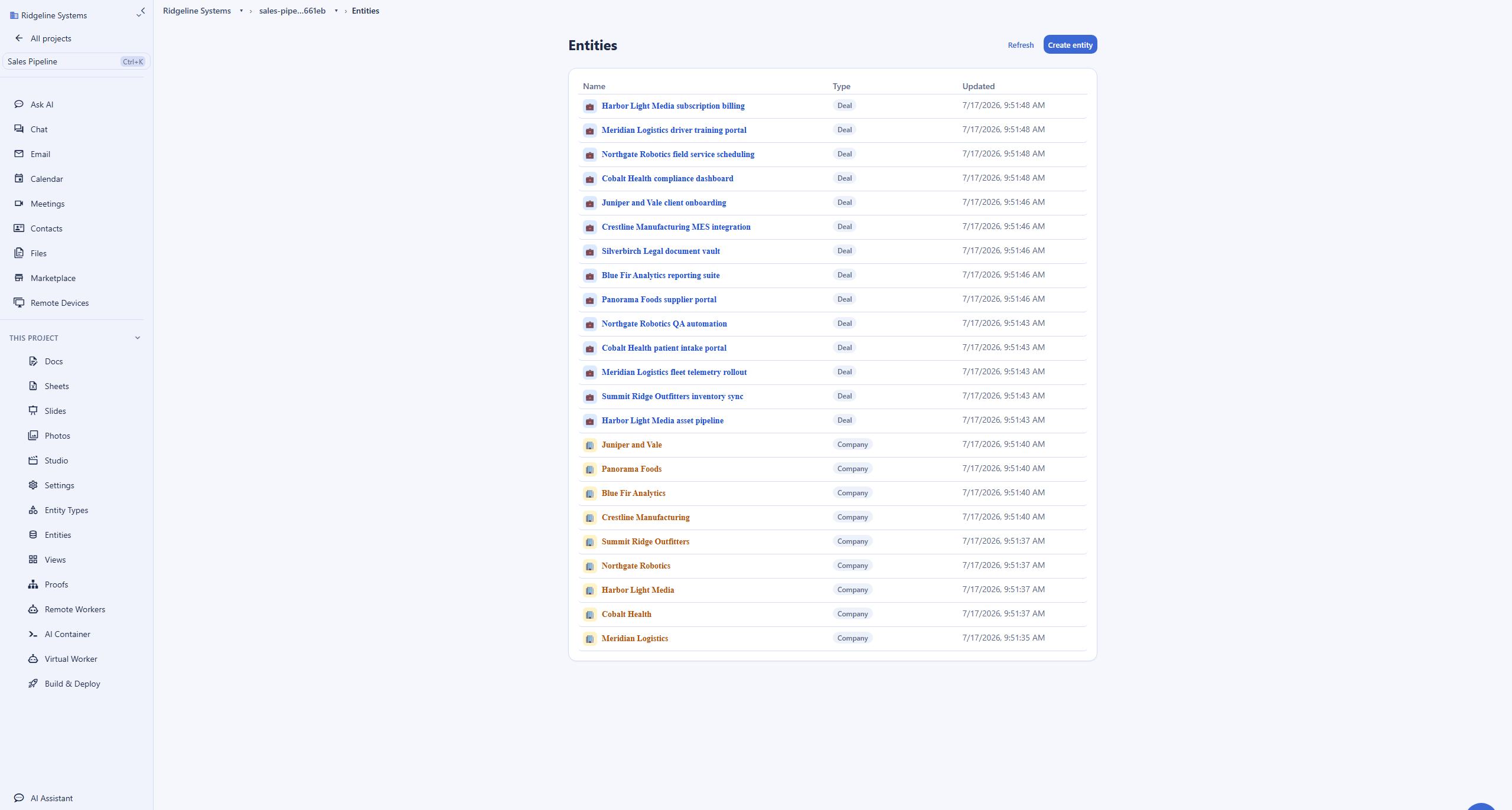
Google Sheets is a free-form grid: any cell can hold any value or formula, which is exactly what makes it flexible. Backbuild Sheets is the same kind of free-form grid, with more than 500 functions, dynamic-array spill, LAMBDA, and the in-cell QUERY language, and it lives beside a structured-data grid built on typed entity types for teams that want columns with enforced types, records with an owner and a workflow state, and saved views with filters and sorting over one dataset. The two are complementary: use Backbuild Sheets for the everyday spreadsheet, and reach for typed entities when a table needs validation, relationships, and per-record access control that a free-form grid does not enforce. Both surfaces, and the rest of the workspace, are readable and writable through the same REST API.
The formula engine, QUERY, and in-cell math
The Backbuild Sheets formula engine covers the shapes an analyst reaches for: XLOOKUP, INDEX and MATCH, SUMIFS, SUMPRODUCT, and XIRR, dynamic-array spill with UNIQUE, SORT, and FILTER, LAMBDA with LET, MAP, REDUCE, SCAN, BYROW, and BYCOL, and an in-cell SQL-style QUERY language with SELECT, WHERE, GROUP BY, a PIVOT clause, and ORDER BY, recalculated through an incremental dependency graph. Two honest differences matter here. First, Google Sheets has the larger overall function catalog and runs live web-import functions such as IMPORTRANGE, IMPORTHTML, and GOOGLEFINANCE that Backbuild Sheets does not run today, and it supports cross-tab references. Second, Backbuild Sheets adds something Google Sheets does not have: in-cell LaTeX and KaTeX math, so a cell can render a typeset equation, which matters to research and technical teams. For interactive analysis, Google Sheets also has drag-and-drop pivot tables; the Backbuild Sheets answer is the QUERY PIVOT clause, which is written rather than dragged.
AI, the Model Context Protocol, and the API
Both products bring AI to the grid. Google Sheets has Gemini in Sheets, with Help me organize building and editing a sheet from a prompt and an inline AI function. Backbuild Sheets has the built-in AI assistant, and it exposes a native Model Context Protocol tool surface of 27 sheet tools, so an AI agent, whether Backbuild AI on usage credits or a model you bring, can create a workbook, write cells, set formulas, add tabs, import, and export end to end, with every action inside the caller permissions and audit logged. Google Sheets is automated through Apps Script, the Google Sheets API, and add-ons. The grid also answers a REST call directly through the Backbuild Sheets API, on every plan.
Where Google Sheets wins today
Google Sheets is a mature, deep, universally adopted spreadsheet, and several of its strengths are things Backbuild Sheets does not match today. Stated plainly:
Pivot tables and chart breadth
Google Sheets ships interactive drag-and-drop pivot tables with GETPIVOTDATA, and roughly thirty chart types. Backbuild Sheets answers pivots with the written QUERY PIVOT clause and ships six chart types today. For interactive cross-tabulation and chart variety, Google Sheets leads.
Apps Script and live web-import functions
The Apps Script ecosystem, its add-on marketplace, and live functions such as IMPORTRANGE, IMPORTHTML, GOOGLEFINANCE, and GOOGLETRANSLATE have no direct equivalent in Backbuild Sheets, whose answer is a different mechanism: automations, the Model Context Protocol, and the REST API. If your workbook depends on an in-cell macro language or live web pulls, Google Sheets is the better fit.
Offline, mobile, and Connected Sheets
Google Sheets supports offline editing in Chrome, ships mature iOS and Android apps, and connects to BigQuery through Connected Sheets. Backbuild Sheets does not offer full offline editing today, its native mobile apps are still in development, and it has no BigQuery-class connected source.
Adoption, sharing, and a free consumer tier
Nearly everyone already has a Google account, which makes Google Sheets frictionless to share, and it is free for individuals. Reviewers consistently rate it a mature and stable product. Backbuild is the newer entrant with a smaller base, and its free plan is oriented to teams of up to fifty rather than a consumer account.
Common Google Sheets frustrations, and how Backbuild Sheets addresses them
Data lives on Google servers
A recurring reason people look for a Google Sheets alternative is where the data sits and how it is used. Backbuild keeps spreadsheet data in a workspace with single sign-on, role-based access control, and a tamper-evident audit log on every plan, a zero-knowledge post-quantum secrets vault for any credentials the work touches, and the option to run AI under your own provider agreement. Note the honest limit: Backbuild Sheets content is encrypted in transit and at rest but is not end-to-end encrypted.
Performance and the cell ceiling
Reviewers report Google Sheets slows on large datasets and enforces a 10-million-cell cap that cannot be raised even on paid plans. Backbuild Sheets recalculates through an incremental dependency graph and has no packaged cell cap, with capacity scaling with storage credits. We have not published a large-dataset benchmark, so this is a design difference to test with your own data rather than a promised number.
The Apps Script runtime wall
Developers hit the 6-minute Apps Script execution limit and daily quota on bulk work. Backbuild automations run without that per-run wall, and heavier jobs can dispatch to an AI worker on a real containerized computer. The tradeoff is honest: Backbuild has no in-cell macro language, so simple in-sheet scripts are a different pattern, not a drop-in port.
Passwords and secrets stored in a sheet
A common and risky habit is keeping passwords in a spreadsheet. Backbuild ships a zero-knowledge, post-quantum secrets vault in the same workspace, so credentials live encrypted where the service itself cannot read them, and automated work draws them by single-use grant rather than being pasted into a cell.
Which spreadsheet wins, by use case
Budgets, lists, and everyday trackers
For a personal budget, a shared list, or a lightweight tracker, the deciding factors are cost, zero-friction sharing, and working everywhere. Google Sheets is free for individuals, shares instantly to anyone with a Google account, edits offline, and has polished mobile apps. Backbuild Sheets matches the core editing experience and adds governance, but it is oriented to a team workspace rather than a single consumer account, has no full offline mode today, and its mobile apps are still in development.
Business reporting, dashboards, and analysis
Analysts and operations teams buy on formula depth, pivots, chart variety, and turnaround. Here the two products split. Google Sheets has the larger function catalog, interactive pivot tables, about thirty chart types, and Connected Sheets to BigQuery for warehouse-scale analysis. Backbuild Sheets answers with more than 500 functions, LAMBDA, spill arrays, and the in-cell QUERY language whose PIVOT clause cross-tabulates a range in a formula, plus in-cell LaTeX math for technical reporting, and it sits beside double-entry accounting in Backbuild Finances when the report is a financial one.
Spreadsheet automation and programmatic sheets
Developers and power users automate spreadsheets to save labour: pull data, transform it, and push it back. Google Sheets does this through Apps Script, the Google Sheets API, and add-ons, a deep and well-known ecosystem, though bulk jobs meet the 6-minute run limit. Backbuild Sheets is driven through a public REST API and a native Model Context Protocol surface of 27 tools, so an AI agent can build a sheet end to end, and automations can dispatch to an AI worker on a real computer with vault secrets injected by grant. The honest gap: there is no in-cell macro language in Backbuild Sheets, so an Apps Script that lives inside the sheet is a different pattern.
Private, governed, and de-Googled teams
For a team that wants spreadsheet data off Google’s servers, or that has to answer to a security or compliance review, the deciding factors are encryption, access control, audit evidence, and data governance. Backbuild Sheets keeps data in a workspace with single sign-on and a tamper-evident audit log on every plan including Free, role-based access control, a zero-knowledge post-quantum secrets vault, and inference under your own AI provider agreement. Google stores spreadsheet content on Google servers without end-to-end encryption, and admin single sign-on, retention, and the Google Vault audit surface are Workspace features on paid and higher tiers. The honest boundary applies to both: neither product end-to-end encrypts the spreadsheet body.
Consolidating the spreadsheet with the rest of the workspace
Around a spreadsheet, most teams also pay for mail, calendar, documents, slides, file storage, accounting, and support tooling. Google Sheets sits inside Google Workspace, which covers Gmail, Docs, Slides, Drive, Calendar, and Meet, but not double-entry accounting, a help desk, or a secrets vault. Backbuild folds the spreadsheet into a workspace that also includes Mail at your own domain, Calendar, Docs, Slides, Photos, Files, double-entry accounting, a help desk, a training course system, and the secrets vault, in one subscription.
Security, identity, and governance evaluation
A security review of a spreadsheet platform turns on four questions: who can sign in, what each person can see, what evidence survives every change, and where the data and any credentials live. On identity, Backbuild ships single sign-on on every plan, including Free, and SCIM 2.0 provisioning. Google offers admin single sign-on and provisioning too, but through the Google Workspace admin console on paid plans, so for a personal Google Sheets account the identity controls are consumer-grade, and the enterprise posture is a function of the Workspace tier.
On authorization and evidence, Backbuild applies organization-scoped roles beneath record-level sharing scopes, and writes a tamper-evident audit log on every plan. Google Sheets shares at the file and link level, and its retention and audit surface is Google Vault, available on Business Plus and higher. On data handling, Backbuild keeps any credentials the work touches in a zero-knowledge, post-quantum secrets vault the service cannot read, releasing them to automated work by single-use grant, where a common Google Sheets pattern is to keep secrets in a cell. On AI governance, Backbuild lets an organization bring its own AI provider and model, so inference runs under its own agreement, where Gemini in Sheets runs on Google’s bundled model.
The tradeoffs run both ways. Google is the larger, longer-established vendor with a mature Workspace security and compliance program, a deep administrator community, and long-standing certifications; Backbuild is the newer product, and its posture, while built to the standards auditors check, does not carry that long independent operating history yet. Neither product end-to-end encrypts spreadsheet content. The bottom line: if the review demands single sign-on, fine-grained access, an audit log, and a secrets vault without stepping up a paid tier, Backbuild’s floor is higher; if it demands a mature, independently audited enterprise program with a long track record, Google Workspace has more of it today.
The economics for a finance and procurement review
Google Sheets itself is free for individuals, and the cost appears when a team needs a custom domain, admin controls, and more storage, which means a Google Workspace subscription at 7, 14, or 22 US dollars per user per month, billed annually, with admin single sign-on, retention, and the Vault audit surface arriving on higher tiers. Around the spreadsheet, accounting, a help desk, and a password manager are separate purchases.
Backbuild’s model is a single workspace subscription: free for up to 50 seats, then $19 to $149 per seat with no minimum, with variable usage (AI, containers, storage growth) drawing one published credit pool. Single sign-on, SCIM, and audit logging are included on every plan, the AI assistant is on every plan with the option to bring your own provider so inference is billed at the provider’s own rate, and the same subscription includes Mail, double-entry accounting, a help desk, and the secrets vault, each of which is a separate invoice around Google Sheets. Be precise about the free tiers in both directions: an individual pays nothing for Google Sheets, and a team of up to fifty pays nothing on Backbuild, but the Backbuild free plan includes a fixed storage allowance before growth draws credits, so a team hosting heavy data can pay Backbuild for storage where a personal Google Sheets user would not.
The bottom line: for a single user, Google Sheets is free and hard to beat on price; for a team that would otherwise buy Workspace plus accounting plus a help desk plus a password manager, Backbuild’s single subscription consolidates several line items, and its governance does not cost an extra tier.
Rolling it out across a team
Adoption risk on a spreadsheet is concentrated in three places: how fast people are productive, whether existing files come across cleanly, and whether the tool fragments. On the first, both are fast, because the grid is a familiar surface; Google Sheets has the edge of near-universal prior exposure. On the second, Google Sheets files move into Backbuild Sheets through XLSX or CSV export and Backbuild Sheets import, with two honest caveats to plan for: live web-import functions import as their last cached value, and cross-tab references collapse to a single sheet, so workbooks that lean on either need rework.
On governance during rollout, Backbuild’s advantage is that single sign-on, role-based access control, and audit logging are on from the first seat, and the rest of the workspace, including the built-in help desk, is there on day one, so questions about the new tooling have somewhere to live without another purchase. Google’s advantage is muscle memory and mobile: most people already know the interface, and the mobile apps are mature. The bottom line: pilot both with real workbooks. If the team lives in pivots, offline editing, and mobile, Google Sheets lands faster today; if it works in a governed workspace with the back office attached, Backbuild rolls out at zero cost for the whole team with governance included.
Data ownership, migration, and lock-in
The exit question deserves as much scrutiny as the entrance. Google Sheets data leaves through XLSX, CSV, ODS, PDF, and HTML export and through the Google Sheets API, and exported XLSX preserves formulas. Backbuild Sheets exports CSV, TSV, XLSX, and SQLite, and the REST API returns the grid on every plan; the honest gap on the way out is that Backbuild Sheets XLSX export is a values-only snapshot today, so a formula-preserving round trip is a place where Google Sheets is ahead.
Migrating into Backbuild is a two-lane move: grid-shaped files import from CSV, TSV, XLSX, and ODS, with formulas translated where the engine can on XLSX and ODS, and anything programmatic loads through the API or by handing the file to an AI agent over the Model Context Protocol, which can build the workbook end to end. The bottom line: both products let you leave, and the practical difference is that Google Sheets preserves formulas on XLSX export while Backbuild Sheets adds SQLite export and an uncapped, agent-drivable API for both directions.
Strategic fit and vendor risk
Google Sheets is a category-defining product, and the strategic case for it is maturity and reach: a universally adopted spreadsheet, a deep function library, Apps Script and a large add-on ecosystem, Connected Sheets for warehouse-scale analysis, and Google Workspace behind it. The risk on that side is data governance for teams that want their data off Google’s servers or under their own AI agreement, and the way admin controls and the audit surface sit on higher Workspace tiers.
Backbuild’s strategic case is governance and consolidation: a real formula engine with in-cell math, an agent-drivable tool surface, security included on every plan, a secrets vault, and the whole workspace in one subscription. The real risks: it is the younger vendor, and it does not yet match Google Sheets on interactive pivot tables, chart breadth, an in-cell macro language, live web-import functions, offline editing, mobile maturity, or a BigQuery-class connected source. The bottom line: choose Google Sheets when formula and add-on depth, pivots, offline, mobile, and category maturity are the controlling criteria; choose Backbuild Sheets when governance on every plan, in-cell math, an agent-drivable API, a secrets vault, and workspace consolidation matter more.
Frequently asked questions
Is there a free Google Sheets alternative?
Yes. Backbuild Sheets is included in the Backbuild workspace, which is free for teams of up to 50 seats, and the free plan also includes single sign-on, SCIM, a tamper-evident audit log, the AI assistant, and the public REST API, with 25 MB of database storage and 1 GB of file storage before further growth draws usage credits. Google Sheets is free for individuals with any Google account, and to use it at your own domain with admin controls you subscribe to Google Workspace, which starts at 7 US dollars per user per month on Business Starter, billed annually. So an individual can use Google Sheets at no cost, and a team of up to fifty people can use Backbuild Sheets, with governance included, at no cost.
Is Backbuild Sheets as powerful as Google Sheets on formulas?
On the core formula language they are close, and on a few advanced surfaces Google Sheets is deeper. Backbuild Sheets ships a formula engine with more than 500 functions, LAMBDA with LET, MAP, REDUCE, SCAN, BYROW, and BYCOL, dynamic-array spill, and an in-cell SQL-style QUERY language that includes a PIVOT clause. Google Sheets has a larger total function catalog and, importantly, live web-import functions such as IMPORTRANGE, IMPORTDATA, IMPORTHTML, GOOGLEFINANCE, and GOOGLETRANSLATE that Backbuild Sheets does not run today, plus cross-tab formula references. Backbuild Sheets also adds in-cell LaTeX math that Google Sheets does not have. For most day-to-day modelling the engines are comparable; if your workbook depends on live external-data functions, drag-and-drop pivot tables, or references across tabs, Google Sheets is the better fit today.
Does Backbuild Sheets have pivot tables?
Not as interactive drag-and-drop pivot tables. Google Sheets has a mature pivot-table editor where you drag fields into rows, columns, and values. Backbuild Sheets offers an in-cell QUERY language whose PIVOT clause can group and cross-tabulate a range with a formula, which covers many reporting cases but is written rather than dragged, and it does not have GETPIVOTDATA. If interactive pivot tables are central to your work, Google Sheets leads here, and a drag-and-drop pivot surface for Backbuild Sheets is a capability we have queued rather than shipped.
Can Backbuild Sheets replace Google Sheets for a private or de-Googled team?
For most spreadsheet work, yes, and this is where Backbuild is strongest. Backbuild Sheets keeps your data in a workspace with single sign-on, role-based access control, and a tamper-evident audit log on every plan including Free, a zero-knowledge post-quantum secrets vault for any credentials the work touches, and the option to bring your own AI provider so inference runs under your own provider agreement rather than a vendor-bundled model. Google stores spreadsheet content on Google servers without end-to-end encryption, and admin single sign-on, retention, and the Google Vault audit surface are Workspace features gated to paid and higher tiers. Note the honest limit: Backbuild Sheets content is encrypted in transit and at rest but is not end-to-end encrypted, so if your requirement is zero-access encryption of the spreadsheet body itself, neither product provides it.
Does Backbuild Sheets work offline like Google Sheets?
This is a place where Google Sheets is ahead. Google Sheets supports offline editing in Chrome, where you can open and edit a sheet without a connection and it syncs when you reconnect. Backbuild Sheets is a real-time collaborative grid and does not offer full offline editing today. If you regularly work on spreadsheets without a network connection, Google Sheets is the better choice.
Can an AI agent build a Backbuild Sheets spreadsheet?
Yes, end to end. Backbuild Sheets exposes a native Model Context Protocol tool surface of 27 sheet tools, including create, write cells, set formula, read range, apply style, insert and delete rows and columns, manage tabs, import, export, and describe function. An AI agent, whether Backbuild AI on usage credits or a model you bring, can create a workbook, write data, set formulas, add tabs, and export it, all through the same tools, with every action running inside the caller permissions and audit logged. Google Sheets is scripted through Apps Script and driven through the Google Sheets API and add-ons; both approaches automate a sheet, and the mechanism differs.
How do I move a Google Sheets spreadsheet into Backbuild Sheets?
Export the Google Sheets file as XLSX or CSV from the File menu, then import it into Backbuild Sheets, which reads CSV, TSV, XLSX, and ODS, translating formulas where it can on XLSX and ODS import. Values and structure move cleanly. Be aware of two honest gaps on the way in: live web-import functions such as IMPORTRANGE do not run in Backbuild Sheets, so those cells import as their last cached value, and cross-tab formula references collapse to a single sheet, so a workbook that leans on references across tabs needs rework. For anything programmatic, the public REST API and the Model Context Protocol tools can load and read a sheet directly.
What does Backbuild Sheets include that Google Sheets does not?
In the grid itself, in-cell LaTeX and KaTeX math and SQLite export. Around the grid, a native Model Context Protocol tool surface, single sign-on, SCIM, role-based access control, and a tamper-evident audit log on every plan including Free, a zero-knowledge post-quantum secrets vault with grant-based secret injection for automations, the option to bring your own AI provider and model, containerized automations that can operate a real browser, desktop, and terminal, and a workspace that folds in double-entry accounting in Backbuild Finances, a help desk, a training course system, and Backbuild Studio, each of which is a separate product or subscription around Google Sheets.
Try Backbuild Sheets free
A real formula engine with more than 500 functions, LAMBDA, spill arrays, and an in-cell QUERY language, real-time co-editing, in-cell LaTeX math, and SQLite export, inside a workspace that is free for up to 50 seats with single sign-on, SCIM, and audit logging included and no per-seat minimum. If the deciding factors are interactive pivot tables, chart-type breadth, Apps Script, live web-import functions, offline editing, or mature mobile apps, Google Sheets is the stronger choice today.
Get started free