

monday.com alternative: the Backbuild data platform vs monday.com
monday.com is a work platform built on boards, items, columns, dashboards, and automations for project and work management; Backbuild answers it with a real relational database with typed relationships, lookups, and rollups, saved views, and automations with no monthly action cap, together with Backbuild Sheets for the spreadsheet grid, inside a full workspace that monday.com does not have, with single sign-on and a tamper-evident audit log on every plan including Free, no per-plan record caps, and no per-seat minimum. monday.com still leads today on the drag and drop polish of its in-place board, timeline, and gantt layouts, its dashboards and widgets, its marketplace of more than 850 integrations, and its native mobile apps.
The short answer
monday.com is a work platform built on boards, items, columns, dashboards, and automations, with monday AI, a public API, and native mobile apps; on the Backbuild side that job is done by the data platform (entity types and entities on a relational database, typed relationships, saved views, and automations) together with Backbuild Sheets, inside a wider workspace. Choose Backbuild if you want a governed relational database with typed relationships, lookups, rollups, and referential integrity instead of items on a board, automations with no monthly action cap, single sign-on, SCIM, and audit logging on every plan including Free, a 72-endpoint data-model REST API with no monthly call quota, and no per-plan record caps and no per-seat minimum, inside a workspace that also includes Mail at your own domain, a real spreadsheet, double-entry accounting, and a secrets vault. Choose monday.com if the deciding factors are the drag and drop polish of the board, timeline, and gantt layouts it renders in place today, its dashboards and widgets, its large template and automation-recipe library, the breadth of its integration marketplace, or its native mobile apps in the app stores.
Backbuild vs monday.com: feature by feature
Prices and limits below are quoted from each vendor’s own pages, observed 2026-07-18. The highlighted column is Backbuild. Row notes name the Backbuild surface each capability lives in.
| Backbuild Relational data platform and work management inside a full workspace Workspace free up to 50 seats, including the data platform, Backbuild Sheets, the AI assistant, and the full API, with single sign-on, SCIM, and audit logging on every plan, no per-seat minimum, and no monthly automation-action cap. Pro, $49/seat/mo, adds the SaaS Builder. Get Started Free | monday.com Work platform of boards, items, columns, dashboards, and automations Free for up to 2 seats. Basic $9, Standard $12, Pro $19 per seat, billed annually, at a 3-seat minimum sold in fixed buckets. Timeline, gantt, and automations start on Standard; single sign-on, SCIM, and audit logs are Enterprise only. | |
|---|---|---|
| Price and limits | ||
| Free plan | Up to 50 seats | Up to 2 seats, 3 boards |
| Cost per additional editor | $0 on Free; $19 to $149 by plan | $9 Basic, $12 Standard, $19 Pro, per seat |
| Per-seat minimum and seat buckets | No minimum; pay per seat | 3-seat minimum; buckets of 3, 5, 10 |
| Monthly automation-action cap | None on any plan | 250 Standard; 25,000 Pro; 250,000 Enterprise |
| Records before a forced upgrade | No per-plan record cap; storage credit-metered | Item limits by plan; connected-board item ceiling |
| Change history and activity log | Audit logged on every plan; version history | 1 week Basic; up to unlimited Enterprise |
| Data model (a relational database vs items on a board) | ||
| Structured records model | Entity types on a relational database | Items on a board |
| Custom field and column types | 31 field types | Column types (8 on Free) |
| Linked records across tables (via entity types and typed relationships; monday.com via Connect Boards) | Connect Boards (1 Free to 50 Enterprise) | |
| Two-way relations between records | Connect Boards and Mirror | |
| Rollups of related records | Mirror column, read-only | |
| Dedicated lookup field across a relationship | Mirror column, read-only | |
| Enforced referential integrity and legal-link restrictions | ||
| Linked value writable through the API and usable on a form | Mirror not in API or forms | |
| Formula fields computed on each record | Rollups on records; full formulas in Backbuild Sheets | Formula column (Pro) |
| Record workflow states with legal transitions | Status column and automations | |
| Validated type evolution without breaking live records | Column edits apply immediately | |
| Performance at scale (reviewers report lag on large monday.com boards) | No cap; scales with storage credits | Dashboards and boards can lag |
| Views over one dataset | ||
| Saved views with filters, sort, and grouping | ||
| Board, timeline, gantt, and calendar layouts rendered in place with drag and drop | Grid today; tickets board and gantt render; layouts Soon | Advanced views on Standard and above |
| Workload and resource-capacity view | Not a saved-view layout today | Workload view (Pro) |
| Map view of geolocated records | Map view | |
| Full calendar app with month, week, and day layouts (via Backbuild Calendar, with two-way Google, Microsoft 365, and CalDAV sync) | Calendar view of a board | |
| Structured data-entry with validation | Entity editor as a validated form | Item form and WorkForms |
| Public intake forms from anyone Soon | On the roadmap; in-workspace entry uses the entity editor | WorkForms |
| Private and shared views | Private boards (Pro) | |
| Rows re-filtered to each viewer’s access on every run | Board and column permissions | |
| Automations | ||
| Trigger plus action automation rules | Every plan, including Free | Standard and above |
| No monthly action cap | 250 to 250,000 actions by tier | |
| Record event triggers (Backbuild also triggers on email, calendar, and help desk events) | Board item triggers | |
| Scheduled time triggers | Recurring automations | |
| Outbound webhook action | Webhook integration | |
| Hand an event to an AI agent running your skills | monday AI agents | |
| Role-gated approval workflows with states and transitions | Approvals via automations and apps | |
| Author AI skills as governed state machines (states, transitions, and per-state prompts and models) | ||
| Dispatch an automation to an AI worker on a real computer (a container with a browser, desktop, and terminal, on usage credits) | ||
| Vault secrets injected into automated work by grant (zero-knowledge vault; the model never sees a plaintext value) | ||
| Dashboards and reporting | ||
| Dashboards with widgets combining data | Charts in Backbuild Sheets; entity dashboards Soon | Dashboards and widgets |
| Cross-source reporting | Sheets query language plus the API | Combine boards (caps by tier) |
| Spreadsheet grid | ||
| Real-time spreadsheet with a formula engine (via Backbuild Sheets, free on every plan; monday.com has no spreadsheet) | ||
| Function library | More than 500 functions | Formula column only |
| LAMBDA and dynamic spill arrays | ||
| In-cell SQL-style QUERY language | ||
| Charts | Chart view and widget | |
| AI and agents | ||
| Built-in AI assistant grounded in your data | monday AI and Sidekick | |
| AI builds the data model and automations end to end | Agent Factory and Vibe | |
| Open agent protocol over MCP (Backbuild spans the whole platform) | Whole platform | |
| Full AI included on the free plan | Assistant on every tier, usage credits | Metered AI credits by tier |
| AI credits roll over | Usage credits roll over up to 3 months | Credits reset by plan |
| AI worker operating a real computer (a full desktop, browser, and terminal, not only in-app agents) | Virtual Workers, on usage credits | |
| Bring your own AI providers and models | Bundled model, metered credits | |
| API, integrations, and migration | ||
| Public REST API for the data model | 72 endpoints | REST and GraphQL API |
| API spans the entire platform (OpenAPI 3.1, every surface) | Boards, items, users | |
| Monthly API call quota | None; not credit-metered | Daily call limit and complexity budget by tier |
| Hosted MCP server for AI agents | Native, whole platform | |
| Signed outbound webhooks with delivery log | Webhooks | |
| First-party one-click integration catalog | Provider integrations plus custom tools; smaller catalog today | More than 850 integrations |
| Extensions and app marketplace (Backbuild: installable, publishable SaaS packages, part of Backbuild Pro) | SaaS packages on the Backbuild marketplace | monday apps marketplace |
| Per-role app publishing without code (Backbuild’s saved views with role-based access, packaged by the SaaS Builder into installable, sellable apps) | Views plus RBAC; SaaS Builder packages (Pro) | Board views and custom apps |
| CSV and Excel import | ||
| Export beyond CSV | Excel export; SQLite export on paid plans; plus the full API | Board export to Excel |
| Security, governance, and native apps | ||
| Single sign-on | Every plan, including Free | Enterprise only |
| SCIM provisioning | SCIM 2.0 user provisioning | Enterprise |
| Role-based access control | Every plan | Permissions; private boards from Pro |
| Tamper-evident audit log | Every plan, including Free | Enterprise audit log |
| Per-field access controls and masking | ||
| Record sharing scopes (user, group, department, organization, with the five-right model) | Board, workspace, and account level | |
| Offline-first sync | No offline mode | |
| Native desktop apps (Windows and macOS installers) | ||
| Native mobile apps in the app stores today | In development; coming soon | |
| Workspace apps in the same subscription | ||
| Backbuild Mail (mail at your own domain from a real mail server) | ||
| Backbuild Calendar (monday.com’s similar offering: a calendar view of a board) | Calendar view | |
| A full calendar app with month, week, and day layouts | Board view only | |
| Two-way sync with Google, Microsoft 365, and CalDAV | ||
| Backbuild Chat (team chat) Soon | On the roadmap for every plan | |
| Backbuild Meetings (secure video meetings) Soon | On the roadmap for paid plans | |
| Backbuild Contacts (shared address book) | ||
| Backbuild Docs (monday.com’s similar offering: WorkDocs) | WorkDocs | |
| WYSIWYG with a raw LaTeX source mode and live math | ||
| Export to LaTeX, DOCX, ODT, HTML, Markdown, RTF, and EPUB | ||
| Backbuild Sheets (a real spreadsheet grid; monday.com has boards, not a spreadsheet) | ||
| Backbuild Slides (presentation decks with themes, charts, and PowerPoint export) | ||
| Backbuild Diagrams Soon | On the roadmap for every plan | |
| Backbuild Photos (albums, slideshows, and a non-destructive layer editor) | ||
| Backbuild Files (monday.com’s similar offering: a files column on items) | Files column | |
| A standalone file explorer with folders and per-audience libraries | ||
| Training video editor (Backbuild Studio screen-demo videos narrated from a script) | Every plan; cloud rendering on paid plans, on usage credits | |
| Video, audio, and music editors (in Backbuild Studio) Soon | Authoring preview today; rendering on the roadmap | |
| Backbuild Finances (double-entry accounting, invoicing, bills, and bank reconciliation) | ||
| Help desk (tickets, workflow states, assignment, and replies; monday.com’s similar offering: monday Service, a separate product) | 20 tickets/mo Free; unlimited paid | monday Service, sold separately |
| Training course system (build and publish courses, quizzes, and certificates) | ||
| Remote desktop (browser-based access to your own machines and cloud desktops) | ||
| Secrets vault (zero-knowledge, post-quantum password and secrets manager) | ||
A cross means the platform does not offer the feature today. Soon means the feature is on the Backbuild roadmap and not shipped yet. In the workspace apps group, each row is one app in the Backbuild subscription; where monday.com has a similar offering, the row note names it and the indented rows beneath list the features that differ. monday.com prices and limits are quoted from the monday.com pricing page, its product pages, and its developer documentation, observed 2026-07-18. Backbuild capabilities are cited to the verified documentation for entity types, relationships, views, workflows, Backbuild Sheets, and the API reference.
monday.com and the Backbuild surfaces that do the same job
monday.com is a work platform built from one raw material: the board, a table of items with typed columns, presented as board, timeline, gantt, calendar, chart, workload, and map views, rolled up into dashboards, and driven by no-code automations. Cross-board data comes from a Connect Boards column and a read-only Mirror column. On the Backbuild side the same job is done by the data platform: entity types define the model on a relational database, entities are the records, typed relationships link them with lookups and rollups, saved views present one dataset many ways, and automations react to events, with Backbuild Sheets supplying the spreadsheet grid that monday.com does not have. Both surfaces, and everything else in the workspace, are drivable through the same REST API and through AI agents over the Model Context Protocol.
The Backbuild surfaces that answer monday.com
Several of these surfaces will be new to a reader coming from monday.com: entity types and typed relationships, saved views, and Backbuild Sheets. Each has a specific job, a specific mechanism, and a specific price.
Entity types, records, and typed relationships
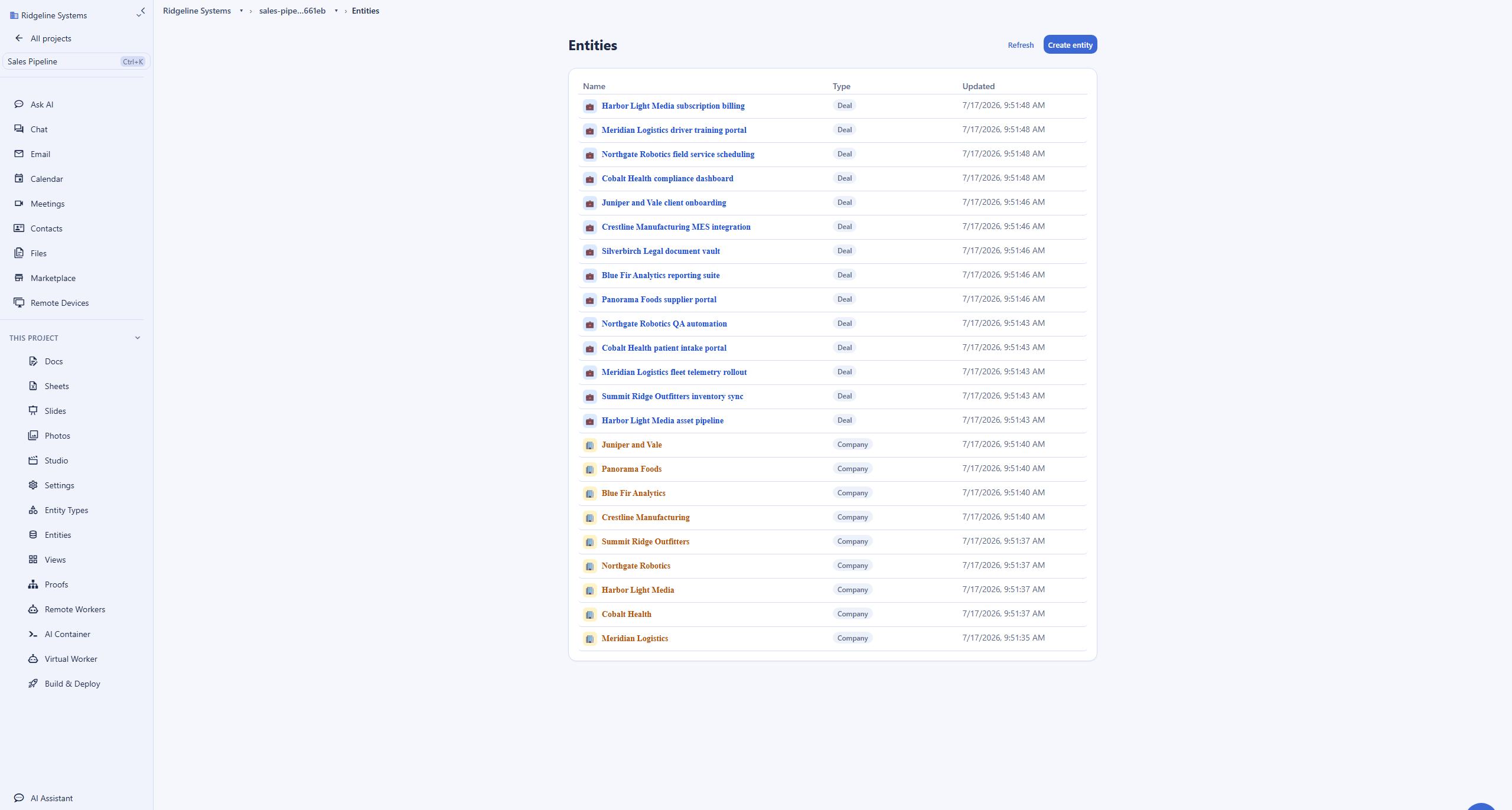
A monday.com board is a table of items with typed columns; the Backbuild entity type is the schema of one kind of record, a Deal, a Supplier, an Asset, defining thirty-one field types including references to other records, people, groups, and roles, with required flags and validation the platform enforces on every save. Entities are the records themselves, each carrying an owner, sharing scopes, and a workflow state, with every create, update, and delete audit logged. Typed relationships are the linked records: directional connections with their own meaning, with a dedicated lookup field that pulls a value across a link and a rollup field that lists and counts related records, backed by enforced referential integrity and legal-link restrictions. monday.com links data across boards with a Connect Boards column and a read-only Mirror column, which give one or two levels of reference but no rollups, no dedicated lookups, and no referential integrity, and the Mirror value cannot be written through the API or shown on a form. Backbuild adds versioned type evolution, where schema changes are validated against live records instead of applying instantly, and has no per-plan record cap.
Saved views: layouts, forms, and per-role working surfaces
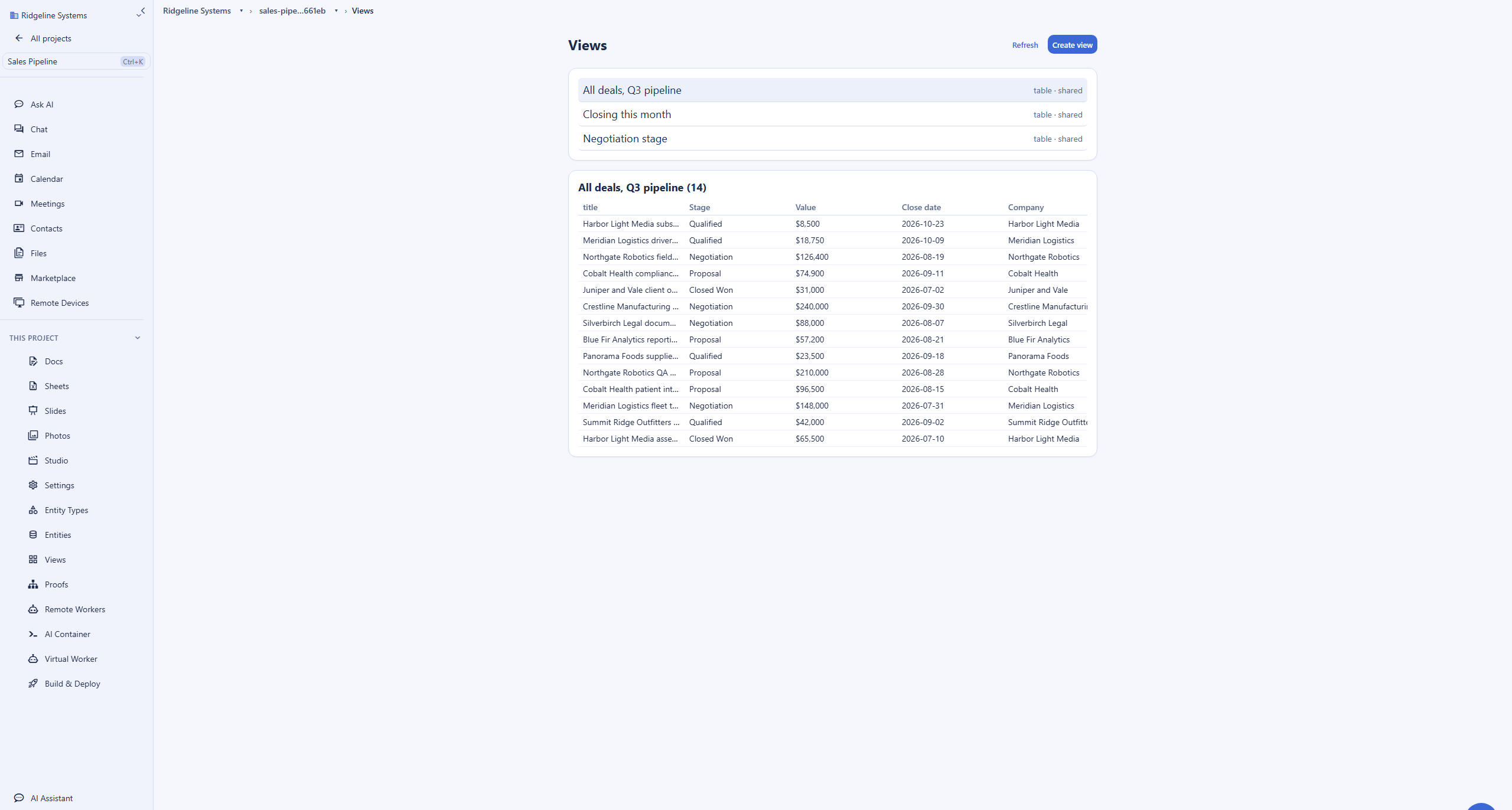
A saved view is a named definition over one dataset: the entity type to show, filters, sorting, grouping, and a view type of table, board, list, calendar, timeline, or gantt. Views are private by default and shareable deliberately, and every execution re-filters rows to the running viewer’s access on the server, so sharing a view definition never widens data access; that property turns views into per-role working surfaces, a sales pipeline board for one role and a finance table for another over the same records. On rendering, the current state is specific and worth stating plainly: the app opens a saved view as a paginated grid today, dedicated layouts are coming soon, the help desk tickets surface already renders a drag and drop board and a gantt chart, and Backbuild Calendar renders full calendar layouts. This is where monday.com is clearly ahead today: monday.com renders every board, timeline, gantt, and calendar layout in place, with drag and drop across all of them, and adds workload and map views Backbuild does not offer as saved-view layouts. On data entry, both ship a form surface: the Backbuild entity editor renders each type’s fields as a validated form for members, and monday.com collects public submissions through WorkForms; Backbuild’s public intake form surface is on the roadmap.
Where monday.com wins today
monday.com is the longer-established product in this category, with a large installed base, and several of its strengths are things Backbuild does not match today.
Board, timeline, and gantt layouts rendered in place
monday.com renders board, timeline, gantt, calendar, chart, workload, and map layouts in place, with drag and drop across all of them, and that rendering polish is real and mature. Backbuild defines the same view types over one dataset and returns them through the API, but saved entity views open as a paginated grid in the app today, with dedicated layouts coming soon; a drag and drop board and a gantt chart already render on the help desk tickets surface, and Backbuild Calendar renders full calendar layouts. The concession here is in-app rendering polish, plus the workload and map views, not the underlying view model.
Dashboards, widgets, and reporting
monday.com ships dashboards that combine boards into widgets with real-time metrics, a polished reporting surface teams rely on for status at a glance. Backbuild produces charts in Backbuild Sheets and reads across data with the Sheets query language and the API, and dedicated entity dashboards are on the roadmap, so monday.com holds the more finished at-a-glance reporting surface today.
The template and integration marketplace
monday.com ships a large template center and automation-recipe library, so a new team can start from a finished board rather than a blank one, and its marketplace lists more than 850 integrations. Backbuild covers external connections with provider integrations, the full REST API, signed webhooks, MCP, and custom tools built in the Tool Builder wired to automations, which reaches anything with an API but is built, not clicked, and its template set is younger. That head start is genuinely monday.com’s today.
Native mobile apps in the stores
monday.com’s iOS and Android apps are in the app stores today. Backbuild’s Windows and macOS desktop apps ship now, with the mobile apps and browser extension coming soon, so on a phone monday.com has the more mature, distributed experience today. This is a distribution difference rather than an architecture gap, and monday.com holds it now.
Common monday.com frustrations and how Backbuild addresses them
Per-seat minimums and ghost seats
monday.com sells paid plans at a three-seat minimum, in fixed buckets of three, five, ten, and up, so a team of four pays for five, a pattern reviewers describe as ghost seats that inflate the bill. Backbuild is free for the first 50 seats and then charges per seat with no minimum bucket, so a small team pays for the seats it uses and nothing more.
Automation-action caps that run out mid-month
monday.com meters automations by action, and reviewers note the 250-action Standard cap is often exhausted within days, with no way to buy more actions below Enterprise. Backbuild includes workflows and automations on every plan, including Free, with no monthly action cap; actions that consume compute or an AI model draw on usage credits or your own AI provider keys.
A board is not a relational database
Reviewers who compare the two note that a monday.com board is a flat list of items, with cross-board links limited to Connect Boards and a read-only Mirror column and no true rollups, lookups, or joins. Backbuild ships typed relationships with a dedicated lookup field, rollups that aggregate across links, and enforced referential integrity, on a model with validation and versioned type evolution.
Security features gated to Enterprise
On monday.com, single sign-on, SCIM, and audit logs arrive only with Enterprise. Backbuild includes single sign-on, SCIM, and a tamper-evident audit log on every plan, including Free, with per-organization roles and per-field access controls and masking on records, so the security posture does not depend on the contract tier.
No offline access
monday.com reviewers note that the product does not work offline, so a dropped connection stops the work. Backbuild is built on an offline-first sync layer that buffers work locally and merges it on reconnect, so editing continues without a connection on the desktop.
Reporting locked behind a spreadsheet you do not have
monday.com has no spreadsheet, so heavier calculation and modeling usually move to an external tool. Backbuild includes Backbuild Sheets free on every plan, with more than 500 functions, LAMBDA, dynamic spill arrays, an in-cell query language, and charts, alongside the same data, so modeling stays in the workspace.
Which platform wins, by use case
Running projects and work across a team
This is monday.com’s home turf and the reason many teams adopt it: a board of tasks with owners, dates, and status, rendered as a drag and drop board, timeline, or gantt, rolled up into dashboards. Backbuild answers with a relational project model, entity types for tasks linked to sprints linked to people, presented through saved board and timeline view definitions, with workflow states and legal transitions keeping status honest and automations that fire on record events or a schedule with no monthly action cap. The tradeoff is depth against polish: Backbuild adds referential integrity, no record cap, uncapped automations, and a real spreadsheet, while monday.com renders the draggable board, timeline, gantt, and workload layouts in place today, which Backbuild’s saved views do not draw in the app yet.
A cheaper monday.com alternative without per-seat minimums
Small businesses, agencies, and solo operators run into monday.com’s pricing shape quickly: paid plans start at a three-seat minimum sold in fixed buckets, and the features a growing team wants, timeline and gantt views, automations, and time tracking, sit on Standard and Pro. Backbuild is free for the first 50 seats with no minimum bucket, and the capabilities monday.com tiers up, saved views, automations, and single sign-on, are on the free plan. When the work turns into money, invoicing and double-entry accounting are built into the same workspace instead of a second subscription, and mail at your own domain and a real spreadsheet are included too. monday.com’s edge for this audience is its large template library, which gets a first board running from a finished starting point faster.
A relational database instead of items on a board
Operations, revenue, and content teams reach for monday.com boards to track suppliers, orders, deals, and assets, then hit the edges of the board model: cross-board data limited to Connect Boards and a read-only Mirror column, with no rollups, lookups, or referential integrity, and a Mirror value that cannot be written through the API or shown on a form. Backbuild builds the same domain with entity types and typed relationships that carry lookups, rollups, and enforced referential integrity, presents it through saved views, and fires automations on record events, on schedules, or into an approval workflow with role-gated transitions, with no per-plan record cap and a real spreadsheet alongside in Backbuild Sheets. The difference that cuts the other way: monday.com renders its board, timeline, and gantt layouts in place today, where Backbuild’s saved views open as a grid with layouts coming soon.
Automations without a monthly action cap
Teams that lean on monday.com automations run into the meter: 250 actions a month on Standard, exhausted within days, with no way to buy more below Enterprise, and reviewers report automations that fire twice or fail to trigger under load. Backbuild runs trigger and action automations on every plan, including Free, with no monthly action cap, triggered by record, email, calendar, and help desk events or a schedule, with signed webhook actions and a hand-off to an AI agent. It goes further than a serverless step: an automation can dispatch work to an AI worker on a real containerized computer with a browser, desktop, and terminal, and that worker draws credentials from the zero-knowledge vault by grant, so the model never sees a plaintext secret.
Developers building on the data and API
Developers use monday.com as a backend with an API, then work within its daily call limit and complexity budget and the fact that a Mirror column is not exposed through the API. Backbuild’s REST API is generated from an OpenAPI 3.1 specification and spans the whole platform; the projects, entities, and data-model group alone documents 72 endpoints for types, records, relationships, permission grants, media, and views, with no monthly call quota on any plan. Add signed webhooks with a delivery log, SQLite export on paid plans, and an MCP surface any AI coding tool can drive across the whole platform, where monday.com has no hosted MCP server, and the developer surface is materially broader.
Replacing several subscriptions with one workspace
monday.com consolidates boards, dashboards, and automations, and sells adjacent products, monday CRM, Dev, and Service, as separate purchases. Backbuild consolidates further inside one subscription: Backbuild Mail at your own domain from a real mail server, Backbuild Calendar with two-way Google, Microsoft 365, and CalDAV sync, a real spreadsheet, Backbuild Docs, Backbuild Slides, Backbuild Photos with a layer editor, double-entry accounting, a help desk, a training course system, and a secrets vault, each of which is a separate subscription in a monday.com-centered stack.
Security, identity, and governance evaluation
A security review of a work platform turns on four questions: who can get in, what each person can see, what record survives every change, and what the answers cost. On identity, Backbuild ships single sign-on on every plan, including Free, and SCIM 2.0 user provisioning. monday.com gates single sign-on, SCIM, and its audit log to Enterprise, so on monday.com the identity posture is a function of the contract, and a small team on Standard or Pro does not get it.
On authorization, the difference is granularity. monday.com’s model runs at the board, workspace, and account level, with private boards arriving on Pro. Backbuild applies organization-scoped roles beneath record-level sharing scopes (user, group, department, organization) with a five-right model, per-field access modes, and field masking, and re-filters every view execution to the running viewer’s access on the server, so sharing a view can never leak rows the viewer is not entitled to see. On evidence, Backbuild writes a tamper-evident audit log on every plan, where monday.com’s audit log arrives with Enterprise. Credentials the workspace touches can live in the zero-knowledge, post-quantum secrets vault in the same workspace, and automated work draws them by grant, injected at the moment of use so the model never sees a plaintext value. On AI governance, Backbuild lets an organization bring its own AI providers and models or run on usage credits, so inference can run under the organization’s own provider agreement, where monday AI runs on a bundled, credit-metered model.
The tradeoffs run both ways. monday.com is the older product with a longer public track record, a large base of administrators who know its permission model, and an Enterprise tier with its own governance and compliance program; Backbuild is newer, and its posture, while built to the standards auditors check, does not yet carry that long independent history. The bottom line: if the evaluation demands single sign-on, SCIM, fine-grained access, and audit evidence without an Enterprise contract, Backbuild’s floor is materially higher; if it demands a mature Enterprise security program with a long operating history and a large administrator community, monday.com has more of it today.
The economics for a finance and procurement review
The monday.com line item is driven by three levers: the plan a team lands on for the capability it needs, the seat-bucket minimum, and the way automations and AI are metered. Seats run 9 US dollars on Basic, 12 on Standard, and 19 on Pro, per seat, billed annually, at a three-seat minimum sold in fixed buckets, so a team of four pays for five. The upgrade trigger is often a feature rather than storage: timeline and gantt views and automations start on Standard, private boards, time tracking, and the formula column start on Pro, and single sign-on, SCIM, and audit logs are Enterprise, while automation actions are capped per month and cannot be topped up below Enterprise.
Backbuild’s model is flatter: the workspace is free to 50 seats, paid plans run $19 to $149 per seat with no minimum bucket, and variable usage (AI, containers, storage growth) draws one published credit pool that rolls over for up to three months. Automations carry no monthly action cap, single sign-on and audit logging are included on every plan, and the AI assistant is on every plan with the option to bring your own AI provider so inference is billed at the provider’s own rate. The consolidation math matters as much as the rate card: the same subscription includes the full workspace app roster compared in the matrix above, Backbuild Mail, Backbuild Calendar, Backbuild Contacts, Backbuild Docs, Backbuild Sheets, Backbuild Slides, Backbuild Photos, Backbuild Files, Backbuild Finances, a help desk, a training course system, and the secrets vault, several of which are separate invoices in a monday.com-centered stack.
Be precise about the free tiers in both directions: a team of two that stays inside monday.com’s free plan pays nothing, and a team of fifty pays nothing on Backbuild, but Backbuild’s free plan includes a fixed storage allowance before further growth draws credits, so a small team hosting heavy data can pay Backbuild for storage before it would pay monday.com for seats. The bottom line: monday.com’s cost climbs with seat buckets, the tier a needed feature sits on, and the automation meter; Backbuild’s grows with seats on the tier you choose and metered usage you can read on one page.
Rolling it out across a team
Adoption risk on this category is concentrated in three places: how fast the first useful board or dataset appears, whether the team can find a starting point, and whether the tool fragments into copies. On the first two, monday.com is genuinely fast: a board, a few columns, and a rendered view exist within minutes, and its template center means most teams start from a finished board rather than a blank one. Backbuild’s equivalent first hour runs through view templates that arrive pre-configured, a familiar spreadsheet, and an assistant that builds the model from a prompt; it is comparable for the data model, but a team whose muscle memory is monday.com’s template gallery and rendered board layouts will feel both today.
On governance during rollout, the structural difference is that Backbuild’s private-by-default views with server-side re-filtering let a lead share a definition without ever widening data access, and versioned type evolution means an admin can change the model without breaking live records mid-rollout, where a monday.com column change applies instantly across every view of the board. Rollout also inherits the rest of the workspace on day one, including the built-in help desk, so support requests about the new tooling have somewhere to live without another purchase. The bottom line: pilot both with the actual daily surface in mind. If the pilot group lives in rendered boards, dashboards, and templates, monday.com lands faster today; if it works in a governed relational model, automations without a cap, and a real spreadsheet, Backbuild rolls out at zero cost for the whole team with single sign-on and audit logging included from the first seat.
Data ownership, migration, and lock-in
The exit question deserves as much scrutiny as the entrance. monday.com data leaves as a board export to Excel, but a Mirror column is read-only and not exposed through the API, so cross-board links do not survive the export as live relationships. Backbuild’s export posture is broader by design: Backbuild Sheets exports Excel and, on paid plans, SQLite, Backbuild Docs exports to LaTeX, DOCX, ODT, HTML, Markdown, RTF, and EPUB, and the full REST API returns every record, type, relationship, and view, with no call quota to meter the exit.
Migration into Backbuild has two lanes. Grid-shaped boards import into Backbuild Sheets from Excel and CSV, and into an entity type from the same export. Relational structure moves through the entities API: create the types, then load records and typed relationships, or hand the exported data to an AI agent over MCP and let it build the types, records, views, and automations end to end. Because a monday.com Mirror column is not in the export as a live link, rebuilding the connections as typed relationships through the API is the reliable path. The bottom line: both platforms let you leave, but Backbuild’s wider document export, SQLite export, uncapped API, and agent-drivable loading make both directions of the move cheaper to execute.
Strategic fit and vendor risk
monday.com is a category leader for work management, and the strategic case for it is maturity: a large installed base, a deep template and automation-recipe library, a marketplace of more than 850 integrations, an adjacent family of CRM, Dev, and Service products, and an aggressive AI program around Sidekick and its Agent Factory. The risk on that side is a pricing model that gates capability by tier and meters automations and AI: capping automation actions below Enterprise and selling seats in fixed buckets with a three-seat minimum show how a committed workspace absorbs vendor pricing decisions, and reviewers raise performance at scale and a fiddly setup as recurring frictions.
Backbuild’s strategic case is depth and consolidation: a real relational database and a real spreadsheet rather than one flexible board model, the whole workspace app roster compared in the matrix in one subscription, security included rather than tiered, an OpenAPI-documented exit, and an open agent protocol across the platform as the AI strategy rather than a single bundled assistant. The real risks: it is the younger vendor, its saved-view layout rendering is still maturing, its dashboards, public intake forms, and native mobile apps have not shipped, and its template and integration libraries are smaller. The bottom line: choose monday.com when rendered-layout polish, dashboards, template and integration breadth, and category maturity are the controlling criteria; choose Backbuild when relational depth, uncapped automations, a real spreadsheet, tool consolidation, a security floor on every plan, and AI openness matter more.
Frequently asked questions
Is there a free monday.com alternative?
Yes. The Backbuild workspace is free for teams of up to 50 seats, and the free plan includes the whole data platform (custom entity types, saved views, typed relationships, and automations), Backbuild Sheets, the AI assistant, the full platform REST API, and single sign-on, SCIM, and a tamper-evident audit log, with no per-plan record-count cap, no monthly automation-action cap, and no monthly API call quota. The monday.com free plan is limited to two seats and three boards, with no automations, no integrations, and no timeline, gantt, or calendar views, and every paid plan starts at a three-seat minimum. So fifty people can run relational data, boards, and automations on Backbuild at no cost, and get single sign-on and audit logging that monday.com reserves for Enterprise.
Is Backbuild cheaper than monday.com?
For most teams, yes. monday.com bills per seat, starts paid plans at a three-seat minimum, and sells seats in fixed buckets of three, five, ten, and up, so a team of four pays for five, a pattern reviewers call ghost seats. Backbuild is free for the first fifty seats and then charges per seat with no minimum bucket, and it does not push single sign-on, timeline and gantt views, or automations up a paid tier the way monday.com does. Backbuild also folds mail at your own domain, a real spreadsheet, double-entry accounting, a help desk, and a secrets vault into the same subscription, each of which is a separate purchase in a monday.com-centered stack.
Does Backbuild have a relational database instead of monday.com boards?
Yes, and it is a deeper data model. A monday.com board is items with columns, and cross-board data comes from the Connect Boards column and a read-only Mirror column that is not writable through the API and cannot appear on a form. Backbuild ships custom entity types on a relational database with thirty-one field types, typed and directional relationships between records, dedicated lookup fields, rollups that aggregate across links, and enforced referential integrity, plus record workflow states with legal transitions and an audit trail on every change. There is no per-plan record cap, and capacity scales with storage credits rather than a board item ceiling.
Does Backbuild have board, timeline, and gantt views like monday.com?
Backbuild saves the same view types over one dataset, board, list, table, calendar, timeline, and gantt, and returns each view type and its grouping through the API. On rendering, monday.com leads today: it draws every board, timeline, gantt, and calendar layout in place with drag and drop. In the Backbuild app today a saved entity view opens as a paginated grid whatever its type, with dedicated board, calendar, timeline, and gantt layouts coming soon. Purpose-built layouts already render elsewhere in the platform: the help desk tickets surface renders a drag and drop board and a gantt chart, and Backbuild Calendar renders full month, week, and day layouts. The honest difference here is in-app rendering polish, not the underlying view model.
Does Backbuild cap automations the way monday.com does?
No. monday.com meters automations and integrations by action: the Standard plan allows 250 automation actions per month, Pro allows 25,000, and only Enterprise reaches 250,000, and you cannot buy more actions below Enterprise. Backbuild includes workflows and automations on every plan, including Free, with no monthly action cap; actions that consume compute or an AI model draw on usage credits or your own AI provider keys. Backbuild automations also fire on email, calendar, and help desk events, run on a schedule, call signed webhooks, and can hand work to an AI worker on a real containerized computer.
Does Backbuild have single sign-on and audit logs without an Enterprise plan?
Yes. Backbuild includes single sign-on, SCIM 2.0 user provisioning, role-based access control, and a tamper-evident audit log on every plan, including Free, along with per-field access controls and masking on records. monday.com reserves single sign-on, SCIM, and audit logs for its Enterprise plan, so on monday.com the identity and governance posture is a function of the contract, and a small team on Standard or Pro does not get it.
Can Backbuild replace monday.com?
For most monday.com work, yes. Boards and trackers move to entity types, typed relationships, saved views, and automations, all drivable through a REST API with no monthly call quota and through AI agents over the Model Context Protocol. The rest of the workspace, mail at your own domain, a real spreadsheet, calendar, docs, slides, photos, files, double-entry accounting, a help desk, and a secrets vault, is included rather than bolted on. monday.com remains the better fit today when the deciding factor is the drag and drop polish of its in-place board, timeline, and gantt layouts, its dashboards and widgets, its workload and map views, its large template and automation-recipe library, its marketplace of more than 850 integrations, or its native mobile apps in the app stores.
How do I migrate from monday.com to Backbuild?
A monday.com board exports to Excel, which imports into Backbuild Sheets, and a grid-shaped board can be loaded into an entity type from the same export. Relational structure moves through the entities REST API: create the entity types, then load records and their typed relationships programmatically, or hand the exported data to an AI agent over the Model Context Protocol, which can build the entity types, records, views, and automations end to end. Note that a monday.com Mirror column is read-only and is not exposed through its API, so cross-board links are best rebuilt as typed relationships on the Backbuild side rather than recovered from the export. There is no per-plan record cap waiting on the other side, and your data exports back out at any time through the same API.
Try the Backbuild workspace free
A real relational database with typed relationships, lookups, rollups, and referential integrity; saved views and automations with no monthly action cap; Backbuild Sheets for the spreadsheet grid; and a full-platform REST API with no monthly call quota, inside a workspace that is free for up to 50 seats with single sign-on, SCIM, and audit logging included and no per-seat minimum. If the deciding factors are the drag and drop polish of board, timeline, and gantt layouts rendered in place today, dashboards and widgets, a large template and integration library, or native mobile apps in the app stores, monday.com is the stronger choice today.
Get started free