

Google Drive alternative: Backbuild Files vs Google Drive
Google Drive is the cloud file storage and sync service inside Google Workspace, with a mature Drive for Desktop sync client, best-in-class search including automatic text recognition in images and PDFs, and a large Workspace Marketplace ecosystem. On the Backbuild side that same job is done by Backbuild Files, the file app inside a full workspace, with governance on every plan, a relational data platform for structured data alongside the files, an AI assistant with native Model Context Protocol tools, a public REST API, and a zero-knowledge Secrets vault. Google Drive still leads on its 15 GB free tier, mature block-level desktop sync, automatic image and PDF text recognition, very large uploads, native mobile apps, its ecosystem, and its published certifications and long track record.
The short answer
Both store files in the cloud, but they aim at different jobs. Choose Backbuild Files if you want file storage governed the same way as the rest of your work, files that open straight in the Docs, Sheets, and Slides editors, a relational data platform for structured data in the same place, a zero-knowledge Secrets vault, and single sign-on, per-organization roles, and a tamper-evident audit log on every plan, inside an all-in-one workspace. Choose Google Drive if you want its 15 GB free tier and low-cost multi-terabyte storage, its mature Drive for Desktop block-level sync with selective sync, automatic image and PDF text recognition in search, very large per-file uploads, native mobile apps, or its large Workspace Marketplace ecosystem. Both store, share, and open files in built-in editors; Backbuild does not offer a desktop sync client, automatic optical character recognition, or large per-file uploads today, and Google Drive keeps a relational data platform, a zero-knowledge vault, and the advanced governance controls out of its lower tiers.
Backbuild Files vs Google Drive: feature by feature
Google Drive is free with 15 GB; Google One paid storage starts at 1.99 US dollars a month, Google Workspace starts at 7 US dollars per user a month, and the advanced governance controls are reserved for Business Plus and Enterprise. Prices below are from the Google pricing pages, observed 2026-07-20. The highlighted column is Backbuild Files.
| Backbuild Files Governed file storage, editors, and a data platform in one workspace In the workspace on every plan; 1 GB on Free, then storage per seat metered on usage credits, with no separate storage subscription Get Started Free | Google Drive Cloud file storage and sync inside Google Workspace Free with 15 GB across Drive, Gmail, and Photos; Google One from $1.99/mo for 100 GB; Google Workspace from $7/user/mo; advanced governance on Business Plus and Enterprise | |
|---|---|---|
| Price and storage | ||
| Free tier | In the workspace, 1 GB | 15 GB shared |
| Storage model | Per seat, metered on credits | Flat tiers, pooled on Workspace |
| Included storage on paid plans | 25 GB / 100 GB / 1 TB per seat | 30 GB to 5 TB pooled per user |
| Large low-cost bulk storage | Credit-metered | 100 GB to multi-terabyte tiers |
| Per-file upload size | 25 MB on web upload | Up to 5 TB per file |
| Files and organization | ||
| Upload and store any file | ||
| Folders: create, rename, delete, nested | ||
| Drag and drop upload | ||
| List, detail, and grid views | ||
| Audience-scoped libraries (personal, department, org) | Shared drives | |
| Files roll up per project | ||
| Files open in built-in editors | Docs, Sheets, Slides | Docs, Sheets, Slides |
| Native LaTeX and live math in the editors | ||
| Machine-checked proof blocks in documents | ||
| Desktop sync, offline, and clients | ||
| Block-level desktop sync client | Drive for Desktop | |
| Selective sync and stream vs mirror modes | ||
| Offline availability of stored items | Docs, Sheets, Slides only | Any file, mirror mode |
| Native desktop app | Workspace app, Windows and macOS | Sync client |
| Native mobile apps Soon | Rolling out | iOS and Android |
| Search | ||
| Search across file names and content | ||
| Automatic image and PDF text recognition | Background OCR | |
| AI semantic search by meaning | Gemini on Workspace | |
| Sharing and collaboration | ||
| Public and organization-wide share access | ||
| Granular subject sharing (user, group, department, project) | People and groups | |
| Access ladder from view up to edit, revocable | Viewer, commenter, editor | |
| Expiring links | Signed, short-lived links | Named people only |
| Cross-organization recipient sharing | External sharing | |
| Visibility floor: unauthorized read returns 404 | ||
| Versioning, recovery, and screening | ||
| Version history | Audit-logged writes and publish | 30 days, named versions kept |
| File recovery and rewind Soon | Roadmap | |
| Content screening on upload (malware, active content) | Malware scan | |
| Authenticated download only, no guessable URLs | Shared links | |
| AI and agents | ||
| AI semantic search and indexing of files | Gemini, Workspace tiers | |
| In-app AI assistant reads your files | Gemini, Workspace tiers | |
| AI-generated files kept under the same governance | Artifacts | |
| Bring your own AI provider and model | Gemini only | |
| Native Model Context Protocol tools | ||
| Integrations, API, and automation | ||
| Public REST API over the file surface | No monthly call quota | Drive API v3 |
| Large third-party integration ecosystem | First-party plus REST API and MCP | Marketplace and Apps Script |
| Structured data alongside files (relational platform) | Entity types and views | |
| Automations over files and records | Apps Script | |
| Security, identity, and governance | ||
| Single sign-on | Every plan | Google as identity provider |
| SCIM user provisioning | Every plan | Workspace |
| Per-organization roles and tiered admin | Every plan | Admin console |
| Tamper-evident audit log | Every plan | 6-month standard retention |
| Data loss prevention for files | Business Plus, Enterprise | |
| Retention and eDiscovery hold | Google Vault, Enterprise | |
| Device approval and remote wipe | Endpoint management | |
| Client-side or end-to-end encryption of files | Enterprise Plus and Education | |
| Zero-knowledge secrets vault in the workspace | ||
| Published certifications and long track record | Built to meet, not yet audited | |
| Workspace apps | ||
| Files (Backbuild Files) (Google Drive is the storage app) | Google Drive | |
| Native LaTeX and math in the editors | ||
| Machine-checked proof blocks in documents | ||
| Relational data platform alongside files | ||
| Governance (SSO, roles, audit) on every plan | Advanced on top tiers | |
| Block-level desktop sync and text recognition | ||
| 15 GB free tier and very large uploads | ||
| Email at your own domain (Backbuild Mail vs Gmail) | Gmail | |
| Team chat (Backbuild Chat vs Google Chat) Soon | Google Chat | |
| Meetings (Backbuild Meetings vs Google Meet) Soon | Google Meet | |
| Calendar (Backbuild Calendar vs Google Calendar) | Google Calendar | |
| Contacts (Backbuild Contacts vs Google Contacts) | Google Contacts | |
| Documents (Backbuild Docs vs Google Docs) | Google Docs | |
| Spreadsheets (Backbuild Sheets vs Google Sheets) | Google Sheets | |
| Presentations (Backbuild Slides vs Google Slides) | Google Slides | |
| Diagrams (Backbuild Diagrams vs Google Drawings) Soon | Google Drawings | |
| Photos (Backbuild Photos vs Google Photos) | Google Photos | |
| Photo editor | Photos editor | |
| Video, audio, and music editors Soon | Authoring preview | |
| Accounting and invoicing (Backbuild Finances) | ||
| Password and secrets manager (Backbuild Secrets) | ||
| Help desk and support tickets | ||
| Remote desktop and cloud desktops | ||
| Autonomous AI virtual workers | ||
| Training course system | ||
A cross means the tool does not offer the feature today. "Soon" marks a capability on the Backbuild roadmap. Google Drive prices, plans, and features are quoted from Google One plans, the Google Workspace pricing page, the Drive for Desktop help pages, the Drive sharing help, and a dated third-party review, observed 2026-07-20. Backbuild capabilities are cited to the Backbuild Files documentation, the storage documentation, and the pricing page.
Two shapes for the same job
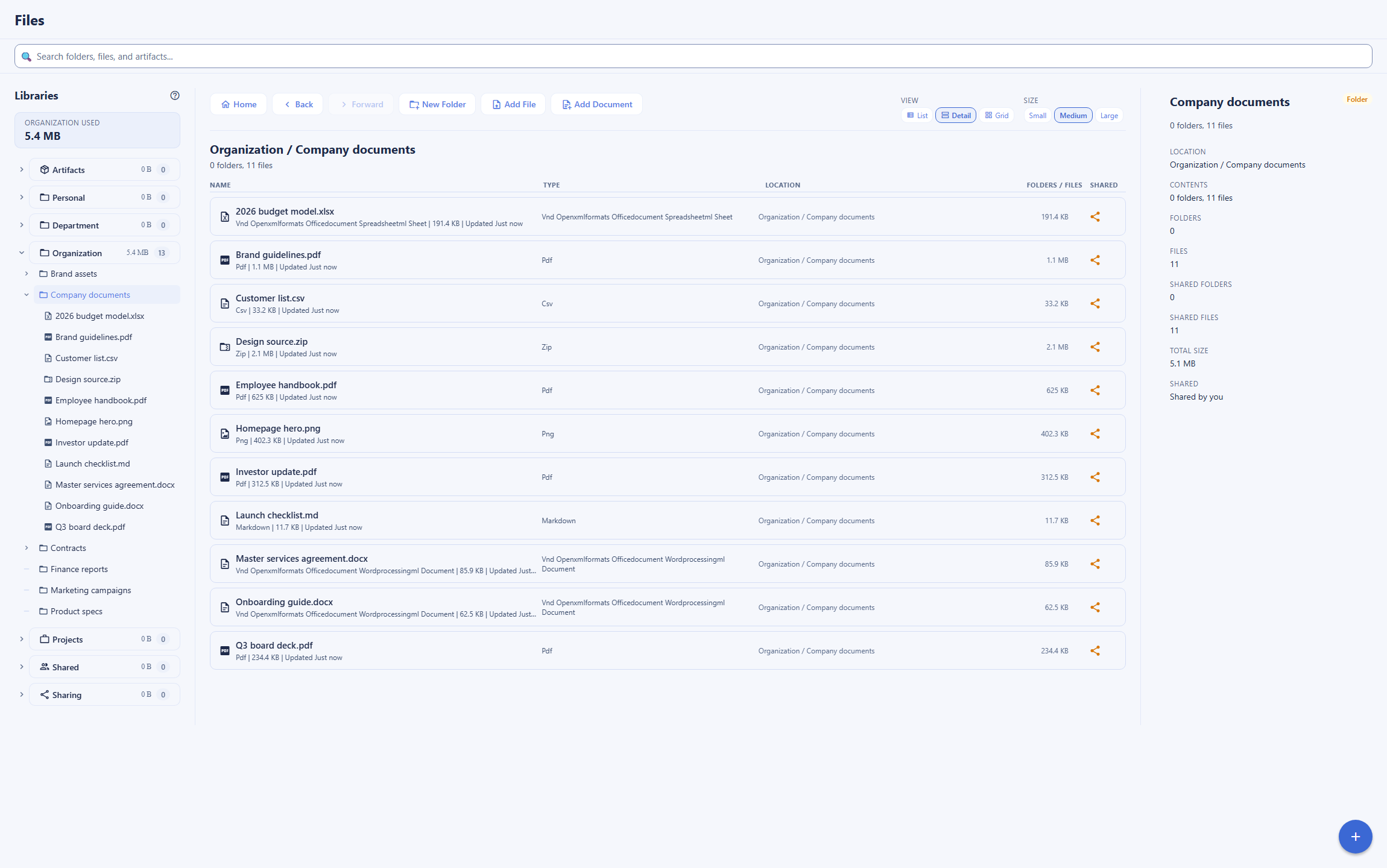
Google Drive is the storage app inside a mature productivity suite. Its center of gravity is scale and reach: a 15 GB free tier shared across Drive, Gmail, and Photos, low-cost multi-terabyte plans, a Drive for Desktop sync client that keeps a local folder mirrored to the cloud, best-in-class search with automatic text recognition inside images and PDFs, and the files opening in Google Docs, Sheets, and Slides. Around it sits the rest of Google Workspace, Gmail, Calendar, Meet, Chat, and Photos, sharing one storage pool, and a large Marketplace ecosystem and Apps Script. Backbuild Files is the file app inside a different workspace: you upload files, organize them into folders and libraries, and grant exactly the access you intend, and the files sit next to the relational data platform, the document editors, the Secrets vault, and the governance that applies to everything in the organization. The two overlap on storing, sharing, and editing files, but the surround is not the same. Where you want the largest free tier, a mature local sync client, and best-in-class search, Google Drive leads. Where you want files governed and worked on in the same place as the rest of your structured data, with the advanced controls included on every plan, Backbuild is the stronger fit.
Where Google Drive leads
Google Drive is the market leader in cloud file storage and sync, and several of its strengths are things Backbuild Files does not do at all today.
The free tier, bulk storage, and large uploads
Google Drive gives 15 GB free, shared across Drive, Gmail, and Photos, sells storage cheaply in large tiers through Google One and pooled Workspace plans, and accepts files up to 5 terabytes. Backbuild storage is metered per seat on usage credits, with 1 GB on Free, and web upload is capped at 25 MB per file today. For a large, inexpensive pool of raw storage and big single-file uploads, Google Drive is the better buy.
Block-level desktop sync and native mobile
Drive for Desktop keeps a local folder mirrored to the cloud with a block-level sync client on Windows and macOS, with stream and mirror modes and selective sync, and Google ships mature native mobile apps. Backbuild ships a native desktop workspace app and uploads files through the web and the API, but it has no local-folder sync daemon, and its mobile apps are rolling out. For continuous background sync of a large folder, Google Drive leads decisively.
Search with automatic text recognition
Google Drive runs automatic text recognition on scanned images and PDFs, so a phrase inside a photographed receipt becomes searchable, part of a deep, mature search. Backbuild search is AI semantic search by meaning over the formats the assistant reads, a different mechanism that does not extract text from scanned images today. For finding words inside scanned pictures, Google Drive leads.
Ecosystem, mobile maturity, and track record
Google Drive connects to the Workspace Marketplace and Apps Script, has near-universal adoption, and carries published certifications and a long operating history. Backbuild answers integration with a public REST API, native Model Context Protocol tools, and first-party integrations, but it is newer, its catalog is smaller, and it is not yet independently audited. For breadth of ready connectors and vendor maturity today, Google Drive leads.
Common Google Drive frustrations and how Backbuild Files addresses them
Advanced governance locked to the top tiers
Google Workspace includes single sign-on and an admin console, but it reserves the advanced controls, data loss prevention for Drive, Google Vault retention and eDiscovery, extended audit retention, and the security center, for its Business Plus and Enterprise tiers. Backbuild puts single sign-on, SCIM, per-organization roles, and a tamper-evident audit log on every plan, including Free, so the identity and audit controls an administrator needs do not require an upgrade.
One bundled AI model and content used for AI features
Google Drive AI runs on Gemini, bundled to Google models, and stored content is processed for search and AI features. Backbuild lets you bring your own AI provider and model, so inference runs under your own provider agreement, and the credentials AI work needs live in a zero-knowledge Secrets vault the model never reads in plaintext.
No structured data next to the files
Storing files does not track the records around them, so teams pair Google Drive with a separate database or spreadsheet tool. Backbuild ships a relational data platform of custom entity types, typed relationships, and saved views in the same workspace, so records and their attached files share one governed home.
Reports of lost files and sync lockouts
Users have reported episodes of missing files and desktop sync problems on Google Drive over the past few years, discussed at length in community threads. Backbuild keeps writes and publishes audit-logged and mirrors document data so the record of what changed is preserved, though a full file recovery and rewind feature is on the roadmap rather than shipped today.
How access to a file is decided
Backbuild Files decides who can open a file from two layers: a baseline visibility floor set by where the file lives, plus explicit shares granted on top. Anyone outside that audience who tries to open the file receives a 404, the same result as a file that does not exist, so there is no way to tell the file is even there. Google Drive shares through links and shared drives with viewer, commenter, or editor access; Backbuild adds a finer access ladder and a stricter default.
Which tool wins, by use case
Storing and syncing personal files
This is the use case Google Drive was built for and where it leads. When the job is to keep a large folder of documents, photos, or design assets mirrored between a machine and the cloud, always up to date in the background, the Drive for Desktop sync client with selective sync and mature native mobile apps are the most direct path, and the 15 GB free tier and cheap multi-terabyte plans are an inexpensive way to buy the space. Backbuild Files stores and shares files through the web and the API and does not offer a local sync daemon or cheap bulk storage, so for personal cloud storage with continuous folder sync, Google Drive is the better fit.
Files that live inside your actual work
Both tools open documents in built-in editors, so a stored file is not a dead attachment in either one. The difference is what the editor does. Backbuild Files keeps files next to editors that add native LaTeX and live math and machine-checked proof blocks, and a file attached to a project rolls up with the rest of that project work under one governance model. Google Drive opens files in Google Docs, Sheets, and Slides, which are strong, widely adopted editors, but they do not typeset native LaTeX or check formal proofs. For teams whose documents carry mathematics or verified results, Backbuild fits the job better; for everyday word processing and spreadsheets with the widest sharing reach, Google Drive is excellent.
Team file storage with governance built in
For a business standing up shared storage, the deciding question is control: who can reach a file, how access is provisioned, and what is logged. Google Workspace has single sign-on, SCIM, and an admin console, but it reserves the advanced governance, data loss prevention, Vault retention and eDiscovery, and extended audit retention beyond its standard six months, for its Business Plus and Enterprise tiers. Backbuild puts single sign-on, SCIM, per-organization roles, and a tamper-evident audit log on every plan, files carry a strict visibility floor where an unauthorized read returns 404, and sharing grants a precise access level to a user, group, department, project, or the whole organization. For governed team storage without paying up to a top tier for the audit and identity controls, Backbuild leads; for organizations that need Vault-grade retention and eDiscovery today, Google leads.
Files alongside structured data
Many teams do not just store files; they track the records the files belong to, a client, a contract, a deliverable, and today that means pairing Google Drive with a separate database or spreadsheet tool. Backbuild answers both in one workspace: the relational data platform holds custom entity types with typed relationships and saved views, and a file can live next to the record it belongs to under the same governance. Google Drive stores the file well but has no in-suite structured-data layer, so the record lives in another tool. For work where files and the data around them belong together, Backbuild covers the whole job.
Programmatic and AI-driven file access
For developers and automation, both tools expose their files. Google Drive has a mature Drive API v3 and a large ecosystem built on it plus Apps Script, a genuine strength. Backbuild exposes the whole file surface over a public REST API with no monthly call quota, adds native Model Context Protocol tools so an AI agent can drive files directly, and lets the AI assistant read and semantically search the formats it understands on your own model. Google Drive AI runs through Gemini, bundled to Google models. For building on a file API with a broad connector ecosystem today, Google Drive leads on maturity; for agent-native file access, a no-quota API, and a choice of model in the same workspace as the data, Backbuild leads.
Finding a document across a large library
Search is one of the places Google Drive is strongest. Its indexing is deep, fast, and includes automatic text recognition inside scanned images and PDFs, so a phrase inside a photographed page is findable. Backbuild search takes a different approach: AI semantic search by meaning, which returns the right passage even when the wording does not match, but it does not read text out of scanned image files today. For a library heavy in scanned documents and images, Google Drive leads; for asking plain-language questions across the documents the assistant understands, Backbuild semantic search is the more direct tool.
How the two compare for each part of a buying decision
Storing and working with files day to day
The daily evaluation turns on how a person actually touches their files. For someone whose habit is to drag files into a folder on their desktop and have them appear everywhere, Google Drive is the more direct tool: the Drive for Desktop sync client and selective sync make the cloud feel like a local disk, native mobile apps carry that everywhere, and search reaches into scanned images. For someone whose files are documents they open and edit, both tools open a stored file in a built-in editor, so neither round-trips through a separate application, but Backbuild adds native LaTeX, live math, and machine-checked proof blocks and organizes files into libraries scoped by audience rather than one flat drive.
The offsetting consideration is upload limits and the free tier. Backbuild caps web upload at 25 MB per file today and includes 1 GB on Free, where Google Drive handles very large files and gives 15 GB free, so a person routinely moving large media, or working from a big free allowance, is better served by Google Drive. The bottom line for this evaluation: for a synced local folder, large files, and a big free tier, Google Drive is the stronger daily tool; for editing documents with math or verified results in place and organized, governed storage, Backbuild is stronger.
Rolling it out across a team
An administrator judges provisioning, access control, and what happens when someone leaves. Google Workspace is mature here, with an admin console, single sign-on, and SCIM, and it gates the strongest controls, data loss prevention, Vault retention and eDiscovery, endpoint management with remote wipe, and extended audit retention, to its Business Plus and Enterprise tiers. Backbuild includes single sign-on, SCIM, per-organization roles, and a tamper-evident audit log on every plan, and files enforce a visibility floor plus explicit shares so access is precise by default, though it does not offer data loss prevention, eDiscovery hold, or device wipe today.
The genuine gaps run both ways. Google leads on data loss prevention, retention and eDiscovery, device management, and the maturity of its console; Backbuild leads on getting core identity and a tamper-evident audit without an upgrade, and on a stricter sharing default. The bottom line: a team that needs Vault-grade retention, data loss prevention, and device wipe leans Google Drive; a team that wants single sign-on, roles, and audit included from the first plan leans Backbuild.
Security and data-handling evaluation
A review of a storage service looks at where files sit, how access is scoped, what governance is included, and how content is processed. Both are cloud services that encrypt files at rest and in transit, and neither is end-to-end encrypted by default: Google Drive offers client-side encryption only on Enterprise Plus and Education, and Backbuild Files makes no end-to-end claim either. Google Drive is the more mature and externally validated of the two, with published certifications and a long operating history, which for many reviewers is the deciding evidence, and Backbuild is newer and not yet independently audited.
On the controls Backbuild does include, it leads in two places a reviewer cares about. Access is scoped to a per-organization workspace with roles and a tamper-evident audit log on every plan, where Google reserves data loss prevention and extended audit for its top tiers, and an unauthorized read of a file returns 404 with no existence oracle, a stricter default than a shareable link. The credentials that file work often needs live in a zero-knowledge, post-quantum Secrets vault in the same workspace, encrypted so that neither Backbuild nor the AI can read them, and the AI assistant can run on your own provider under your own agreement. The bottom line: for external certifications, mature client-side encryption, and a proven record, Google Drive leads on evidence; for included per-organization governance, a stricter access default, and provider-blind secret handling, Backbuild leads on the model.
The economics for a finance buyer
The cost question is total spend, how it scales, and how many separate products a decision commits to. Google Drive is storage sold with the Google Workspace suite, from 7 US dollars per user a month with pooled storage, or through consumer Google One plans from 1.99 US dollars a month, with a large free tier. For a buyer who mainly needs a large, cheap pool of storage and a suite of familiar editors, Google Drive is an efficient purchase, and that is a real advantage. Backbuild Files is included in the workspace on every plan, with storage metered per seat on usage credits rather than a fixed storage fee.
The larger economic point is consolidation. Because Files, the data platform, the editors, the accounting app, the help desk, and the Secrets vault are one product, adopting Backbuild can retire a separate database or spreadsheet tool, a password manager, and an accounting subscription at once, which turns the comparison from a storage line item into a workspace decision. The offsetting consideration is fit and scale: a team whose only need is a large bucket of cheap storage and mainstream editors may find Google Drive the cheaper and more familiar buy, and Google carries the maturity some finance teams count as lower switching risk. The bottom line: for consolidated cost and included governance, Backbuild is materially cheaper; for cheap raw storage at terabyte scale inside a familiar suite, Google Drive is hard to beat on price alone.
Strategic fit and vendor risk
At the sponsor level the decision is about direction and durable risk rather than individual features. Google Drive offers a proven service that leads its category inside the widely adopted Google Workspace suite, with a long track record and published certifications, a low-surprise choice for an organization that wants best-in-class file storage and sync and a familiar set of editors. Its trade-offs are governance reserved for the top tiers, a single bundled AI model, and content processed for search and AI features.
Backbuild consolidates file storage, structured data, the document editors, a zero-knowledge vault, and the rest of an organization core tools into one governed workspace, with governance on every plan and a public REST API and Model Context Protocol tools across the whole surface, and a choice of AI model. The strategic upside is fewer vendors and files governed like everything else; the strategic risk is that Backbuild is newer, not yet independently audited, and does not match Google Drive on desktop sync, the free tier, search with text recognition, or ecosystem breadth. The bottom line: an organization optimizing for the best dedicated storage-and-sync service inside a familiar suite leans Google Drive, while one consolidating vendors and prioritizing governed files next to their data and documents leans Backbuild.
Frequently asked questions
Is there a free alternative to Google Drive?
Yes, with a difference in the storage model. Backbuild Files is part of the Backbuild workspace on every plan, including the Free plan, which includes 1 GB of storage. Paid plans add credit-metered storage per seat: 25 GB per seat on Lite, 100 GB per seat on Pro, and 1 TB per seat on Enterprise, with overage billed on usage credits. Google Drive has a generous free tier of 15 GB shared across Drive, Gmail, and Photos, and its Google One and Google Workspace plans buy much larger pools of storage at a low cost. So if the first requirement is a large, cheap pool of raw storage with a big free allowance, Google Drive is built for exactly that. If the requirement is file storage governed the same way as the rest of the work, sitting next to structured data and the document editors, with single sign-on and a tamper-evident audit log at no extra tier, Backbuild is the better fit.
Does Backbuild have a desktop sync client like Google Drive?
No, and Drive for Desktop is a genuine Google Drive strength. Google Drive keeps a local folder mirrored to the cloud with a block-level sync client on Windows and macOS, in a stream mode that keeps files in the cloud until opened and a mirror mode that keeps a full local copy, with selective sync. Backbuild does not ship that kind of local-folder sync daemon. Files in Backbuild are uploaded and downloaded through the web app and the REST API, with a 25 MB per-file cap on web upload today. Backbuild does ship a native desktop workspace app for Windows and macOS, but it is the workspace, not a Drive-style file-sync client. If continuous background sync of a large local folder is the first requirement, Google Drive leads decisively.
How much storage do you get, and how does the cost compare?
Backbuild Files includes 1 GB on the Free plan and adds storage per seat on paid plans: 25 GB per seat on Lite, 100 GB per seat on Pro, and 1 TB per seat on Enterprise, with any overage billed on usage credits rather than a fixed monthly storage fee. Google Drive gives 15 GB free, sells consumer storage through Google One from 1.99 US dollars a month for 100 GB up to multi-terabyte tiers, and pools storage across a Google Workspace domain from 7 US dollars per user a month. For an individual who mainly needs a big bucket of cheap storage, the Google tiers are the cheaper way to buy raw space. For a team that values governance, structured data, and the editors in one place, Backbuild bundles the file surface into the workspace price with storage metered per seat.
Is Google Drive private, and does Google scan the files I store?
Google Drive encrypts files at rest and in transit, but it is not end-to-end encrypted by default, so Google can technically access stored content, and its systems process file content for features such as search indexing and, on Workspace, Gemini AI. Some users have raised concerns about AI features reading private Drive content, and those concerns are worth reading against the current Google Workspace admin and privacy documentation, which changes over time. Backbuild Files is also a cloud service that is not end-to-end encrypted, so it makes no stronger claim there. Where Backbuild differs is the Secrets vault: a zero-knowledge, post-quantum vault in the same workspace where credentials are encrypted on the device and Backbuild cannot read them, kept out of anything the AI sees. For the files themselves, a buyer who needs storage the provider cannot read should evaluate a dedicated end-to-end encrypted service.
Can Backbuild search scanned images and PDFs the way Google Drive does?
Not with automatic optical character recognition, which is a genuine Google Drive strength. Google Drive runs background text recognition on scanned images and PDFs so their contents become searchable, part of its best-in-class search. Backbuild search works differently: it is AI semantic search over the file formats the assistant can read, so it finds passages by meaning even when the wording does not match, but it does not automatically read text out of scanned image files today. For finding a phrase inside a photographed receipt or a scanned contract image, Google Drive leads; for asking a plain-language question across the documents the assistant understands, Backbuild semantic search is the stronger tool.
What can Backbuild Files do that Google Drive cannot?
A few things stand out. First, structured data lives next to the files: the workspace ships a relational data platform of custom entity types, typed relationships, and saved views, so records and files share one governed home, which Google Drive has no in-suite equivalent for. Second, a zero-knowledge, post-quantum Secrets vault sits in the same workspace for the credentials file work often needs, encrypted so that neither Backbuild nor the AI can read them. Third, the file surface is drivable by AI agents through native Model Context Protocol tools, and the AI assistant can run on your own linked provider and model rather than a single bundled model. Google Drive, for its part, leads on its 15 GB free tier, Drive for Desktop sync, automatic image and PDF text recognition, very large uploads, native mobile apps, the Marketplace ecosystem, and its long track record.
Does Google Drive have single sign-on and audit logs, or does Backbuild win there?
Google Drive rides inside Google Workspace, which does have single sign-on with Google as the identity provider, SCIM provisioning, an admin console, and Drive audit-log events, so it is not accurate to say Google has no governance. The difference is tier gating and tamper-evidence. Backbuild ships single sign-on, SCIM, per-organization roles, and a tamper-evident audit log on every plan including Free, while Google Workspace gates the advanced controls, data loss prevention for Drive, Google Vault for retention and eDiscovery, extended audit retention, and the security center, to its Business Plus and Enterprise tiers, and its standard audit-log retention is six months. So both have identity and audit; Backbuild includes the governance without an upgrade, and Google reserves the advanced pieces for its higher tiers.
Does Backbuild let an AI assistant work with my files?
Yes. Files stored in Backbuild are indexed for AI in the formats the assistant understands, including PDF, office documents, and text, so the in-app AI assistant can read and semantically search them, and any AI agent can drive the whole file surface through native Model Context Protocol tools and the public REST API. That assistant can point at your own linked AI provider and model or run on usage credits. Google Drive offers AI over Drive content through Gemini on Workspace tiers, bundled to Google models. So both can bring AI to files; the difference is that in Backbuild the assistant and the agent tools are part of the same workspace as the files, and you choose the model.
Try Backbuild Files free
Store files and share them at exactly the access level you intend, open documents, spreadsheets, and decks straight in the editors with native LaTeX and live math, keep structured data next to the files, and drive it all through a public REST API and native Model Context Protocol tools, with a zero-knowledge Secrets vault and single sign-on, per-organization roles, and a tamper-evident audit log on every plan, inside an all-in-one workspace. If your first requirement is a block-level desktop sync client, a 15 GB free tier, cheap bulk storage at terabyte scale, automatic text recognition in scanned files, or large per-file uploads, Google Drive is the stronger choice today.
Get started free