

Freshdesk alternative: the Backbuild Helpdesk in your workspace
Freshdesk is an omnichannel customer-support suite by Freshworks: ticketing plus live chat, voice, social, and WhatsApp, a customer help center, and Freddy AI. On the Backbuild side that job is done by the Backbuild Helpdesk, a complete ticketing help desk, together with the workspace it lives in: a relational data platform for custom ticket-linked data, Virtual Workers and finite-state-machine AI skills for governed triage, the public REST API and native MCP tools, and single sign-on with a tamper-evident audit log on every plan. Freshdesk still leads today on omnichannel channels, a customer knowledge base and self-service portal, its marketplace, mature SLA management, and Freddy AI.
The short answer
Freshdesk is an omnichannel customer-support suite by Freshworks: ticketing plus live chat, voice, social, and WhatsApp, a customer help center, and Freddy AI; on the Backbuild side that job is done by the Backbuild Helpdesk and the workspace around it. Choose the Backbuild Helpdesk if you want a real ticketing help desk, with custom workflow states, priorities, ticket types, hierarchy, and per-state SLAs, inside a workspace that adds a relational data platform for custom ticket-linked data, governed AI triage with a human-approval floor, a full REST API with no monthly call quota and native MCP tools, and single sign-on and audit logging on every plan including Free, with a permanent free tier and no separate per-agent support-suite subscription. Choose Freshdesk if the deciding factors are omnichannel channels (live chat, voice, social, WhatsApp, and inbound email), a customer-facing knowledge base and self-service portal, the Freshworks Marketplace, mature SLA management and skill-based routing, or its deeper reporting and long track record.
The Backbuild Helpdesk vs Freshdesk: feature by feature
Prices and limits below are quoted from each vendor’s own pages, observed 2026-07-20. The highlighted column is the Backbuild Helpdesk. A cross means the feature is not offered today, and Soon means it is on the Backbuild roadmap and not shipped yet.
| The Backbuild Helpdesk A ticketing help desk built into the Backbuild workspace Included in the workspace with no separate per-agent support fee. Free is permanent and covers 20 tickets a month; every paid plan, $19 to $149 per seat, is unlimited. Single sign-on and audit logging on every plan. Get Started Free | Freshdesk An omnichannel customer-support suite by Freshworks: tickets, chat, voice, and a help center Free Program for 1 to 2 agents for 6 months, then Growth $19, Pro $55, Enterprise $89 per agent per month (annual). Omnichannel needs the pricier Freshdesk Omni plan. Freddy Copilot is a $29 per-agent add-on. | |
|---|---|---|
| Price and limits | ||
| Permanent free plan | Up to 20 tickets a month, no clock | Free Program, 1 to 2 agents, 6 months |
| Entry price | $0 on Free; $19 to $149 per seat | $19 per agent, Growth |
| Separate per-agent support-suite subscription | Included in the workspace | Priced per agent |
| Ticket volume on paid plans | Unlimited | Unlimited, agent-priced |
| Omnichannel on the same plan | Ticket-focused today | Requires Freshdesk Omni, $29 to $119 |
| Agent-assist AI included, not an add-on | Usage credits or your own provider | Freddy Copilot, $29 per agent add-on |
| Autonomous AI without a per-session meter | Usage credits, no per-session meter | $49 per 100 Freddy sessions, expiring |
| Ticketing core | ||
| Tickets and a staff queue | ||
| Public replies separated from internal notes | Public replies and private notes | |
| Requester and staff privacy wall | Requesters and agents | |
| Assignment | ||
| Priorities | Low, normal, high, urgent | Low, medium, high, urgent |
| Categories and routing rules | Ticket dispatch and routing | |
| Canned responses and macros | Canned responses | Canned responses and scenarios |
| Customer satisfaction (CSAT) | ||
| Snooze, watchers, and merge | Merge, split, and watchers | |
| Saved queue views (List, Grid, Board, and Table) | Ticket views | |
| Bulk actions over a selection | ||
| Export a filtered queue | CSV, Sheets, and Docs | CSV export |
| Issue tracking and workflow depth | ||
| Custom workflow states and transitions | Custom ticket statuses (Pro) | |
| Ticket types (Bug, Epic, and your own) | Type field, customizable | |
| Parent-child hierarchy (epic to subtask) | Parent-child ticketing (Pro) | |
| Typed relations between tickets | Linked tickets (Pro) | |
| Per-state SLAs and work-in-progress limits | Multiple SLA policies; no per-state WIP | |
| Approval and step-up gates on transitions | Approval workflows (Enterprise) | |
| Labels and custom fields with internal-only visibility | Tags and custom fields | |
| Channels and self-service | ||
| Inbound email-to-ticket Soon | On the roadmap | |
| Live chat and messaging widget | Freshchat (Omni or add-on) | |
| Voice and telephony | Freshcaller (Omni or add-on) | |
| Social and WhatsApp intake | Social and WhatsApp | |
| Public anonymous ticket portal | Authenticated filer or subscriber | Support portal and web form |
| Customer-facing knowledge base and help center | Knowledge base and help center | |
| Customizable self-service portal | Customizable portal | |
| Community forums | Community forums | |
| AI and automation | ||
| Turnkey autonomous per-resolution AI bot | Governed Virtual Workers instead | Freddy AI Agent, per-session billing |
| Agent-assist draft replies | Drafted as internal notes | Freddy Copilot (add-on) |
| Governed finite-state-machine AI skills for triage | Automations and dispatch rules | |
| Human-approval floor before a reply is sent | Configurable | |
| Bring your own AI providers and models | Bundled Freddy model | |
| AI without a per-session overage | Usage credits, no per-session meter | $49 per 100 sessions, expiring |
| Custom data, reporting, and platform | ||
| Relational data platform for custom ticket-linked data (entity types, views, automations) | Custom objects (higher tiers) | |
| No packaged record ceiling on custom data | Scales with storage credits | Object and record limits |
| Reporting and analytics | Saved views and Sheets export | Custom dashboards and Freddy Insights (deeper) |
| Built-in accounting for money-touching support (refunds, credits, invoicing) | Backbuild Finances | |
| White-label subscriber ticketing routed per package | Multiple products and portals (higher tiers) | |
| Internal IT or HR service desk without a second product | One workspace | Separate Freshservice product |
| API, integrations, and MCP | ||
| Public REST API drives the whole help desk | ||
| Monthly or throttled API limits | No call quota | Per-account rate limits by plan |
| Native MCP tools for AI agents | Ticket and configuration tools | |
| Signed outbound webhooks with a delivery log | Webhooks in automations | |
| Third-party app marketplace | SaaS packages; smaller catalog today | Freshworks Marketplace |
| Security, identity, and governance | ||
| Single sign-on | Every plan, including Free | Higher tiers |
| SCIM provisioning | Every plan | Freshworks Org (Enterprise) |
| Role-based access control, default-deny | Every plan | Custom roles (higher tiers) |
| Tamper-evident audit log | Every plan, including Free | Audit logs (Enterprise) |
| Strict per-organization tenant isolation | ||
| Step-up multi-factor on elevated configuration | Two-factor authentication | |
| Sandbox environment | Sandbox (Enterprise) | |
| Per-region data residency choice | Data center region at signup | |
| Native apps | ||
| Native desktop app (Windows and macOS) | Web app | |
| Native mobile agent app in the app stores Soon | In development | |
A cross means the platform does not offer the feature today. Soon means the feature is on the Backbuild roadmap and not shipped yet. Freshdesk prices, tiers, and limits are quoted from Freshdesk pricing, its features pages, its developer API reference, and dated third-party analyses, observed 2026-07-20. Backbuild capabilities are cited to the verified documentation for the help desk, types, workflows, and SLAs, AI support, the API and MCP, and security and governance.
Freshdesk and the Backbuild surfaces that do the same job
Freshdesk is a customer-support suite built around a set of products: a ticketing agent workspace, live chat and messaging through Freshchat, voice through Freshcaller, social and WhatsApp intake, a customer knowledge base, self-service portal, and community forums, reporting with custom dashboards and Freddy Insights, and the Freshworks Marketplace. It is a deep, mature product whose reach spans many channels. The Backbuild side is narrower in channels but sits inside a workspace: the Backbuild Helpdesk is the ticketing help desk, and around it the workspace carries a relational data platform for custom ticket-linked data, Virtual Workers and finite-state-machine AI skills for governed triage, built-in accounting for money-touching support, and the everyday workspace apps. Every one of these surfaces is drivable through the same REST API and through AI agents over the Model Context Protocol. Freshdesk bundles channels, a customer help center, and analytics that the Backbuild Helpdesk does not, and the Backbuild workspace bundles a data platform, governed AI automation, and back-office apps that Freshdesk does not.
The Backbuild Helpdesk, feature by feature
The Backbuild Helpdesk is a real ticketing product, not a repurposed database board. It ships the queue, the ticket, the workflow engine, and the governance a support or issue-tracking team runs on.
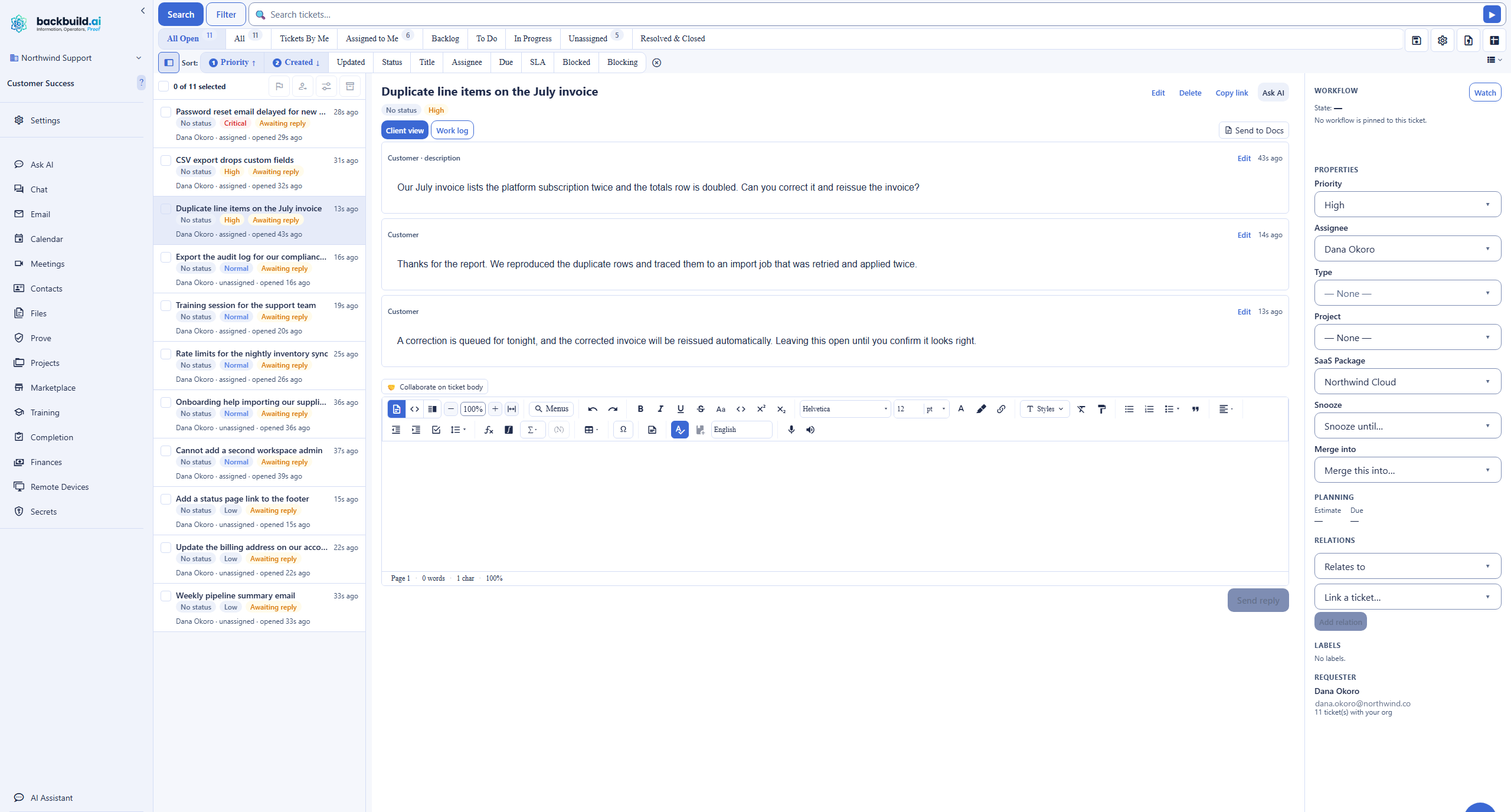
A requester files a ticket through the Open Ticket dialog, and agents work it in the Tickets console, with quick-filter chips that carry live counts, a search mode and a structured filter builder, saved views a team can share, and List, Grid, Board, and Table layouts. Inside a ticket, the Client view and Work log tabs keep public replies to the requester separated from internal notes the requester never sees, and a message can be edited with version history. The workflow layer is where the Backbuild Helpdesk goes deep: custom workflow states and transitions, ticket types like Bug and Epic with parent-child hierarchy from epic to subtask, typed relations between tickets, per-state SLAs and work-in-progress limits, approval and step-up gates, labels, and custom fields with internal-only visibility. Administration covers categories, routing rules, SLA policies, and canned responses, and the whole queue exports to CSV, Backbuild Sheets, and Backbuild Docs.
Custom ticket-linked data, governed AI triage, and the back office
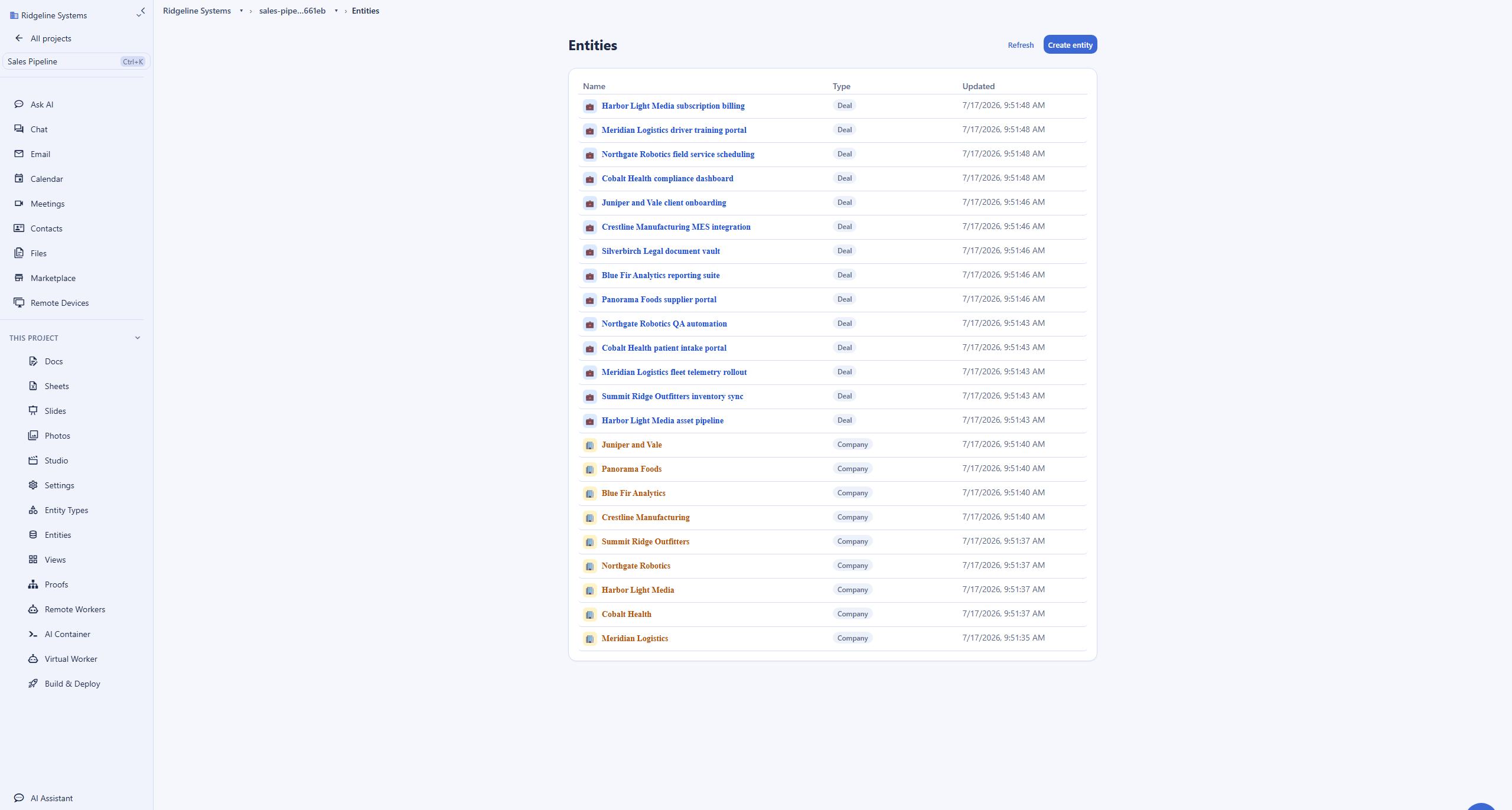
Around the ticket queue, the workspace adds surfaces a support team reaches for. The relational data platform holds custom ticket-linked data as entities of custom types with typed relationships, lookups, and referential integrity, so a ticket links to a real customer, asset, or account record rather than a flat text field, and there is no packaged record ceiling. Governed AI triage comes from assigning a Virtual Worker and a finite-state-machine skill to a workflow stage: the worker drafts a reply as an internal note, auto-dispatch is off by default and carries per-ticket budgets, and a person approves before anything is sent. Backbuild Finances keeps invoicing and a double-entry ledger in the same workspace, so a support case that ends in a refund or a credit does not cross into a separate accounting subscription. The whole help desk is drivable over the public REST API and native MCP tools, so an agent, an automation, or an AI worker can create, query, and configure tickets programmatically.
Where Freshdesk wins today
Freshdesk is the far more established support product, with a very large installed base and a long track record, and several of its strengths are things the Backbuild Helpdesk does not match today.
Omnichannel channels in one ticket
Freshdesk unifies email, live chat and messaging through Freshchat, voice through Freshcaller, and social and WhatsApp intake into a single ticket with full context. The Backbuild Helpdesk is ticket-focused: inbound email-to-ticket is on the roadmap, and there is no live-chat widget, telephony, social, or WhatsApp intake today. A team whose support spans many real-time channels gives up genuine capability by moving off Freshdesk now.
A customer knowledge base, portal, and community
Freshdesk ships a customer-facing knowledge base, a customizable self-service portal, and community forums, with article versioning and multi-language content. Backbuild ships authenticated ticketing and Backbuild Docs for internal knowledge, but it has no public knowledge-base, portal, or community-forum product, so a team that needs branded self-service should treat this as a real gap.
The marketplace, SLA management, and routing
The Freshworks Marketplace and Freshdesk’s mature SLA management, business hours, escalations, and skill-based routing are a deep capability set built over many years. Backbuild answers external connection with publishable SaaS packages, the full REST API, signed webhooks, and custom tools, but its catalog is smaller today.
Freddy AI and deeper reporting
Freshdesk ships Freddy AI for self-service, agent assist, and insights, and reporting with curated reports, custom dashboards, and Freddy Insights. Backbuild answers automation with governed Virtual Workers and finite-state skills, a different, human-approved mechanism, and reporting through saved views and Sheets export rather than a dedicated analytics product. Freshdesk keeps the advantage in reporting depth today.
Common Freshdesk frustrations and how the Backbuild Helpdesk addresses them
Tier jumps and add-on creep
Freshdesk lists Growth at 19 US dollars per agent, but the price climbs quickly: Pro is 55 and Enterprise is 89 per agent, and Freddy Copilot is a separate 29 per-agent add-on. The Backbuild Helpdesk is included in the workspace with no separate per-agent support fee, permanently free for up to 20 tickets a month, and unlimited on paid plans.
Per-session AI billing that expires
Freddy AI Agent is metered per session at roughly 49 US dollars per 100 sessions after the allowance, with sessions that expire each cycle, do not roll over, and are charged whether or not they resolve the request. Backbuild meters AI on usage credits and lets a team bring its own AI provider and model, so inference runs at the provider rate under its own agreement rather than a per-session meter.
The Omni fork for omnichannel
Omnichannel on Freshdesk is not part of Support Desk: live chat, voice, and social require the pricier Freshdesk Omni plan, from 29 to 119 US dollars per agent, so a buyer comparing the 19 dollar number finds a different bill once the channel mix is added. The Backbuild Helpdesk is ticket-focused today, with one workspace price and no channel-tier fork, and inbound email-to-ticket on the roadmap.
A permanent free tier, not a 6-month clock
Freshdesk’s free entry, the Free Program, covers only 1 to 2 agents and runs for 6 months rather than permanently, and omnichannel is not included. The Backbuild Helpdesk is permanently free for up to 20 tickets a month, with workflow states, priorities, assignment, public replies separated from internal notes, and CSAT, and no clock on the plan.
Governance gated to the Enterprise tier
On Freshdesk, audit logs, custom roles, IP controls, and the sandbox arrive on the Enterprise tier. The Backbuild Helpdesk includes single sign-on, role-based access control, and a tamper-evident audit log on every plan, including Free, with step-up multi-factor on elevated configuration, so the security posture does not depend on the tier.
Weak issue tracking for engineering
Freshdesk carries parent-child ticketing and linked tickets on its higher tiers, but it is a support tool rather than an issue tracker, so engineering teams still bridge to a separate tool like Jira. The Backbuild Helpdesk carries ticket types, parent-child hierarchy from epic to subtask, typed relations, and custom workflow states natively, so a support ticket can become a tracked bug in the same system.
Which tool wins, by use case
A support team running a ticket queue and hitting SLAs
This is the most common reason a team buys Freshdesk: a shared queue, response and resolution SLAs, and CSAT reporting. The Backbuild Helpdesk answers with a staff console of List, Grid, Board, and Table views, saved views, and bulk actions, custom workflow states with per-state SLAs and work-in-progress limits, public replies separated from internal notes, and CSAT, and it is included in the workspace with no separate per-agent fee where Freshdesk charges from 19 US dollars per agent per month once the 6-month free program ends. The counterweight is SLA depth and channels: Freshdesk ships mature multi-policy SLA management, business hours, and escalations, and if the queue is fed by live chat, phone, and social as well as email, Freshdesk unifies them in one ticket today and Backbuild does not.
A small business or store answering customer email
Founders and small stores are drawn to Freshdesk by its free entry, but the Free Program covers only 1 to 2 agents and runs for 6 months, after which the queue moves to a paid per-agent plan. The Backbuild Helpdesk is permanently free for up to 20 tickets a month and lives in a workspace that already carries mail at your own domain, documents, and a calendar, so a small team runs support without a second subscription or a clock. The honest limits are real: without inbound email-to-ticket yet, a requester files through the app rather than by replying to an email, and a customer who expects a public help center will not find one.
An internal IT or HR service desk
Freshworks routes internal support to a separate product, Freshservice, so an internal desk on Freshdesk usually means a second instance to run and pay for. The Backbuild Helpdesk runs an internal IT or HR service desk in the same workspace as the rest of a team, with custom workflow states, per-state SLAs, approval gates on transitions, and ticket types, and a relational data platform that links a ticket to the asset, system, or employee record it concerns. Governance is included: single sign-on, role-based access control, and a tamper-evident audit log on every plan.
Turning support tickets into tracked engineering work
Freshdesk carries parent-child ticketing and linked tickets on its higher tiers, but it is a support tool rather than an issue tracker, so a support ticket that turns out to be a bug is usually handed to a separate tool like Jira, and the two systems drift apart. The Backbuild Helpdesk carries issue-tracking depth natively: ticket types like Bug and Epic, parent-child hierarchy from epic to subtask, typed relations between tickets, and custom workflow states with work-in-progress limits, and the same tickets are drivable over the REST API and MCP, so a support ticket becomes a tracked engineering item in one system. Freshdesk keeps the advantage in raw support channel breadth and its marketplace of engineering integrations.
Offering support to your own subscribers
A software company or agency that resells software wants its own subscribers to file support, routed per product and branded. Freshdesk answers with multiple products and customizable portals on its higher tiers. The Backbuild Helpdesk routes subscriber tickets per SaaS package, so a company that publishes its own product on Backbuild gives its subscribers a support channel routed to its organization under a label it controls, in the same workspace where it builds and sells the product. The tradeoff is channel breadth and the maturity of Freshdesk’s multi-product help centers.
Omnichannel customer support across chat, phone, and social
For a team whose support is spread across live chat, phone, social, WhatsApp, and email, Freshdesk is the stronger choice today. Freshchat for messaging, Freshcaller for voice, and social and WhatsApp intake all land in one ticket, and a customer knowledge base and self-service portal give customers a place to self-serve. Those channels run on the pricier Freshdesk Omni plan, but they are shipped and mature. The Backbuild Helpdesk is ticket-focused, with inbound email-to-ticket on the roadmap and no chat, voice, social, or WhatsApp intake, so it does not cover this shape of support yet.
Security, identity, and governance evaluation
A security review of a help desk turns on four questions: who can get in, what each agent can see, what record survives every change, and what the answers cost. On identity, the Backbuild Helpdesk ships single sign-on on every plan, including Free, and SCIM provisioning across plans, with default-deny role-based access control that separates who can read tickets from who can configure the help desk. Freshdesk provides single sign-on and directory provisioning as well, though its custom roles, audit logs, IP controls, and sandbox sit on the Enterprise tier, so a small team on Growth or Pro does not have the granular controls or the audit trail.
On what survives a change, the Backbuild Helpdesk writes a tamper-evident, append-only audit trail on every plan, keeps a strict per-organization tenant isolation and an internal-notes privacy wall so a requester never sees staff notes, and requires step-up multi-factor on elevated configuration changes. Freshdesk answers with an access and audit log and enterprise controls, but the deeper audit and role features arrive at the top of its range. On AI governance, an organization can bring its own AI providers and models so inference runs under its own agreement, and automated triage drafts as internal notes behind a human-approval floor, where Freshdesk runs Freddy AI on a bundled model.
The tradeoffs run both ways. Freshdesk is the older product, with a long track record, published compliance attestations, a sandbox for safe configuration, and a data-center region choice at signup that Backbuild does not match today. The bottom line: if the review demands single sign-on, fine-grained roles, a tamper-evident audit trail, and AI that runs under your own provider agreement without an upgrade, the Backbuild Helpdesk sets that floor higher on every plan; if it demands a formal data-residency choice, an isolated sandbox, and years of attested operating history, Freshdesk has more of it today.
The economics for a finance and procurement review
The Freshdesk line item is per agent per month, and the total often exceeds the sticker. The Growth plan starts at 19 US dollars, Pro at 55, and Enterprise at 89 per agent per month, the free program is time-boxed to 6 months, and the bill grows in three more ways: Freddy Copilot is a 29 per-agent add-on, Freddy AI Agent is metered per session with no rollover, and omnichannel requires the pricier Freshdesk Omni plan. Capability also sets the tier: custom roles, the sandbox, and audit logs sit on Enterprise.
The Backbuild Helpdesk changes the shape of the bill. It is included in the workspace with no separate per-agent support-suite subscription: the free plan is permanent and covers 20 tickets a month, and paid plans, from 19 to 149 US dollars per seat, make ticket volume unlimited while also carrying the rest of the workspace. AI runs on usage credits or an AI provider you bring yourself rather than a per-session meter and add-on, and governance is included on every plan rather than reserved for a higher tier. The counterweight is scope: Freshdesk buys omnichannel channels, a customer help center, and a large marketplace that the Backbuild Helpdesk does not include. The bottom line: for a ticket-and-email support team, the Backbuild Helpdesk removes the per-agent support fee, the per-session AI meter, the Copilot add-on, and the omnichannel plan fork, and folds the help desk into a workspace subscription; for a team that needs the full omnichannel suite, Freshdesk’s price buys capability the Backbuild Helpdesk does not have.
Rolling it out across a support team
Adoption risk on a help desk is concentrated in the switch itself: open tickets have to keep moving, and agents have to find their queue on day one. Freshdesk’s advantage here is familiarity and onboarding: reviewers consistently praise its intuitive interface and fast setup, though some note that deeper customization needs technical resources. The Backbuild Helpdesk reduces the switch cost differently: it is already inside a workspace a team may use for mail, documents, and a calendar, so agents work tickets next to the rest of their day, and the queue is drivable over the REST API and MCP for a scripted or AI-assisted import.
On governance during rollout, the structural difference is that the Backbuild Helpdesk keeps role-based access and the internal-notes privacy wall from the first seat, so a lead can bring agents in without widening what requesters see, and governed AI triage stays behind a human-approval floor during the learning period. The unavoidable caveat is channels: because inbound email-to-ticket, chat, and voice are not shipped, a rollout that depends on those should keep Freshdesk for the customer channels and use the Backbuild Helpdesk for the internal and issue-tracking side. The bottom line: pilot both with the real intake in mind. If the queue is fed by many live channels, Freshdesk is the smoother path today; if it is fed by tickets and email inside a workspace a team already uses, the Backbuild Helpdesk rolls out at no separate cost with governance from the first seat.
Data ownership, migration, and lock-in
The exit question deserves as much scrutiny as the entrance. Freshdesk exports tickets to CSV, and its public REST API is rate-limited per account, with per-minute request caps that vary by plan and a shared pool that installed marketplace apps draw from, so a large migration has to be paced against those limits. The Backbuild Helpdesk’s export posture is broad by design: the REST API returns every ticket, message, type, and relationship, a filtered queue exports to CSV, Backbuild Sheets, and Backbuild Docs, and there is no monthly call quota to meter the exit.
Migration into the Backbuild Helpdesk has one main lane: tickets and their custom fields are recreated through the public REST API, or the exported data is handed to an AI agent over MCP, which can build the ticket types, workflow states, and linked records end to end. Because the API is uncapped, loading a large backlog does not meter against a plan. The bottom line: both tools let you leave, but the Backbuild Helpdesk’s uncapped API and agent-drivable loading make both directions of the move cheaper to execute, while Freshdesk’s advantage is the maturity of the migration tools and partners built around its long-established format.
Strategic fit and vendor risk
Freshdesk is a category incumbent, and the strategic case for it is maturity and reach: a long operating history, a very large installed base, a 4.4 out of 5 rating across thousands of reviews, the Freshworks Marketplace, mature omnichannel channels, and a customer help center few pure ticketing tools match. The risk on that side is cost and add-on creep: the tier jumps, the Copilot add-on, the per-session AI billing, and the omnichannel plan fork are what send teams looking for an alternative in the first place.
The Backbuild Helpdesk’s strategic case is consolidation and governance: a real ticketing help desk with issue-tracking depth, inside a workspace that adds a data platform, accounting, and governed AI, with security included rather than tiered, an uncapped, OpenAPI-documented exit, and an open agent protocol across the platform. The real risks: it is the younger vendor and pre-launch, in early adopter alpha, it has no omnichannel channels or customer help center, its marketplace and reporting are smaller, and its native mobile app is still coming. The bottom line: choose Freshdesk when omnichannel breadth, a customer help center, marketplace depth, mature SLA management, and a long track record are the controlling criteria; choose the Backbuild Helpdesk when a governed ticket-and-issue system inside a consolidated workspace, with a security floor on every plan and no per-agent, per-session, or add-on meter, matters more, and omnichannel channels can wait or run alongside.
Frequently asked questions
Is there a free alternative to Freshdesk?
Yes. Freshdesk ships a genuine free entry, the Free Program, but it covers only 1 to 2 agents and runs for 6 months rather than permanently, and omnichannel is not part of it. The Backbuild Helpdesk is included in the Backbuild workspace with no separate per-agent support-suite subscription, and its free plan is permanent, covering up to 20 tickets a month, with single sign-on, role-based access control, and a tamper-evident audit log on every plan. A small team can run a real support queue, with workflow states, priorities, assignment, public replies separated from internal notes, and CSAT, at no cost and with no clock, and paid plans from 19 US dollars per seat make ticket volume unlimited.
Why does Freshdesk cost more than the sticker price?
Freshdesk lists Growth at 19 US dollars per agent per month on an annual plan, and the price climbs in three ways past that number. Moving from Growth to Pro is a large jump, to 55 and then 89 US dollars per agent for Enterprise. Freddy AI Copilot, the agent-assist assistant, is a separate 29 US dollars per agent add-on. And Freddy AI Agent, the autonomous self-service bot, is billed per session at roughly 49 US dollars per 100 sessions once the allowance is spent, with sessions that expire each cycle and do not roll over, charged whether or not the session resolves the request. Omnichannel adds a fourth line, because live chat, voice, and social require the pricier Freshdesk Omni plan rather than Support Desk. The Backbuild Helpdesk is included in the workspace subscription with no separate per-agent support fee, its AI runs on usage credits or on an AI provider you bring yourself rather than a per-session meter, and governance is on every plan rather than reserved for a higher tier.
Can Backbuild replace Freshdesk?
For teams whose support runs on tickets, the Backbuild Helpdesk covers the core: filing, a staff console with List, Grid, Board, and Table views, custom workflow states, categories, priorities, assignment, public replies separated from internal notes, per-state SLAs, ticket types with hierarchy and relations, custom fields, CSAT, and export. It cannot replace Freshdesk for a team that depends on omnichannel intake, because Backbuild does not yet offer live chat, telephony, social intake, or inbound email-to-ticket, and it has no customer-facing knowledge base, help center, or community forums like Freshdesk. A team whose support is email, chat, and phone across many channels, or that needs a public self-service portal, should stay on Freshdesk, or run the Backbuild Helpdesk for the internal and issue-tracking side while keeping Freshdesk for the customer channels.
Does Backbuild have live chat, phone, and WhatsApp support like Freshdesk?
Not today. Freshdesk is an omnichannel suite with live chat and messaging through Freshchat, voice through Freshcaller, and social and WhatsApp intake, all landing in one ticket, though those channels run on the pricier Freshdesk Omni plan. The Backbuild Helpdesk is ticket-focused: a requester files a ticket and both sides continue on the ticket thread, with public replies separated from internal notes. Inbound email-to-ticket is on the roadmap, and there is no live-chat widget, telephony, social, or WhatsApp intake yet. For a team whose first requirement is real-time chat or phone support, Freshdesk is the stronger choice right now.
Does Backbuild have a customer knowledge base or help center like Freshdesk?
No. Freshdesk ships a customer-facing knowledge base, a customizable self-service portal, and community forums, with article versioning and multi-language content, and this is a genuine strength of the product. Backbuild ships authenticated ticketing plus Backbuild Docs for internal knowledge, but it does not have a public help-center or community-forum product. A team that needs a branded self-service knowledge base and a customer community should weigh that gap; a team that mainly needs to work a ticket queue with governed workflows does not.
What is the best Freshdesk alternative for an internal IT or engineering team?
This is where the Backbuild Helpdesk is strongest. It runs an internal IT or HR service desk and an engineering issue tracker in the same workspace as the rest of a team, without moving internal support to a second product the way Freshworks routes it to Freshservice. Ticket types like Bug and Epic support parent-child hierarchy from epic to subtask and typed relations between tickets, custom workflow states carry per-state SLAs and work-in-progress limits, transitions can require approval or a step-up, and a relational data platform links tickets to custom records such as assets or systems. Freshdesk answers internal support with the separate Freshservice product and issue tracking with parent-child ticketing and integrations to a tool like Jira.
How much does Freddy AI cost on Freshdesk?
Freddy AI is billed in two separate ways on top of the seat price. Freddy Copilot, the agent-assist assistant that suggests replies and summarizes tickets, is an add-on at roughly 29 US dollars per agent per month on an annual plan. Freddy AI Agent, the autonomous self-service bot, is metered per session at about 49 US dollars per 100 sessions once the plan allowance is used, and reviewers note the sessions expire at the end of each billing cycle, do not roll over, and are charged whether or not the session resolves the query. The Backbuild Helpdesk meters AI on usage credits or lets a team bring its own AI provider and model, so inference runs at the provider rate under its own agreement rather than a per-session meter.
What does Freshdesk do better than Backbuild?
Several things, and they are real. Freshdesk is a full omnichannel suite with live chat, voice, social, WhatsApp, and inbound email, where Backbuild is ticket-focused. It ships a customer-facing knowledge base, a customizable self-service portal, and community forums that Backbuild has no equivalent for. Freshdesk has mature SLA management and skill-based routing, the Freshworks Marketplace of apps and integrations, Freddy AI for self-service and agent assist, deeper reporting with custom dashboards and Freddy Insights, CSAT, a data-center region choice at signup, a sandbox on its Enterprise tier, native mobile agent apps, and a long track record with large adoption. Backbuild is newer and pre-launch, in early adopter alpha, and answers automation with governed Virtual Workers and finite-state-machine skills rather than a turnkey bot.
Try the Backbuild Helpdesk free
A real ticketing help desk, with custom workflow states, priorities, assignment, replies, SLAs, ticket types, and CSAT, inside a workspace that adds a relational data platform, governed AI triage, built-in accounting, a full REST API and native MCP tools, and single sign-on and audit logging on every plan, permanently free for up to 20 tickets a month. If the deciding factors are omnichannel channels, a customer help center, the marketplace, or mature SLA management, Freshdesk is the stronger choice today.
Get started free