

n8n alternative: Backbuild automation and Virtual Workers
On the Backbuild side of automation, rules fire on workspace events and timers and dispatch an autonomous AI worker that operates a real computer: a full Linux desktop, a browser, and a terminal it drives to do work, using credentials from an encrypted vault the model never sees in plaintext, on isolated containers metered by usage credits. n8n is a source-available, self-hostable, node-based workflow automation tool that builds multi-step workflows on a visual node-graph canvas, connects more than 400 pre-built integration nodes, drops into JavaScript and Python code nodes, and runs unlimited executions free on your own infrastructure, and it leads on self-hosting and data sovereignty, its visual builder and code nodes, its integration and AI node catalog, and its developer flexibility.
The short answer
n8n is a source-available, self-hostable, node-based workflow automation tool that builds multi-step workflows on a visual node-graph canvas, connects more than 400 pre-built integration nodes, drops into JavaScript and Python code nodes, and runs unlimited executions free on your own infrastructure; on the Backbuild side that job is done by automation rules that fire on workspace events and timers and dispatch an autonomous AI worker which operates a real Linux desktop, a browser, and a terminal on an isolated container under an encrypted vault the model never reads in plaintext, plus outbound webhooks and bounded scripts, on usage credits inside the all-in-one Backbuild workspace with the public REST API and native Model Context Protocol tools. They are different mechanisms for different jobs: a self-hostable, node-based data flow with code where you need it, or a hosted AI worker operating real systems under governed credentials.
Choose n8n if you want to self-host and keep your data on your own infrastructure with a free, unlimited-execution edition, the visual node-graph builder with JavaScript and Python code nodes, the catalog of more than 400 integration nodes, a rich AI and LangChain node ecosystem with local-model support, and a long track record. Choose Backbuild if the work has to run in apps that have no API, under credentials your organization governs, with an AI worker that operates a real computer, the AI model of your choice, and single sign-on, roles, and audit on every plan, free to start. The biggest differences in n8n favor are self-hosting, the visual node-graph builder, and the code nodes, which Backbuild does not match; the biggest differences in Backbuild favor are operating real systems and no-API apps under a zero-knowledge vault, and governance on every plan.
Backbuild automation and Virtual Workers vs n8n: feature by feature
n8n prices, plans, and capabilities below are from n8n pages, observed 2026-07-20 and subject to change. The highlighted column is Backbuild.
| Backbuild automation and Virtual Workers Rules that fire on workspace events and dispatch an AI worker operating a real desktop, browser, and terminal under a governed vault On every plan, including Free. No separate per-task subscription: worker work draws on one universal usage-credit pool as it runs, larger containers draw more, and idle time is not metered. Get Started Free | n8n The source-available, self-hostable, node-based workflow automation tool with a visual builder and code nodes Community edition is free and self-hosted with unlimited executions. Cloud Starter about €20/mo (2,500 executions), Pro about €50/mo (10,000 executions), Business about €667/mo (SSO, environments, Git), Enterprise custom, billed on executions where a whole workflow run counts as one. | |
|---|---|---|
| Deployment and cost model | ||
| Source-available and self-hostable on your own infrastructure | Hosted platform only | Sustainable Use License |
| Free, unlimited-execution edition on your own server | Hosted, usage credits | Community edition |
| Fully managed hosting with no server to maintain | n8n Cloud | |
| Free plan with the automation surface | Free self-hosted | |
| Metering model | One usage-credit pool, idle free | Per workflow execution, or self-host |
| Bring your own AI provider account and billing | Powers everything on your account | Own key in AI nodes |
| Automation triggers | ||
| Pre-built triggers on external app events | Fires on workspace events | 400+ nodes |
| Native triggers on your own workspace data (mail, calendar, records, tickets, alerts) | Via app nodes | |
| Scheduled and cron triggers | Schedule trigger | |
| Inbound webhook trigger | Workspace-event driven | Webhook node |
| Chat and event-stream triggers | Over the AI surface and MCP | Chat trigger |
| Building the automation | ||
| Visual node-graph builder (drag and connect nodes on a canvas) | Logic in the AI skill | Node canvas |
| Branching, switch, merge, and filter | In the AI skill | Flow control |
| Loops and item iteration over arrays | In the AI skill | Loop nodes |
| Expressions and data mapping | In the AI skill and Sheets | Expressions |
| JavaScript code node | Bounded script action | Code node |
| Python code node | Bounded script action | Code node |
| npm packages in code steps | Full Linux tools on the worker | Self-hosted code |
| Call any REST or GraphQL API with no node | Outbound webhook action | HTTP Request node |
| Reusable sub-workflows | Skills call skills | Sub-workflows |
| Error handling and retries | Retry and audit on the run | Error workflows |
| Template and recipe gallery for a fast start | Skills and prompts | Thousands of templates |
| Built-in lightweight data storage | Entity types and Sheets | Data table nodes |
| Automation actions and execution | ||
| Deterministic action steps across a connector catalog | Webhook, script, worker, notify | 400+ nodes |
| Dispatch an autonomous AI worker as an action | AI Agent node | |
| Outbound webhook or HTTP action to any endpoint | HTTP Request node | |
| Bounded script or code step | Code node | |
| In-app notification action | ||
| Containerized, real-computer execution | ||
| Runs the automation on a real Linux desktop, browser, and terminal | Workflow and code steps | |
| Operates apps and sites that have no API, like a person | Node and API connected | |
| Full Linux tool suite available to the run | Execute Command, self-hosted | |
| In-browser terminal and remote-desktop surface | Not offered | |
| Fully unattended orchestrated background runtime Soon | Rolling out per organization | Continuous workflow runs |
| AI agents and building | ||
| Autonomous AI agent that reasons and acts on a goal | AI Agent node | |
| Governed finite-state-machine skills (deterministic, auditable execution) | Free-form agent planning | |
| AI and LangChain node ecosystem | AI over MCP and the surface | 70+ AI and LangChain nodes |
| Local or self-hosted model in the automation | Your provider and billing | Local models on self-host |
| Natural-language automation copilot | Over the AI surface and MCP | AI workflow builder |
| Bring your own model to power the agent | Your provider and billing | Model of your choice |
| Connectors and integrations | ||
| Pre-built app-connector catalog | Webhooks, Tool Builder, SaaS packages | 400+ nodes |
| Community-contributed connectors | SaaS packages, paid add-on | Community nodes |
| MCP surface exposed to any AI client | Workspace and worker over MCP | MCP nodes |
| Custom tools wired to automations | Tool Builder | Custom nodes |
| Installable, publishable extension packages | SaaS packages, paid add-on | Community node registry |
| Security and governance | ||
| Credentials in an encrypted, zero-knowledge vault the model cannot read | Encrypted at rest by the instance | |
| Grant-based, single-use credential injection, never plaintext to the model | Stored credentials in nodes | |
| Session acts under a scoped, revocable delegated token | Not documented | |
| Non-overridable approval floor on irreversible actions | Manual workflow controls | |
| Per-organization roles | Every plan | RBAC on Pro and up |
| Tamper-evident audit log | Every plan | Log streaming on Enterprise |
| Single sign-on | Every plan | SAML and LDAP on Business |
| SCIM 2.0 provisioning | Every plan | Not documented |
| Environments and Git version control of automations | No environment promotion | On Business and up |
| External secrets store integration | Built-in zero-knowledge vault | On Enterprise |
| Post-quantum encrypted operation stream | TLS in transit | |
| SOC 2 and independent penetration testing | Built to standard, not yet audited | |
| Platform, API, and track record | ||
| Public REST API over the whole platform on every plan | Every plan | n8n API |
| Native Model Context Protocol tools | MCP nodes | |
| Transparent single-pool usage credits, idle not metered | Per-execution or self-host | |
| Established track record and large user base | Newer, not yet audited | |
| Ease of building a simple automation with no AI | AI-worker centric | Visual builder |
| Workspace apps the automation operates within | ||
| Connects to mail apps | ||
| Chat Soon | Backbuild Chat rolling out | Not a workspace |
| Meetings Soon | Backbuild Meetings rolling out | Not a workspace |
| Calendar | Connects to calendars | |
| Contacts | Not a workspace | |
| Docs | Connects to doc apps | |
| Sheets | Connects to spreadsheet apps | |
| Slides | Not a workspace | |
| Diagrams Soon | Backbuild Diagrams rolling out | Not a workspace |
| Photos and the photo editor | Not a workspace | |
| Training video editor | Not a workspace | |
| Video, audio, and music editors Soon | Authoring preview | Not a workspace |
| Files | Connects to storage | |
| Finances | Connects to accounting apps | |
| Help desk | Connects to help desks | |
| Secrets vault | Stored credentials | |
A cross means the tool does not offer the feature today. n8n prices, plans, and capabilities are quoted from the n8n pricing, features, integrations, documentation, and license pages, observed 2026-07-20. Backbuild capabilities are cited to the workflows and automations documentation, the Virtual Workers docs, the Secrets vault, SSO and SCIM, MCP, and API reference pages, and the pricing page. The Chat, Meetings, Diagrams, video, audio, and music editor rows and the unattended orchestrated runtime are marked at the status Backbuild ships them at today, not asserted as complete.
A self-hostable node graph, or an AI worker on a real computer
n8n is a strong, developer-loved automation tool. Its strength is building multi-step workflows on a visual node-graph canvas that connects more than 400 pre-built integration nodes, drops into JavaScript and Python code nodes when a node is not enough, and runs unlimited executions free on your own infrastructure so the data never leaves a server you control. For a self-hostable, node-based data flow with code where you need it, that is exactly the right tool, and its builder, its code nodes, its integration catalog, and its data sovereignty are genuine advantages. Backbuild automates a different way. A Backbuild automation rule fires on a workspace event or a timer and dispatches an action, and its most distinctive action hands the task to an autonomous AI Virtual Worker that operates a full Linux desktop, a browser, and a terminal, so it can reason through a multi-step task and drive an application the way a person would, including an application that has no API. It acts under credentials your organization governs in an encrypted vault the model never reads in plaintext, inside per-organization roles and a tamper-evident audit trail on every plan, on the AI model of your choice. Where the work is a self-hostable node graph across integrations, n8n is the fitting tool. Where it needs to operate real systems, reach no-API apps, and run under governed credentials with governance on every plan, Backbuild is built for it.
Two mechanisms for automating work
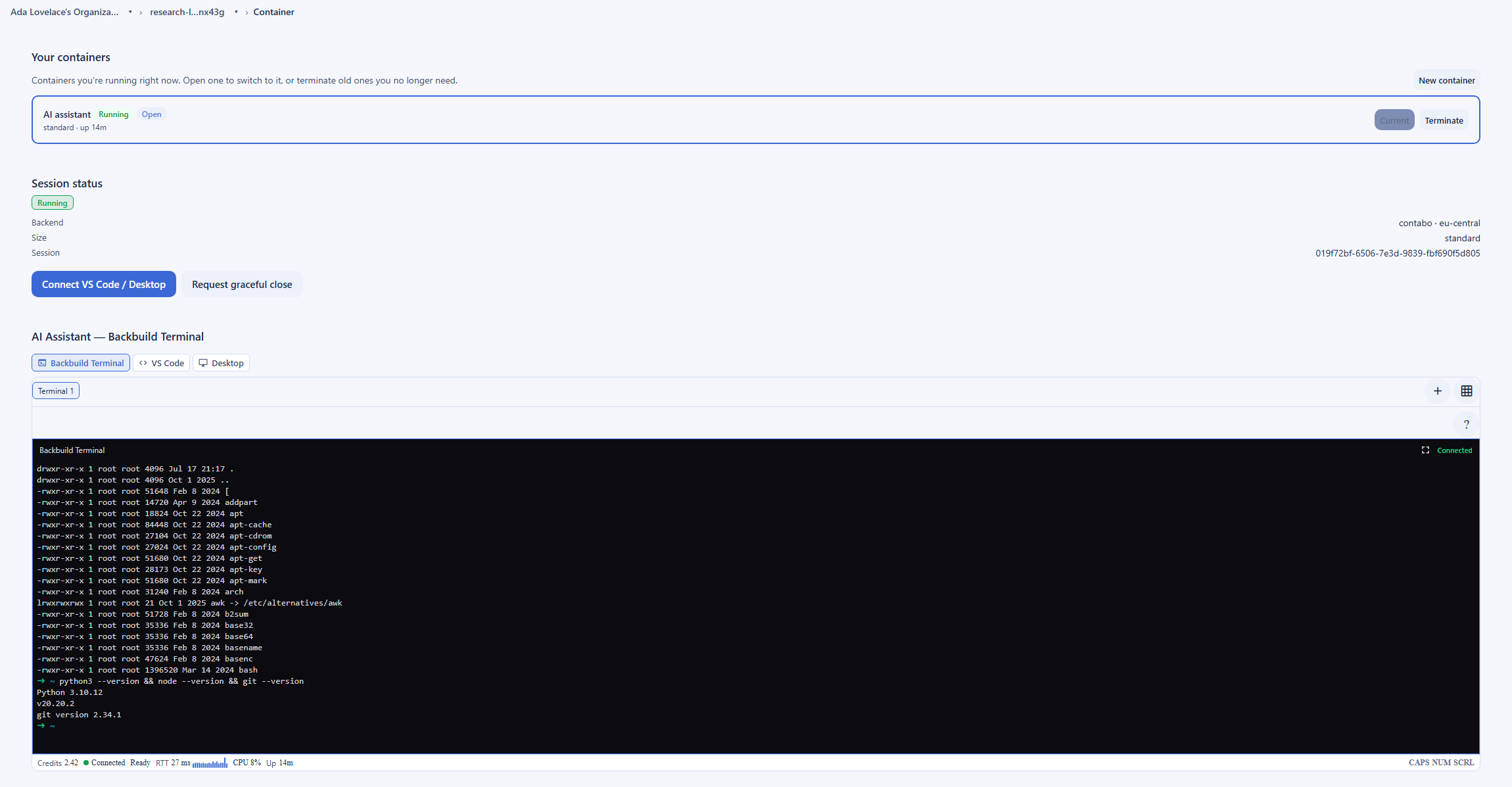
The clearest way to see the difference is to follow one automation through each product. In n8n a trigger node fires, and n8n runs the data through the connected nodes on the canvas, branching, transforming, and calling app APIs or executing code node by node, all on infrastructure you can self-host. In Backbuild a rule fires on a workspace event or a timer and dispatches an AI worker onto an isolated container, where the worker operates a real desktop, a browser, and a terminal to do the task, pulling any credential it needs from the vault without the plaintext ever entering the model. One runs a node graph that reaches apps through their APIs and code; the other operates the systems directly.
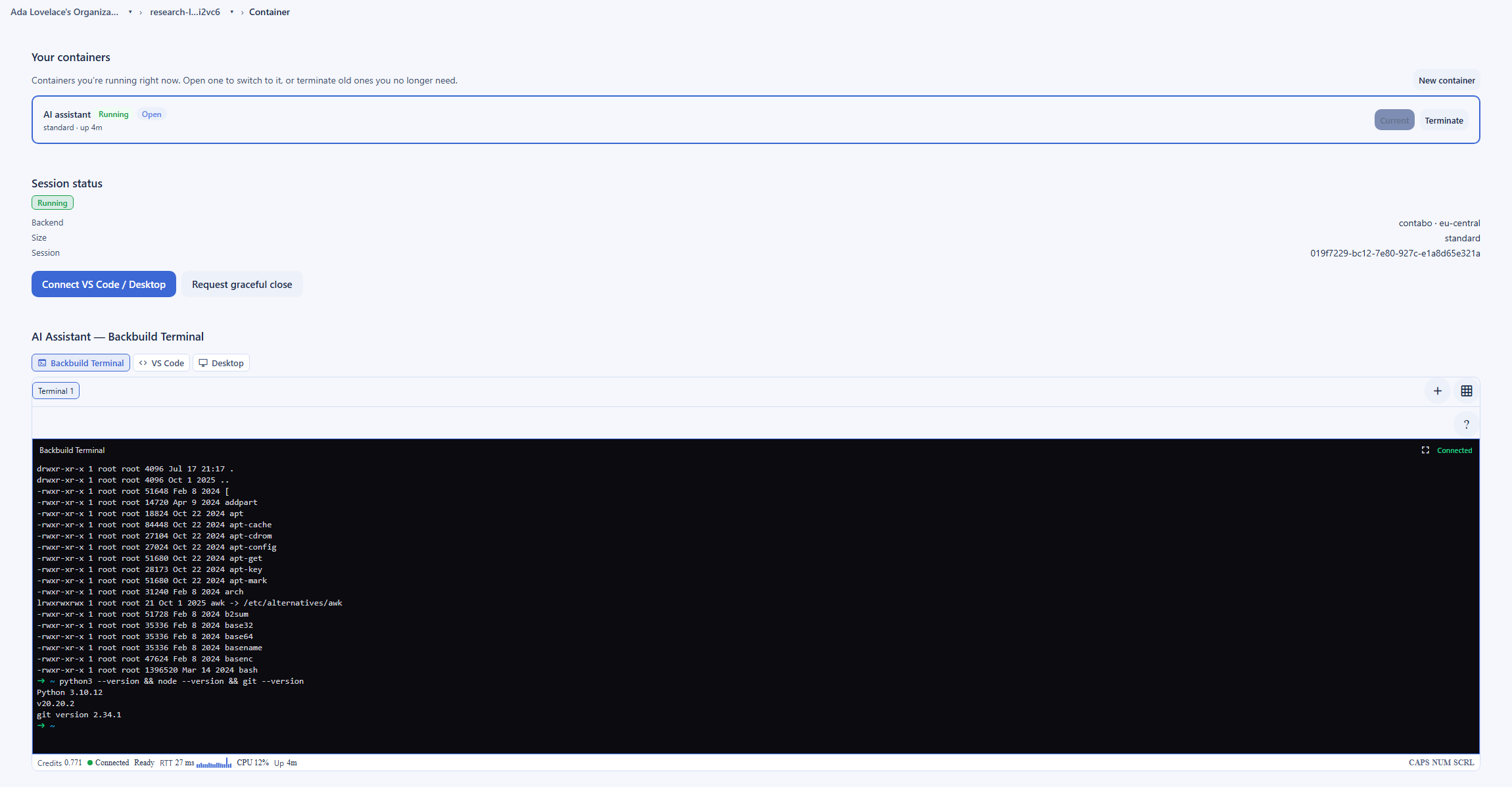
How an automation signs in without the model seeing the password
n8n stores credentials so a workflow can authenticate its nodes: when you add a credential, n8n encrypts it at rest on the instance and the connected nodes use it to call that app, and on a self-hosted Enterprise instance the credentials can be backed by an external secrets store. That is convenient and it works across the whole node catalog, and the stored credential is what a node acts through. Backbuild handles credentials so that no human has to type them and the model still never sees them. Secrets live in your organization vault, an encrypted, zero-knowledge, post-quantum vault, and the model that drives a worker never receives a plaintext value, because no tool returns one. When a worker needs to sign in, the vault hands back an opaque, single-use reference, not the secret. A trusted path substitutes the real value at the moment of use, on a loopback the model cannot read, so the credential reaches the target app while staying out of the model context, its results, and the logs. That is the difference a security reviewer cares about: the automation acts with the login, unattended, without the plaintext ever being present in the automation or the model.
How every automation action stays governed
Autonomy is only safe when it is bounded, so a Backbuild Virtual Worker runs each action through the same set of controls. The run executes as a governed finite-state-machine skill with deterministic, reviewable states rather than a free-form plan. Before an action takes effect it passes an autonomy dial and a non-overridable approval floor, so sending external email and pushing code always require a person no matter how autonomous the run is set to be. The worker holds a scoped, revocable delegated token behind a default-deny capability gate that excludes secrets, roles, billing, and administration. And every action is attributed and written to a tamper-evident audit trail on every plan. n8n places its role-based access control on Pro and up, single sign-on on Business, and log streaming on Enterprise, where Backbuild provides roles, single sign-on, and audit on every plan.
Where n8n wins today
n8n is widely loved for good reasons, and several of its strengths are things Backbuild does not match today. An honest evaluation names them plainly.
Self-hosting and data sovereignty
n8n is source-available under its Sustainable Use License and can be self-hosted with Docker or Kubernetes, including air-gapped, with a free Community edition that runs unlimited executions on your own server, so your workflows and data stay entirely on infrastructure you own. Backbuild is a hosted platform and does not offer a self-hostable or source-available edition. For a team whose requirement is on-premises data sovereignty, this is the clearest reason to choose n8n.
The visual builder and code nodes
n8n builds automations on a visual node-graph canvas and drops into JavaScript and Python code nodes, npm packages on self-hosted, and an HTTP Request node, giving developers complete flexibility to shape a workflow by hand. Backbuild does not ship a visual node-graph builder or a code-node authoring model; its logic lives in a governed AI skill and the reasoning of the worker. For a builder who wants to see and code every branch, n8n is the stronger tool.
The integration and AI node catalog
n8n ships more than 400 pre-built integration nodes plus a community-node ecosystem, a template gallery with thousands of workflows, and more than 70 AI and LangChain nodes with local-model support. Backbuild does not ship a connector catalog or an AI-node library at that scale. For a straight API-to-API sync between apps n8n already has nodes for, that library is a strong reason to choose n8n.
Maturity, compliance, and price at volume
n8n has a long track record, carries a SOC 2 attestation with independent penetration testing, and is dramatically cheap at volume when self-hosted because executions are unlimited on your own server. Backbuild is newer, and while its security posture is built to meet the standards auditors check, it does not yet carry those independent attestations, and it is a hosted, usage-metered platform rather than a free self-hosted one.
Common n8n frustrations and how Backbuild addresses them
A steep learning curve for non-developers
n8n reviewers frequently note that the node canvas, expressions, and data shapes have a real learning curve, especially for non-technical users. Backbuild takes a different, lower-code path: you describe the task and an AI worker operates the systems to carry it out, so building an automation is closer to directing a worker than wiring a graph. The honest counterpoint is that Backbuild is AI-worker-centric, not a simple no-code Zap builder either.
Automations that need an app with no API
An n8n workflow reaches an app through a node, the HTTP Request node, or code, all of which need an API or endpoint. When a workflow depends on a tool with no API, an internal system, or a site that has to be driven like a person, that is outside the model. A Backbuild Virtual Worker operates a full desktop, a browser, and a terminal, so it can drive that application directly, the way a person would.
Where the credentials live
n8n stores credentials encrypted at rest on the instance and the nodes act through them. Backbuild keeps a worker credentials in an encrypted, zero-knowledge vault the model never reads in plaintext, injects them through single-use references, and runs each session under a revocable token behind a default-deny gate.
Governance gated to a higher tier
On n8n, role-based access control arrives on Pro, single sign-on with SAML and LDAP and Git environments arrive on Business, and external secrets and log streaming on Enterprise, so a growing team upgrades to govern who can automate. Backbuild provides per-organization roles, single sign-on, SCIM 2.0 provisioning, and a tamper-evident audit trail on every plan, including Free.
Which tool wins, by use case
Developers and automation builders who self-host
This is the largest audience and the work n8n is built for. If the job is wiring a multi-step workflow on a canvas, dropping into JavaScript or Python code where a node falls short, connecting integration nodes, and running it on infrastructure you own with unlimited free executions, n8n visual builder and self-hostable model are genuinely hard to beat, and its data sovereignty is a real advantage. Backbuild fits the parts of this work that fall outside a clean node or API path: a step that has to operate a tool with no node, log in to an internal system, or run under credentials your organization governs, where a Virtual Worker operates the real application and an automation rule fires on your own workspace data. For the self-hosted node-based flow, n8n is the fitting tool.
Automating work in apps that have no API
This is the use case that separates the two products most clearly. An n8n workflow reaches an app through a node, the HTTP Request node, or code, so a legacy internal tool, a vendor portal with no integration, or a site that has to be operated like a person is out of scope. A Backbuild automation hands the task to a Virtual Worker that drives a full Linux desktop, a browser, and a terminal, so it can open the application, navigate it, fill its forms, and read its results the way a person would, using credentials from the vault the model never reads. The trade is that operating a system is slower and less deterministic than a direct API call, so for an app n8n already has a node for, the workflow is usually the better tool. For an app nothing connects to, only the worker approach applies.
Building AI agents and agentic workflows
Both products build AI automation, and the choice is about mechanism and governance. n8n ships a rich AI and LangChain node ecosystem with an AI Agent node, memory, vector stores, chains, and local-model support, all wireable on the canvas and self-hostable, which is a strong fit for a developer composing a retrieval or agent workflow across tools they connect. Backbuild answers with an autonomous AI worker that operates a real computer, runs as governed finite-state-machine skills that are deterministic and auditable, and can act in apps that have no API, on the model of your choice. The split is a self-hostable node-based agent reaching a tool and API surface, against a hosted AI worker operating real systems under governance.
Data-sovereignty and compliance-constrained teams
For a team in healthcare, finance, government, or an EU data-residency regime, the evaluation turns on where the automation and its data run and how identity and audit are handled. n8n answer is decisive on residency: self-host on your own or on-premises infrastructure, including air-gapped, so data never leaves your control, though its single sign-on, environments, and external secrets are gated to the Business and Enterprise tiers. Backbuild is hosted, so it does not meet an on-premises residency requirement, but it answers the identity and governance side on every plan: single sign-on and SCIM 2.0, per-organization roles and a tamper-evident audit trail, a zero-knowledge vault the model never reads, and per-session isolation under a revocable token.
Security and compliance evaluation
Because an automation platform logs in and acts on real systems, a sharp evaluation of this category is a security one, and it turns on a short list of criteria: where the automation and its data run, where credentials live and who can read them, how tightly a run is scoped and how fast it can be stopped, whether governance and audit are present or gated to a higher tier, and the vendor own posture and attestations. Both products should be measured against those, not against a feature count.
On data residency, n8n has a decisive answer for teams that need it: self-hosting on your own or on-premises infrastructure, including air-gapped deployments, so the automation and its data never leave a boundary you control. That is a genuine advantage Backbuild does not match, because Backbuild is a hosted platform with no self-hostable edition. On credentials, the two take different designs. n8n stores credentials encrypted at rest on the instance, with an external secrets store available on self-hosted Enterprise, and the connected nodes act through them. Backbuild keeps credentials in an encrypted, zero-knowledge vault the model never reads in plaintext: no tool returns a plaintext value, and a trusted path substitutes the real credential at the point of use, so a worker signs in unattended without the secret ever being present in the automation or the model. For a reviewer who treats every automation as a privileged non-human identity, that difference is the center of the evaluation.
On blast radius and control, Backbuild runs each worker session in an isolated, disposable container under a scoped, signed delegated token that is least-privilege, time-limited, and checked against a server-side revocation list on every use, so tearing down a session is a real kill switch, and the code a worker runs is held to a default-deny allowlist that excludes secrets, roles, billing, and administration. A non-overridable approval floor keeps two actions, sending external email and pushing code, always requiring a person. The operation stream itself is post-quantum encrypted. Backbuild also provides per-organization roles, single sign-on, SCIM 2.0 provisioning, and tamper-evident audit on every plan, where n8n places role-based access control on Pro, single sign-on on Business, and log streaming on Enterprise.
On vendor posture the honest picture runs both ways. n8n carries a SOC 2 attestation and independent penetration testing and a long operating history, which Backbuild does not yet match, and that is a genuine advantage for a buyer who requires an attested, established vendor now, or one who can self-host to keep data in place. At the same time, Backbuild offers a stronger structural posture for hosted credentialed automation: a zero-knowledge vault, per-session isolation, a revocable token, a default-deny gate, and governance on every plan rather than only on the top tiers. The bottom line for a security evaluation is that n8n leads on self-hosted data residency, independent attestations, and operating maturity, while Backbuild leads on the credential design and the control set for autonomous hosted work under organization governance.
The economics for a finance buyer
A finance evaluation of an automation platform is about total, predictable cost rather than a sticker price. The criteria are the entry cost, how the meter behaves as usage grows, and whether the spend can be forecast month to month across a team.
On entry cost, n8n has the strongest answer in the category for a team that can self-host: the Community edition is free with unlimited executions, so the automation itself costs only the infrastructure and the labor to run it. n8n cloud plans are execution-based, with Starter at about 20 euros a month, Pro at about 50, Business at about 667, and Enterprise custom, and the model counts a whole workflow run as one execution rather than one charge per step, which is competitive and a genuine strength at volume. The dynamic a finance buyer should weigh is the maintenance cost of self-hosting, which is real but not on the invoice: a server, a database, backups, and upgrades. Backbuild folds automation work into one universal usage-credit pool with idle time free, includes automation rules and Virtual Workers on a free plan with governance included, and lets a team bring its own AI provider and model so inference runs at the provider rate rather than a bundled markup.
The tradeoff a finance buyer should weigh is that Backbuild is a hosted, usage-metered platform: heavy worker work and larger container sizes draw more credits, so an always-busy workload is not free, and a team should size its credit budget against real usage. Against that, self-hosted n8n has the lowest raw cost at volume but shifts the cost into infrastructure and maintenance, and its cloud tiers step up steeply once single sign-on and environments are required on Business. The bottom line: n8n is the cheapest at volume for a team willing to self-host and maintain it, while Backbuild is the single-pool, model-portable cost structure with no server to run and governance included on every plan.
Rolling it out across a team
For the person putting an automation platform into a real team process, the evaluation is about time-to-first-result, how the tool behaves when a run goes wrong, and whether governance scales with the team without forcing a top-tier upgrade. These are operational criteria, and the two products lead on different ones.
On time-to-first-result, n8n is usually ahead for a self-contained node-based task once an instance is running: a template and a couple of connected nodes stand up a working workflow on the canvas, and that speed is real and worth crediting, though standing up a self-hosted instance itself takes setup. Backbuild trades some of that immediacy for surface and governance, because you direct an AI worker with prompts and governed skills on a real computer, but it makes a multi-step job states deterministic and reviewable and every action attributed and audited from the first run rather than only on a paid plan, and there is no server to maintain.
On governance at scale, the difference is where the controls live. n8n gates role-based access control to Pro, single sign-on and Git environments to Business, and external secrets and log streaming to Enterprise, so a growing team reaches for a paid upgrade to get them. Backbuild provides single sign-on and SCIM 2.0 provisioning and per-organization roles, data isolation, and a tamper-evident audit trail on every plan, including Free, and each worker session runs under a revocable token that makes a run that goes wrong visible and stoppable. The honest counterpoint is that a self-hosted n8n instance gives a team full control of its own environment, and that a governed AI-worker approach on a real computer asks more of the person setting it up than a turnkey node template does. The bottom line for a rollout: n8n is the faster first win on a simple node-based automation once self-hosted, and Backbuild is the more governable and auditable hosted foundation as the automations touch no-API systems and the team grows.
Strategic fit and vendor risk
An executive sponsor is evaluating fit and risk more than features: what the tool consolidates or fragments, how much it locks the organization in, and whether the vendor is a safe multi-year bet. Each product presents a different strategic shape.
n8n strategic case is control, flexibility, and a developer following. It is a source-available tool a team can self-host and own outright, with a loved visual builder, code nodes, a large integration and AI node catalog, a long track record, and a SOC 2 attestation with independent penetration testing, so it is a low-risk way to give developers flexible, self-hostable automation with no vendor holding the data. The risks an executive should weigh are that its Sustainable Use License is source-available but not OSI-approved open source and carries commercial-use conditions, that self-hosting carries real maintenance overhead, that governance features step up in price on the Business and Enterprise tiers, and that its reach ends at a node, an API, or code.
Backbuild strategic case is consolidation, real-system reach, and model choice. The automation lives inside an all-in-one workspace spanning Mail, Chat, Meetings, Calendar, Contacts, Docs, Sheets, Slides, Diagrams, and Photos, with dedicated photo, video, training video, audio, and music editors, Files, Backbuild Finances, a built-in help desk, and the Secrets vault, it operates real systems including no-API apps under governed credentials with full audit on every plan, and it runs on the AI model of your choice. That reduces the number of vendors, extends reach past the API boundary, and puts the automation next to the data it acts on. The risk an executive should weigh in the other direction is that Backbuild is newer and pre-launch in parts, is hosted rather than self-hostable, and does not ship n8n visual builder, code nodes, or node catalog, trading that flexibility and self-hosting for real-system reach, governed credentials, model choice, and workspace consolidation. The bottom line: choose n8n for a self-hostable, flexible, node-based automation tool a developer team can own, and Backbuild for a consolidated hosted workspace whose AI worker operates real systems under organization governance with the model you choose.
Frequently asked questions
What is the best n8n alternative?
It depends on the shape of the automation. n8n is a source-available, self-hostable, node-based workflow automation tool, and for building multi-step workflows on a visual node-graph canvas, dropping into JavaScript or Python code nodes where a node falls short, connecting more than 400 pre-built integrations, and running unlimited executions on your own infrastructure for free, it is a strong, developer-loved tool that is hard to beat. Backbuild is the closer fit when the work has to run in apps that have no API, under credentials your organization governs, with an AI worker that operates a real computer rather than a chain of connector nodes and API calls, and with single sign-on, roles, and audit present on every plan rather than gated to a higher tier. On the Backbuild side, automation rules fire on workspace events and timers and dispatch a Virtual Worker that drives a full Linux desktop, a browser, and a terminal on an isolated container, uses secrets from an encrypted vault the model never reads in plaintext, runs as governed finite-state-machine skills, and is attributed and audited on every plan. Backbuild also lets you bring your own AI model and puts the automation inside an all-in-one workspace exposed over a public REST API and native Model Context Protocol tools. The two are different mechanisms for different jobs.
Is Backbuild open source and self-hostable like n8n?
No, and this is the single clearest place n8n leads. n8n is source-available under its Sustainable Use License and can be self-hosted with Docker or Kubernetes, including fully air-gapped, so your workflows and your data stay entirely on infrastructure you own, and the self-hosted Community edition runs unlimited executions for free. Backbuild is a hosted platform: it does not offer a self-hostable edition, and it is not source-available. For a team whose requirement is data sovereignty on owned or on-premises infrastructure, or an unlimited-execution free tier that runs on a server they control, n8n is the right tool and Backbuild does not match it. Backbuild instead offers a hosted, governed platform where credentials live in a zero-knowledge vault the model never reads, and where single sign-on, roles, and audit are on every plan.
Does Backbuild have a visual node-graph builder and code nodes like n8n?
No, and this is the other clear place n8n leads. n8n builds automations on a visual node-graph canvas where you drag and connect nodes, add branching, merging, looping, and filtering, and drop into JavaScript or Python code nodes, npm packages on self-hosted, and an HTTP Request node whenever a pre-built node is not enough. That builder and its code nodes give a developer complete flexibility to shape a workflow by hand. Backbuild does not ship a visual node-graph builder or a code-node authoring model. On the Backbuild side, the logic of an automation lives in a governed finite-state-machine AI skill and in the reasoning of the Virtual Worker that carries the task out, and reaching outside the workspace is done with outbound webhooks, custom tools built in Tool Builder, publishable packages, and a worker operating apps directly. For a builder who wants to see and code every branch of a data flow on a canvas, n8n is the stronger tool.
Does Backbuild have as many integration nodes as n8n?
No. n8n ships more than 400 pre-built integration nodes plus a community-node ecosystem published to the npm registry, and its HTTP Request node can call any REST or GraphQL API, so its reach across connected apps is broad. Backbuild does not ship an integration-node catalog of that scale. Backbuild automations reach outside the workspace through outbound webhooks to any HTTPS endpoint, custom tools built in Tool Builder and wired to automations, and installable, publishable packages, and they can drive apps that have no API at all by operating them on a real computer the way a person would. So the two close the gap differently: n8n through a large library of connector nodes plus code and the HTTP Request node, Backbuild by operating systems directly and calling endpoints. For a workflow that is a straight API-to-API sync between two popular apps that n8n already has nodes for, n8n is usually the faster path.
How is Backbuild automation different from an n8n workflow?
An n8n workflow is a visual graph of nodes: a trigger fires, and n8n runs the data through the connected nodes, branching, looping, transforming, and calling APIs or executing code node by node along the graph you drew. It is powerful, deterministic, self-hostable, and works across hundreds of integrations with code where you need it. A Backbuild automation rule instead fires on a workspace event or a timer and dispatches an action, and its most distinctive action hands the task to an autonomous AI Virtual Worker that operates a real Linux desktop, a browser, and a terminal, so it can reason through a multi-step task and drive an application the way a person would, including an application with no API. Backbuild automations also run bounded scripts, call outbound webhooks, and send notifications. The trade is real: n8n gives a self-hostable visual builder with code nodes and a large integration catalog, and Backbuild gives an AI worker that operates real systems under governed credentials with governance on every plan.
Is Backbuild cheaper than n8n, and how does the pricing work?
It depends on the workload, and self-hosted n8n is genuinely hard to beat on price. The n8n Community edition is free and self-hosted with unlimited executions, so for a team that can run and maintain its own server, the automation itself costs only the infrastructure, which is dramatically cheaper than any per-task meter at volume. n8n cloud plans are execution-based, starting at about 20 euros a month for a Starter plan, where a whole multi-step workflow counts as one execution rather than one charge per step. Backbuild folds automation work into one universal usage-credit pool: worker work draws credits as it runs, larger container sizes draw more, and idle time is not metered, and you can bring your own AI provider so inference runs at your provider rate rather than a bundled markup. Backbuild also includes automation rules and Virtual Workers on a free plan with single sign-on, roles, and audit included. The honest picture is that self-hosted n8n has the lowest raw cost at volume, while Backbuild removes the self-hosting maintenance burden and includes governance on every plan.
Can a Backbuild automation log in to an app without exposing my password?
Yes. Credentials live in your organization vault, an encrypted, zero-knowledge, post-quantum vault, not in a node configuration. The model that drives a worker never receives a plaintext secret, because no tool returns one: an assistant can confirm a vault is set up, list the names and target sites of items, and generate a new password into a named slot, but it cannot read a value back. When a secret is actually needed to sign in, a trusted path substitutes the real value at the moment of use and keeps it out of the model context, its results, and the logs, with no human required to type it. n8n takes a different approach: credentials are stored encrypted at rest by the n8n instance, and on self-hosted instances they can be backed by an external secrets store on the Enterprise plan, and the workflow uses them to authenticate the connected nodes. Both let automations act as you, but Backbuild is built so the credential is never present in the automation or the model.
Does n8n have AI agents, and does Backbuild match them?
Yes, n8n has a rich AI layer. n8n ships more than 70 AI and LangChain nodes, including an AI Agent node, chat models, memory, vector stores, chains, and output parsers, and it lets you run local or self-hosted models, so it is not accurate to say n8n lacks AI autonomy. The difference is mechanism. An n8n AI Agent reasons and then acts through n8n nodes and connected-app APIs, so its reach is the tool and API surface you wire into the workflow. A Backbuild Virtual Worker reasons and then operates a real computer, a desktop, a browser, and a terminal, under a governed vault, so it can act in apps that have no API and run arbitrary tools, and its runs execute as governed finite-state-machine skills that are deterministic and auditable. Both are genuine AI autonomy; they differ in what the agent can touch and how tightly the execution is governed.
What does n8n do better than Backbuild?
Several things, and they are the reasons n8n is widely loved. n8n is source-available and self-hostable with a free, unlimited-execution Community edition, so your workflows and data can stay entirely on your own infrastructure, which Backbuild does not offer. It builds automations on a visual node-graph canvas and drops into JavaScript and Python code nodes and npm packages, giving developers complete flexibility, which Backbuild does not match. It ships more than 400 pre-built integration nodes plus a community-node ecosystem and a template gallery with thousands of workflows. It has a rich AI and LangChain node ecosystem with local-model support. And it has an established track record with a SOC 2 attestation and independent penetration testing, where Backbuild is newer and not yet independently audited. Where a workflow is a self-hostable, node-based data flow with code where you need it, n8n is the stronger fit; where it needs an AI worker operating real systems under governed credentials with your own model and governance on every plan, Backbuild is built for it.
Try Backbuild automation free
Put an automation on a real computer: a rule that fires on a workspace event or a timer and dispatches an AI worker driving a full Linux desktop, a browser, and a terminal, using credentials from an encrypted vault the model never sees in plaintext, on an isolated container inside an all-in-one workspace, with the AI model of your choice, free to start with worker work on usage credits and governance on every plan. If your first requirement is self-hosting on your own infrastructure, a visual node-graph builder with code nodes, and the largest integration node catalog, n8n is the stronger choice.
Get started free