

Dashlane alternative: Backbuild Secrets vs Dashlane
Dashlane is a mature consumer and business password manager with best-in-class autofill, live dark web monitoring, a bundled VPN, and passkeys, mature native mobile apps, and patented Confidential single sign-on with SCIM. Backbuild Secrets is the zero-knowledge, post-quantum vault inside the Backbuild workspace, free on every plan, with role-based access, single sign-on, SCIM, and audit at no cost, a browser extension whose AI control is barred from credential fields, a public REST API, a native desktop app, and a dedicated Dashlane importer. Dashlane still leads on mature mobile autofill, dark web monitoring, a VPN, a password health dashboard, and its long track record.
The short answer
Both are zero-knowledge password managers with strong business governance; the split is a free plan, post-quantum encryption, AI-native automation, a dedicated Dashlane importer, and the all-in-one workspace on the Backbuild side, against best-in-class autofill, dark web monitoring, a bundled VPN, a password health dashboard, passkeys, and mature native mobile apps on the Dashlane side. Choose Backbuild Secrets if you want a manager that is free on every plan now that Dashlane has retired its free tier, that encrypts your vault data with post-quantum cryptography at rest, gives an AI agent full browser control while blocking it from ever touching a credential field, includes role-based sharing, single sign-on, SCIM, and an audit log at no extra cost, reads a Dashlane export directly, and lives inside a workspace spanning Mail, Chat, Meetings, Calendar, Contacts, Docs, Sheets, Slides, Diagrams, and Photos, with dedicated photo, video, training video, audio, and music editors, Files, Backbuild Finances, and a built-in help desk. Choose Dashlane if you want best-in-class autofill accuracy and mature native mobile apps with system autofill, live dark web monitoring, a bundled VPN, a password health dashboard, and passkeys you can sign in with, deeper directory-group provisioning through SCIM for users and groups, and its long track record and clean security history.
Backbuild Secrets vs Dashlane: feature by feature
Dashlane retired its free plan in September 2025, so its lowest tier is now a paid Premium subscription after a trial. Prices below are quoted from Dashlane pricing pages, observed 2026-07-20, and hedged where sources vary. The highlighted column is Backbuild Secrets.
| Backbuild Secrets A zero-knowledge, post-quantum manager in the free workspace Free on every plan, including sharing, roles, single sign-on, SCIM, and audit logging; part of the wider workspace Get Started Free | Dashlane A mature consumer and business password manager No free plan (14-day trial); Premium about $4.99/mo; Friends and Family about $7.49/mo for 10; business tiers from about $8/user/mo, billed annually | |
|---|---|---|
| Price and access | ||
| Free tier that syncs across all your devices | Retired Sept 2025 | |
| Starting price for one person on all devices | Free | ~$4.99/mo Premium |
| Team price with roles and audit | Included free | From ~$8/user/mo |
| Family plan for several people | Shared org, free | Friends and Family ~$7.49/mo, 10 people |
| Encryption and privacy | ||
| Zero-knowledge (the provider cannot read your vault) | ||
| Post-quantum encryption of vault data at rest | AES-256, not post-quantum | |
| Memory-hard master-password hardening (Argon2) | Argon2id | Argon2d |
| AES-256 vault encryption | ||
| No server-side master-password reset | ||
| Published independent third-party audit | Built to meet, not published | Not published |
| Items and fields | ||
| Logins, passwords, and secure notes | ||
| Full item set (cards, identities, SSH keys, and more) | 23 categories plus custom | Five core types |
| Custom sections and typed custom fields | Limited | |
| Built-in TOTP for two-factor codes | In the vault, every plan | In the vault |
| Encrypted file or note attachments | Secure notes, 1 GB | |
| Version history you can restore | Last 50 versions | Password history |
| Generator, hygiene, and monitoring | ||
| Password and passphrase generator | ||
| Compromised, weak, and reused password checks | Every plan | |
| Password health dashboard as a distinct surface | Checks, not a dashboard | |
| Live dark web monitoring and breach alerts | ||
| Phishing and scam alerts | ||
| Bundled VPN | Premium | |
| Sharing and governance | ||
| Share a vault or item with your team | ||
| Role-based access control | Every plan | Business tiers |
| Tamper-evident audit or activity log | Every plan | Business tiers |
| Single sign-on to unlock (SAML, OIDC) | Every plan | Confidential SSO, business tiers |
| SCIM user provisioning | Every plan, users | Business tiers, users and groups |
| Enterprise policy controls | Every plan | Business tiers |
| Per-organization data isolation | ||
| Automation, API, and AI agents | ||
| Public REST API for the vault | Whole vault | |
| Native Model Context Protocol tools for AI agents | ||
| AI browser control barred from credential fields, vault fills them | ||
| Machine access with owner-consented, env-pinned, exact-scope grants | ||
| Developers and infrastructure | ||
| Command-line interface | ||
| Inject secrets into a process or CI at launch | ||
| Dedicated developer secrets surface for machines | Same vault, grant-based | |
| Dedicated one-click importer for a Dashlane export | CSV and JSON | |
| Import from other managers | 1Password, Bitwarden, KeePass, LastPass | |
| Autofill, apps, and platforms | ||
| Browser extension autofill you can install now Soon | ||
| Best-in-class autofill accuracy | Standard autofill | |
| Native mobile apps (iOS, Android) Soon | ||
| System autofill and biometric unlock on mobile | ||
| Native desktop app | Windows, macOS | Retired 2022, extension and web |
| Web app | ||
| Passkeys as a working authenticator (save and sign in) | Reference record only | |
| Workspace apps | ||
| Email at your own domain (Backbuild Mail) | ||
| Team chat (Backbuild Chat) Soon | ||
| Meetings (Backbuild Meet) Soon | ||
| Calendar (Backbuild Calendar) | ||
| Contacts (Backbuild Contacts) | ||
| Documents (Backbuild Docs) | ||
| Spreadsheets (Backbuild Sheets) | ||
| Presentations (Backbuild Slides) | ||
| Diagrams (Backbuild Diagrams) Soon | ||
| Photos (Backbuild Photos) | ||
| Photo editor | ||
| Video editor Soon | ||
| Training video editor (Backbuild Studio) | ||
| Audio editor Soon | ||
| Music editor Soon | ||
| Files | ||
| Accounting and invoicing (Backbuild Finances) | ||
| Help desk and support tickets | ||
| Trust and maturity | ||
| Long track record and large installed base | ||
| Clean public security record | Newer, built to meet standards | |
A cross means the tool does not offer the feature today. "Soon" marks a capability on the Backbuild roadmap. Dashlane prices, plans, and feature availability are quoted from Dashlane personal pricing, its business pricing, its security documentation, and dated reviews at Security.org and CyberInsider, observed 2026-07-20. Business tier names and prices vary by source and are hedged.
Two mature designs, different bets
Dashlane and Backbuild Secrets agree on the most important thing: both are zero-knowledge, so the provider stores only ciphertext and cannot read a vault, and both harden the master password with a memory-hard function, Argon2d on Dashlane and Argon2id on Backbuild. From there they make different bets. Dashlane has built one of the most polished consumer and business managers in the category: best-in-class autofill accuracy, mature native mobile apps, and a clean security record, plus live dark web monitoring, a bundled VPN, a password health dashboard, and passkeys, and patented Confidential single sign-on with SCIM for its business customers. Backbuild Secrets bets on being free on every plan, on post-quantum encryption at rest, on an AI agent that can drive the browser but never touch a credential field, on governance with roles, single sign-on, SCIM, and audit at no extra cost, and on a vault that lives inside a whole workspace. The two suit different priorities.
Where Dashlane leads
Dashlane is a deep, mature product, and several of its strengths are things Backbuild Secrets does not match today. These are genuine advantages, and they belong to Dashlane.
Best-in-class autofill and mature mobile apps
Dashlane is widely rated as having the most accurate autofill in the category, filling logins, payments, and quirky forms cleanly across mature iOS and Android apps with system autofill and browser extensions on every major browser. Backbuild Secrets is fully usable in the web app and a Windows and macOS desktop app, but its mobile app and autofill extension are still rolling out. For autofill on a phone today, Dashlane leads.
Dark web monitoring, a VPN, and a health dashboard
Dashlane bundles live dark web monitoring with breach alerts, a VPN on its Premium plan, a password health dashboard, and phishing and scam alerts. Backbuild Secrets includes compromised, weak, and reused password checks, but it does not run a live dark web monitoring service, does not bundle a VPN, and presents its checks rather than a distinct health dashboard. For those extras, Dashlane leads.
Passkeys and Confidential single sign-on
Dashlane was an early cross-platform passkey manager and lets you save a passkey and sign in with it, and its business offering includes patented Confidential single sign-on and SCIM for users and groups. Backbuild stores a passkey only as a reference record and its SCIM covers users rather than groups. For passkey sign-in and directory-group provisioning, Dashlane leads.
A long track record and clean record
Dashlane is an established brand with a large installed base and a clean public security history. Backbuild Secrets is newer and built to meet SOC 2, ISO 27001, and PCI DSS, but it does not carry that length of record. For a proven vendor with years of history, Dashlane leads.
Common Dashlane frustrations and how Backbuild Secrets addresses them
The free plan is gone
Dashlane retired its free plan in September 2025, leaving former free users on export-only access before deletion. Backbuild Secrets is free on every plan, zero-knowledge, and post-quantum at rest, and it reads a Dashlane CSV or JSON export directly, so a displaced free user can move a whole vault without paying.
Governance costs a business plan
On Dashlane, roles, activity logs, single sign-on, and SCIM sit on the paid business tiers. Backbuild Secrets includes role-based access, single sign-on, SCIM user provisioning, a tamper-evident audit log, and policy controls on every plan, including Free.
No native desktop app
Dashlane discontinued its native desktop app in 2022, so the desktop experience runs through the browser extension and web. Backbuild Secrets ships a native Windows and macOS desktop app alongside the web app, so the vault has a real desktop client.
Secrets sitting apart from everything else
A password manager is usually a separate app. Backbuild Secrets is part of an all-in-one workspace, and the same vault holds infrastructure secrets you inject into apps from the CLI, so human passwords and service secrets live in one governed place.
Moving a Dashlane vault into Backbuild Secrets
Because Dashlane retired its free plan, most people arriving here need a clean way to move a vault out. Backbuild Secrets ships a dedicated Dashlane importer rather than a generic CSV reader. It detects a Dashlane export by its structure and reads both formats: the CSV layout, with the credentials file and the secure-notes file, and the JSON layout, with its authentication, secure-note, payment-card, and identity sections. It preserves the one-time-password secrets on logins, keeps secondary logins as custom fields so they are not lost, and carries across payment cards and identities. Because the vault is zero-knowledge, the parsing and the encryption that follows run on your device, so the plaintext export never reaches a Backbuild server.
Secrets for AI agents, automations, and containers
This is where the two products diverge the most. Dashlane is a password manager for people: it fills logins in a browser and on a phone, and its business tiers govern who can see what. It has no surface for an AI agent that operates the browser itself, and no public REST API or Model Context Protocol tools for driving the vault from automation. Backbuild Secrets treats an automating agent as a first-class, and untrusted, caller. Its browser extension gives an AI agent full control of the page, but both the extension and the server refuse to let that agent focus or drive any password or one-time-code field. When a login needs a credential, the zero-knowledge vault fills the field directly, so the value reaches the page without ever passing through the model. That is the code-verified categorical difference: an agent can navigate, click, and type across a site and still never be a place a password can leak from.
For machine and service secrets, Backbuild reaches beyond what a consumer manager offers. The whole vault is drivable over a public REST API and native Model Context Protocol tools, and any language can call the secrets command-line interface to inject secrets into a process at launch. A machine reaches a vault through an owner-consented grant that is bound to that machine, that specific vault, an exact scope such as read or write, and an environment, and broad or wildcard scopes are rejected. That grant decrypts on the calling machine, as any machine credential does. Dashlane offers no comparable developer or machine-secrets surface, so for infrastructure and automation secrets this is a Backbuild capability without a Dashlane counterpart.
Which tool wins, by use case
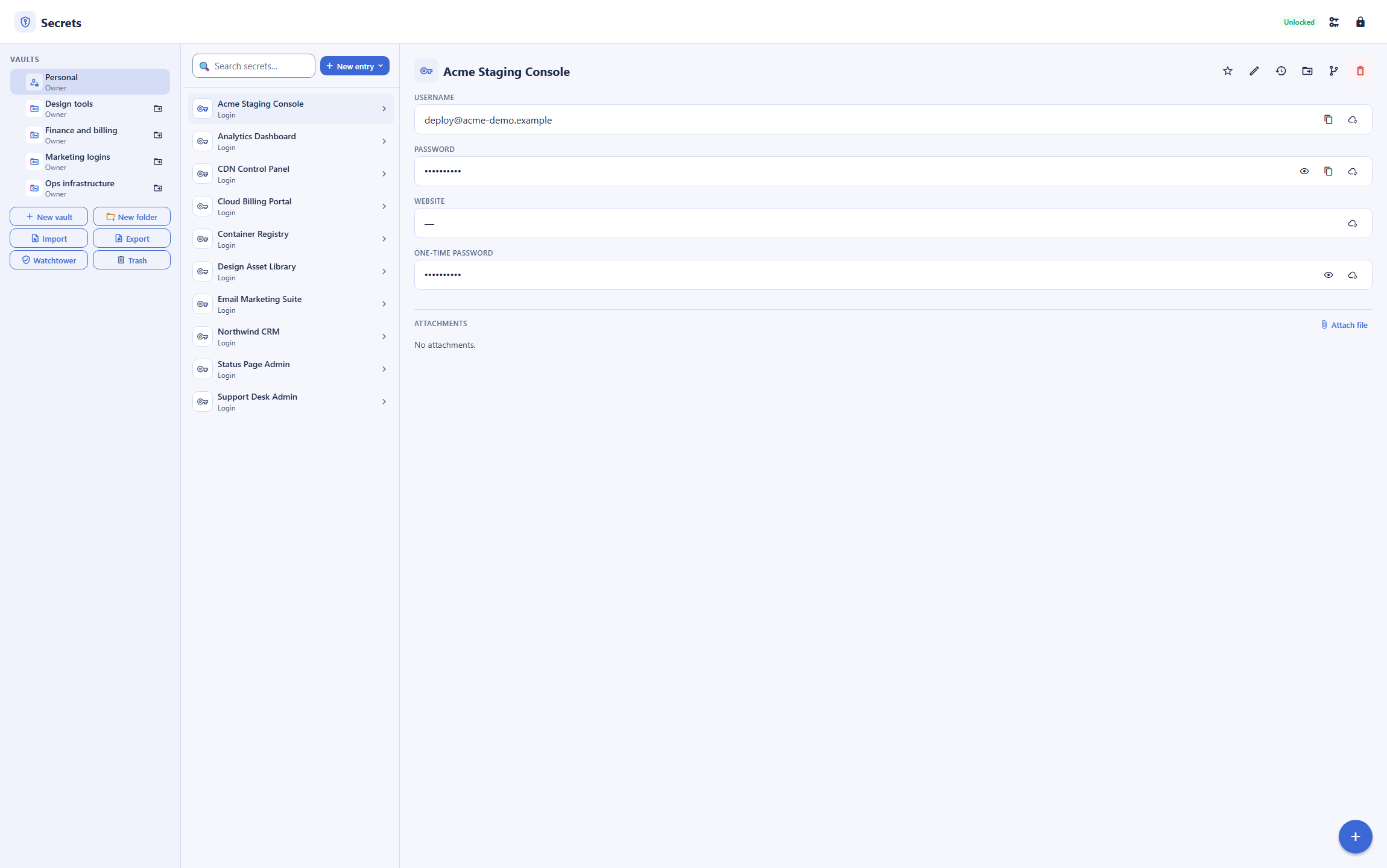
A displaced Dashlane free user who wants a free replacement
Most people searching for a Dashlane alternative right now lost the free plan when Dashlane retired it in September 2025, and they want to move a vault without starting to pay. Backbuild Secrets is free on every plan, zero-knowledge, post-quantum at rest, and includes TOTP and breach checks at no cost, and its dedicated Dashlane importer reads a CSV or JSON export and keeps the one-time-code secrets, secondary logins, cards, and identities. The counterweight is where you use it: Dashlane has mature mobile apps and autofill you can install today, plus dark web monitoring and a VPN, while the Backbuild mobile app and extension are still rolling out. If you live in a browser on a computer and want a free, post-quantum manager you can move to cleanly, Backbuild is a strong choice; if your passwords live on your phone and you rely on dark web monitoring, staying on a paid Dashlane plan is reasonable.
A small business team that needs governed sharing on a budget
A team sharing logins needs roles, an audit trail, single sign-on, and per-tenant isolation. Dashlane offers a strong business package, with patented Confidential single sign-on, SCIM for users and groups, an admin console, and encrypted activity logs, but those sit on its paid business tiers. Backbuild gives a team owner, manager, and member roles, single sign-on, SCIM user provisioning, a tamper-evident audit log, and per-organization isolation on every plan, free, and it sits in the same all-in-one workspace as the rest of the team tools. Dashlane offers deeper directory-group provisioning; Backbuild offers the core governance, including single sign-on, at no cost.
Security-conscious users who want post-quantum and zero-knowledge
For someone whose threat model includes harvest-now, decrypt-later, the question is what is post-quantum today. Dashlane encrypts vaults with AES-256 and derives keys with Argon2d, which is strong against classical attackers but not post-quantum. Backbuild Secrets wraps the vault key that protects your items with hybrid post-quantum cryptography (X25519 with ML-KEM-768) at rest, derives your keys with Argon2id on your device, and keeps private keys inside a sealed module. On key derivation the two are comparable, since both use a memory-hard Argon2 function, and on published transparency they are also similar: neither Dashlane nor Backbuild publishes independent third-party audit results, though both state they are built to recognized standards, and Dashlane carries a longer clean record.
Developers and AI automation that need machine secrets
Developers want to stop scattering secrets across .env files, and teams building AI automation want credentials their agents can use without leaking them. Dashlane is a manager for people and does not offer a developer or machine-secrets product, a public vault REST API, or Model Context Protocol tools. Backbuild Secrets drives the same zero-knowledge vault over a public REST API, native Model Context Protocol tools, and a CLI that injects secrets into a process at launch, and a machine reaches a vault through an owner-consented, environment-pinned, exact-scope grant. Beyond that, the AI-browser boundary lets an agent operate a site while the vault, not the model, fills the credential fields. This is a category Dashlane does not address.
All-in-one workspace seekers
For someone who would rather not run a separate app for passwords, Backbuild Secrets is part of one free workspace spanning Mail at your own domain, Chat, Meetings, Calendar, Contacts, real-time Docs, Sheets, Slides, Diagrams, and Photos, with dedicated photo, video, training video, audio, and music editors, Files, Backbuild Finances, and a built-in help desk, and it holds infrastructure secrets alongside human passwords. Dashlane is a focused password manager with consumer extras such as a VPN and dark web monitoring, but it is a standalone tool you add on top of your other apps.
How the two compare for each part of a buying decision
Everyday use on your phone and browser
The day-to-day experience turns on where the manager fills passwords and what it costs to use everywhere. Dashlane is the stronger daily driver on mobile today, with mature native iOS and Android apps, system autofill, and browser extensions on every major browser, and it is widely rated as having the most accurate autofill in the category. That reach and polish are the single most common reason people stay with Dashlane, and they are a genuine advantage. The offset is that Dashlane no longer has a free plan and no longer ships a native desktop app, so the desktop runs through the browser extension and web.
Backbuild Secrets runs in the web app and, unlike Dashlane, in a native Windows and macOS desktop app, with a browser extension and native mobile app rolling out to the stores. On a computer the vault is fully usable today; on a phone, autofill is not there yet. The offsetting draw is that it is free on every plan, zero-knowledge, and post-quantum at rest, and it includes TOTP and breach checks and a one-click Dashlane import. The bottom line is a split by device: a browser-and-desktop user gets a complete, free, post-quantum manager from Backbuild, while a phone-first user who leans on autofill and monitoring is better served by Dashlane until the Backbuild mobile client ships.
Rolling secrets out across a team
A team rollout is decided by shared access with control, the migration path, and the per-seat bill. On controls, Backbuild includes on every plan what Dashlane reserves for its business tiers: owner, manager, and member roles, single sign-on to unlock, SCIM user provisioning, a tamper-evident audit log, policy controls, and per-organization isolation, free. Dashlane puts roles, activity logs, Confidential single sign-on, and SCIM on its business plans, where it adds deeper directory-group provisioning that covers users and groups rather than users alone.
The counterweight is operational maturity and the extras a team gets. Dashlane has mature clients on every device, best-in-class autofill, an established admin console, dark web monitoring, and a long support history, and its business SCIM covers groups. Backbuild has a dedicated Dashlane importer that eases the switch, but it is newer, its mobile clients are not yet in the stores, and its SCIM covers users rather than groups. The bottom line: for a team that wants governance including single sign-on at no cost and a wider workspace, Backbuild is the stronger fit; for a team that wants proven clients on every device, dark web monitoring, best-in-class autofill, and SCIM group provisioning, Dashlane is the safer rollout today.
Security and compliance evaluation
A security review looks at the encryption model, key handling, transparency, tenant isolation, the audit trail, and how non-human identities get credentials. Both managers are zero-knowledge, so neither provider can read a vault, and both harden the master password with a memory-hard Argon2 function, so key derivation is comparable. They diverge on the cipher applied to stored data: Backbuild wraps the vault key with hybrid X25519 and ML-KEM-768, a post-quantum mechanism, while Dashlane uses AES-256, which is not post-quantum. On published transparency the two are similar: neither publishes independent third-party audit results, though both state they are built to recognized standards, and Dashlane carries the longer clean record.
Second, machine and agent access, where a modern review increasingly focuses. Backbuild adds governance around a machine token, an owner-consented, environment-pinned, exact-scope grant bound to one machine and one vault, and it adds a boundary a consumer manager does not: an AI agent driving the browser is architecturally barred from focusing or driving a credential field, so an automating model never reads a password. That machine grant decrypts on the calling machine, as any machine credential does. Dashlane has no machine-secrets surface and no AI-browser-control model. The bottom line: for post-quantum cryptography at rest, a machine-grant model, and an agent-safe credential boundary, Backbuild leads on the model; for a long transparent history and the deeper monitoring around the vault, Dashlane leads.
The economics for a finance buyer
The cost question is total spend across seats and time, and the risk of forced upgrades. Dashlane is one of the more expensive managers for its tier, with no free plan, Premium at about $4.99 a month, and Friends and Family at about $7.49 a month for ten people, and business plans from about $8 per user a month. Backbuild Secrets is free on every plan, including roles, single sign-on, SCIM, and audit, so the direct line-item cost of the vault is zero and governance carries no upgrade.
The larger economic point for a buyer is consolidation. Because Backbuild Secrets lives inside the same all-in-one workspace as the rest of a company's day-to-day tools, adopting it can retire several separate subscriptions rather than adding one, which changes the comparison from a password-manager line item to a workspace decision. The offsetting consideration is that Dashlane bundles consumer extras such as dark web monitoring and a VPN into its price, which some buyers value, and it carries a long vendor history that reads as lower switching risk. The bottom line: on the vault as a standalone line item Backbuild is free including single sign-on, while Dashlane is a paid subscription; on consolidation Backbuild can remove other subscriptions, while a buyer who wants the bundled monitoring and VPN and a proven vendor may still prefer Dashlane.
Strategic fit and vendor risk
At the sponsor level the decision is about direction and durable risk, not individual features. Dashlane offers a trusted, widely adopted vendor with a long record, mature mobile clients, best-in-class autofill, and a business offering with Confidential single sign-on, which is a low-friction choice for an organization that wants a well-known dedicated manager with consumer extras. Its trade-off is its scope and direction: it is a password manager with monitoring and a VPN, not a workspace, it retired its free plan and its native desktop app, and it does not address AI-agent or machine secrets.
Backbuild consolidates the password vault and the rest of an organization's core tools into one governed, post-quantum workspace, with AI-agent access built into the vault under a credential boundary and a public API for machines. The strategic upside is fewer vendors, forward-looking cryptography, and an AI-native posture; the strategic risk is that Backbuild is newer, not yet independently audited, and still shipping its mobile clients. The bottom line: an organization optimizing for a mature, well-known point tool with consumer extras leans Dashlane, while one consolidating vendors and prioritizing post-quantum and agent-safe secrets leans Backbuild.
Frequently asked questions
Is Dashlane still free?
No. Dashlane retired its free plan in September 2025, so new individuals start on a 14-day trial and then a paid plan, and former free users were moved to export-only access before deletion. Backbuild Secrets is a full password and secrets manager that is free on every Backbuild plan, including the Free plan, and it adds role-based access control, single sign-on, SCIM user provisioning, and a tamper-evident audit log at no cost. If a free replacement is the reason you are here, Backbuild Secrets is a direct answer, and it ships a dedicated importer that reads a Dashlane CSV or JSON export.
Is there a free alternative to Dashlane?
Yes. Backbuild Secrets is free on every plan, is zero-knowledge, and encrypts stored vault data with post-quantum cryptography, and it includes built-in TOTP, a password generator, and compromised, weak, and reused password checks at no cost. It reads a Dashlane export directly, keeping logins, one-time-password secrets, secondary logins, payment cards, and identities. The honest counterweight is where you use it: Dashlane has mature mobile apps with system autofill and a browser extension you can install today, while the Backbuild mobile app and browser extension are still rolling out, and Backbuild does not offer dark web monitoring or a bundled VPN.
How do I move my passwords from Dashlane to Backbuild Secrets?
Export your Dashlane vault as a CSV or JSON file, then import it into Backbuild Secrets. Backbuild detects a Dashlane export by its structure and reads both the CSV layout (credentials and secure notes) and the JSON layout, importing logins, one-time-password secrets, secondary logins kept as custom fields, secure notes, payment cards, and identities so nothing is dropped. Because the vault is zero-knowledge, the import and the encryption that follows happen on your device. It also imports from 1Password, Bitwarden, KeePass, LastPass, and browser CSV.
Does Backbuild Secrets have mobile apps, autofill, dark web monitoring, and a VPN like Dashlane?
This is where Dashlane leads. Dashlane has mature iOS and Android apps with system autofill, best-in-class autofill accuracy, browser extensions on every major browser, live dark web monitoring with breach alerts, a bundled VPN on its Premium plan, a password health dashboard, and passkeys you can sign in with. Backbuild Secrets runs in the web app and, unlike Dashlane, in a native Windows and macOS desktop app; the Backbuild browser extension that adds autofill is rolling out to the stores and the native mobile app is in development. Backbuild has compromised, weak, and reused password checks but not a live dark web monitoring service, and it has no bundled VPN. If autofill on your phone, dark web monitoring, or a VPN is your first requirement, Dashlane is the stronger choice right now.
Is Backbuild Secrets encryption stronger than Dashlane encryption?
Both are zero-knowledge, so neither provider can read a vault, and both harden the master password with a memory-hard key-derivation function: Backbuild uses Argon2id and Dashlane uses Argon2d, so on key derivation the two are comparable. The genuine difference is post-quantum protection of stored data. Backbuild wraps the vault key that protects your items with X25519 combined with ML-KEM-768, the mechanism standardized by NIST as FIPS 203, so ciphertext harvested today cannot be opened by a future quantum computer. Dashlane encrypts vaults with AES-256, which is strong against classical attackers but is not post-quantum. On published transparency the two are similar: neither Dashlane nor Backbuild publishes independent third-party audit results, though both state they are built to meet recognized security standards.
Can an AI agent use Backbuild Secrets without seeing my passwords?
Yes, and this is the categorical difference from a manager built only for people. The Backbuild browser extension gives an AI agent full control of the page, but the extension and the server both refuse to let the agent focus or drive any password or one-time-code field. When a login needs a credential, the zero-knowledge vault fills it directly, so the value is placed in the field without ever passing through the AI. Dashlane has no AI-browser-control surface, so this class of workflow is not part of its model. For machine and service secrets, a Backbuild machine grant is bound to one machine, one vault, and an exact scope, requires owner consent with a step-up, and is pinned to an environment, and that grant decrypts on the calling machine.
How do Dashlane and Backbuild compare on business governance?
Dashlane has a strong business offering: patented Confidential single sign-on that keeps the model zero-knowledge, SCIM provisioning for users and groups, an admin console, and encrypted activity logs, all on its business tiers. Backbuild includes role-based access control, single sign-on, SCIM user provisioning, a tamper-evident audit log, policy controls, and per-organization isolation free on every plan, including the Free plan, though its SCIM covers users rather than users and groups. The split is breadth against price: Dashlane offers deeper directory-group provisioning on a paid business plan, and Backbuild gives the core governance controls, including single sign-on, at no cost inside a wider workspace.
Try Backbuild Secrets free
A zero-knowledge, post-quantum password and secrets manager with vaults, role-based sharing, single sign-on, SCIM, and an audit log free on every plan, a full item set, TOTP, a generator, breach checks, a dedicated one-click importer for a Dashlane export, a native desktop app, a public REST API, native Model Context Protocol tools, and an AI agent that can drive the browser but never touch a credential field, inside an all-in-one workspace. If your first requirement is best-in-class autofill, mature native mobile apps, live dark web monitoring, a bundled VPN, a password health dashboard, passkeys as a working authenticator, or a long track record, Dashlane is the stronger choice right now.
Get started with Backbuild Secrets