

Adobe Lightroom alternative: Backbuild Photos vs Adobe Lightroom
Adobe Lightroom is a specialized professional RAW develop and catalog application in Adobe's Creative Cloud, and on the Backbuild side that job is answered by Backbuild Photos, the photo library and non-destructive layer editor in the free Backbuild workspace, with governed sharing, images that drop straight into documents and slides, a public REST API, and a privacy-first storage pipeline riding along. Adobe Lightroom leads decisively on a dedicated RAW develop engine, AI Denoise, its preset and camera-profile ecosystem, catalog organization, and cross-device cloud sync.
The short answer
Adobe Lightroom is a specialized professional RAW develop and catalog application in Adobe's Creative Cloud, and Backbuild Photos is the photo app inside the Backbuild workspace, alongside Mail, Calendar, Docs, Sheets, Slides, and Files, with a non-destructive layer editor, governed sharing, and a public REST API riding along. Choose Adobe Lightroom if your work is developing camera RAW: it has a dedicated develop engine with per-camera profiles, AI Denoise, a deep preset and camera-profile ecosystem, a full catalog with keywords, ratings, and Smart Collections, advanced AI masking, and cross-device cloud sync with mature native mobile apps, none of which Backbuild Photos matches. Choose Backbuild Photos if you manage, lightly edit, and share images inside your work and want a non-destructive, layer-based editor, governed sharing with roles and audit logging, images that drop straight into your documents and slides, a REST API over the whole library, and a data stance where your stored pictures are not scanned and their location is stripped on upload, inside a free all-in-one workspace.
Backbuild Photos vs Adobe Lightroom: feature by feature
Adobe Lightroom is subscription only, from about 11.99 US dollars a month for the Lightroom plan with 1 TB, with a Photography plan that adds Photoshop and Lightroom Classic. Prices and plan gating below are quoted from Adobe's own product and pricing pages and dated coverage, observed 2026-07-18. The highlighted column is Backbuild Photos.
| Backbuild Photos A photo library and layer editor in the free workspace Free on every plan; file-storage allowance plus credits, wider workspace from $19/seat Get Started Free | Adobe Lightroom A professional RAW develop and catalog app in Creative Cloud Subscription only; Lightroom plan 1 TB about $11.99/mo, Photography plan with Photoshop about $10.99/mo, rising March 2026 | |
|---|---|---|
| Plans and price | ||
| Free plan | Limited free mobile tier only | |
| Use without a subscription | Subscription only since 2015 | |
| Low-cost bulk cloud storage for a large library | Metered in credits | 1 TB included, more via plan |
| Camera RAW and develop | ||
| Opens and develops camera RAW (exposure, temperature, highlights, shadows) | ||
| Dedicated RAW develop engine with per-camera color profiles | ||
| Deconvolution detail sharpening and a lens-correction profile database | ||
| AI Denoise | ||
| Preset and camera-profile ecosystem with a third-party market | ||
| Library and organization | ||
| Upload from a computer, with full-resolution download | ||
| Albums or Collections | ||
| Keywords, star ratings, flags, color labels, and custom metadata | ||
| Smart Collections that update by rule | ||
| Ken Burns motion slideshow | Slideshow module | |
| Perceptual-hash duplicate finder and batch processor | Third-party plug-in | |
| The image editor | ||
| Crop, tone, and color adjustments | ||
| Layer stack with groups, masks, and blend modes | In Photoshop, bundled separately | |
| Selection engine (marquee, lasso, magic wand, subject select, background removal) | Masking, not layer selections | |
| Healing brush and content-aware fill | ||
| Curves, channels, color balance, and selective color | Tone curve and color mixer | |
| Non-destructive edits with a version history | ||
| AI and masking | ||
| Generate an image from a text prompt | ||
| Generative fill inside the editor | Generative Remove | |
| Advanced AI masking (people, sky, subject, objects, seven-element people masks) | ||
| AI Lens Blur with a depth map | ||
| AI runs only on the request you make, not over your stored library | Sensei models index the library | |
| Search and intelligence | ||
| Search by file name and camera details | ||
| Machine-learning search by content (places, objects, subjects) | ||
| Sharing and governance | ||
| Shareable link or shared album | ||
| Expiring and revocable public link | Remove access | |
| Eight granular share scopes (person, role, group, department, project, organization, everyone signed in, public link) | ||
| Role-based access control and audit logging on every plan | Free, every plan | Adobe enterprise admin, paid |
| Single sign-on and SCIM provisioning | Free, every plan | Adobe enterprise, paid |
| Per-organization data isolation | Adobe enterprise, paid | |
| API, agents, and automation | ||
| Public REST API across the whole photo library (upload, albums, slideshows, shares, generate) | Narrow partner services API | |
| Drivable by an AI agent over the platform's tool surface | ||
| AI assistant included on every plan, bring your own model | Firefly and Sensei, bundled | |
| Privacy and data | ||
| Location metadata stripped on upload | ||
| No passive machine-learning analysis of your stored library | Sensei content models | |
| Immutable, content-addressed originals | Originals preserved | |
| No advertising use of your data | Stated in Adobe policy | |
| Clients and cross-device sync | ||
| Web app | ||
| Desktop app (Windows, macOS) | ||
| Native mobile apps (iOS, Android) Soon | Built; store rollout in progress | |
| Cross-device cloud sync of originals and edits | ||
| Offline editing on mobile | ||
| Photography workflow modules | ||
| Import RAW from a folder into a managed catalog | ||
| Map, Book, Print, and Web modules | ||
| Tethered capture | ||
| HDR, Panorama, and HDR Panorama merge | ||
| Virtual Copies and Soft Proofing | ||
| Workspace apps around Photos | ||
| Photos app (Adobe's offering: Adobe Lightroom) | Backbuild Photos | Adobe Lightroom |
| Non-destructive layer editor with selections and compositing | ||
| Eight granular share scopes with role-based access and audit | ||
| Insert photos directly into documents and slides | ||
| Public REST API and AI agent control across the library | ||
| RAW develop engine, AI Denoise, presets, and camera profiles | ||
| Catalog with keywords, ratings, and Smart Collections | ||
| Cross-device cloud sync and mature native mobile apps | ||
| Mail at your own domain (Backbuild Mail) | ||
| Documents, spreadsheets, and slides (Backbuild Docs, Sheets, Slides) | ||
| Calendar and contacts (Backbuild Calendar) | ||
| Cloud file storage (Backbuild Files) | ||
| Team chat and video meetings Soon | On the roadmap | |
| Diagrams Soon | On the roadmap | |
| Training-video editor (Backbuild Studio screen-demo videos from a script) | ||
| Video, audio, and music editors Soon | Authoring preview | |
| Double-entry accounting and invoicing (Backbuild Finances) | ||
| Built-in help desk (tickets, workflow states, assignment) | 20 tickets/mo Free; unlimited paid | |
| Zero-knowledge post-quantum secrets vault | ||
A cross means the product does not offer the feature today. Soon means the feature is on the Backbuild roadmap and not shipped yet. Adobe Lightroom prices and feature availability are quoted from Adobe's Photography plans page, the Adobe Lightroom product page, and the linked Adobe help articles, observed 2026-07-18. In the workspace apps group, the Photos row names each product, the indented rows beneath list the features that differ in both directions, and a cross marks a workspace app Adobe's Photography plan does not include.
Where Adobe Lightroom leads decisively
Adobe Lightroom is a specialized professional tool, and on the jobs it was built for it is excellent and ahead of Backbuild Photos. These are not close calls, and a professional photographer who switches gives up real, specialized capability.
A professional RAW develop engine
Adobe Lightroom develops camera RAW with per-camera color profiles, deconvolution detail sharpening, a lens-correction profile database, and AI Denoise that reconstructs noise with a trained model. Backbuild Photos opens and develops RAW in its editor, but it is not a dedicated develop engine of this depth. For RAW work, Adobe Lightroom leads outright.
Catalog and library organization
Lightroom Classic manages a large library with keywords, star ratings, flags, and color labels, and Collections and rule-based Smart Collections. Backbuild Photos organizes into albums and searches file names and camera details. For cataloging a large or archival collection, Adobe Lightroom leads.
Presets, profiles, and advanced masking
Adobe Lightroom has a deep preset and camera-profile ecosystem with a large third-party market, plus advanced AI masking including seven-element people masks and AI Lens Blur. Backbuild Photos ships subject select and background removal, but not this masking maturity or a preset market.
Cross-device cloud sync and mobile
Adobe Lightroom syncs originals and edits across desktop, mobile, and web, with mature native iOS and Android apps and offline editing. Backbuild Photos uploads from a computer, its native mobile app is still rolling out to the stores, and it does not sync a develop state across devices. For a device-fluid photographer, Adobe Lightroom leads.
What happens to a photo when you upload it
One of the clearest differences between the two products is what each does with the image after it lands. In Backbuild Photos the upload path is fail-closed on privacy: before an image is stored, its EXIF, XMP, and IPTC metadata is scrubbed, GPS coordinates and other location fields are removed, and a file whose metadata cannot be scrubbed is rejected rather than stored with location intact. The safe details, such as dimensions and capture time, are kept for display and search. The stored original is then content-addressed and immutable, and every later edit produces a new render above it rather than overwriting it. Nothing scans, indexes, or profiles the library in the background. Adobe Lightroom keeps the file with its metadata, including the GPS location its Map module and search rely on, and runs Adobe Sensei models over the library to index content for search. Adobe states in its privacy policy that it does not use this content for advertising, a real commitment, but the analysis is intrinsic to how the product finds your pictures.
Adobe states it does not use your Lightroom content for advertising; the analysis is how the product searches and organizes your pictures. Backbuild Photos trades that intelligence for a library that is stored, not scanned.
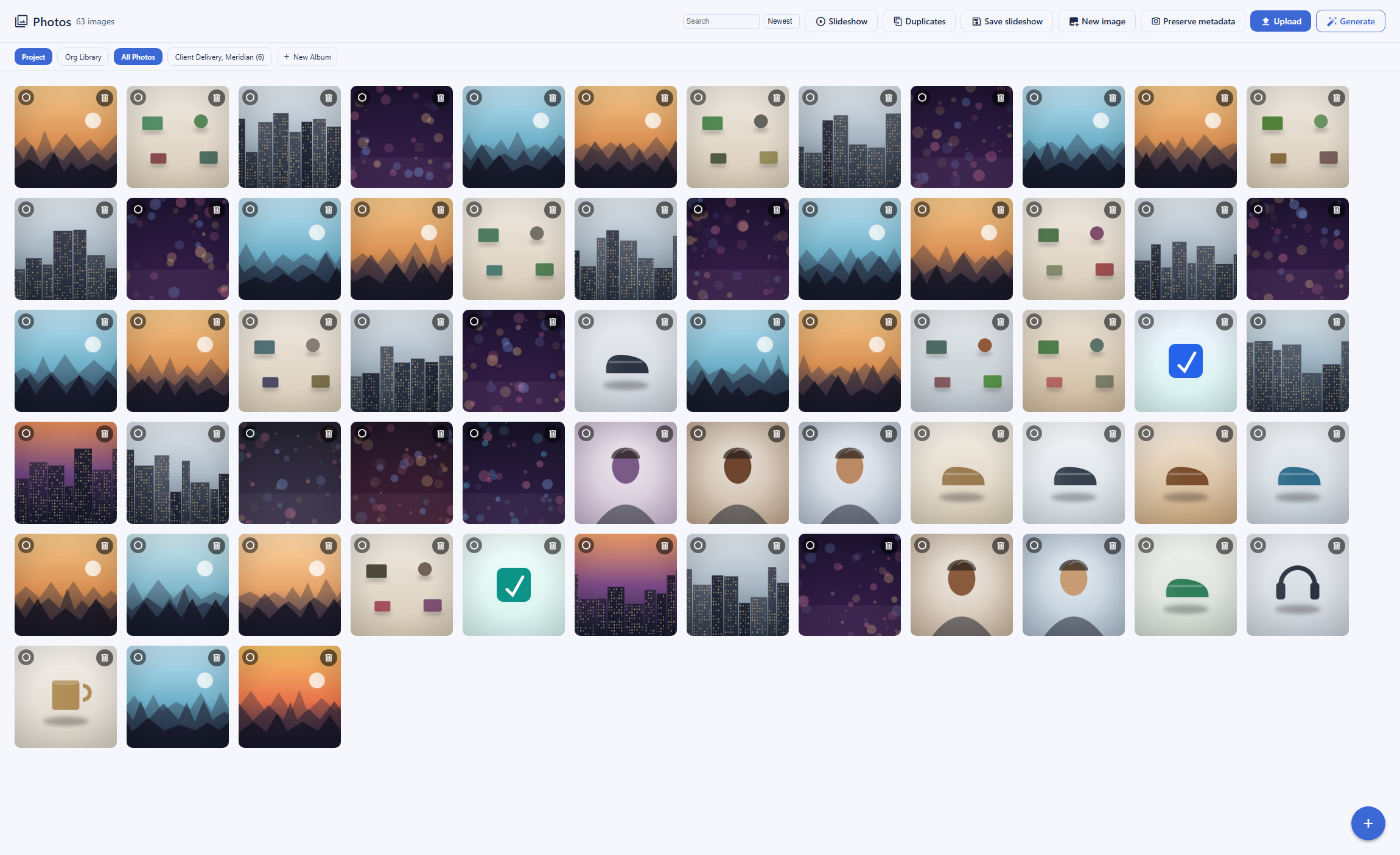
A layer editor, where Lightroom has develop and catalog
The two products answer different halves of image work. Adobe Lightroom is a develop-and-catalog tool: it is superb at RAW tone and color and at organizing a library, and it is deliberately not a layer-based compositor. Adobe answers layers by bundling Photoshop in the Photography plan, a separate application you round-trip the file into. Backbuild Photos includes a non-destructive, layer-based editor inside the same tool that stores the image: a layer stack with groups, masks, and blend modes; a selection engine with marquee, lasso, magic wand, one-click subject select, and background removal; retouching with a healing brush and content-aware fill; curves, channels, color balance, and selective color; and a develop panel that opens and develops camera RAW. Every change lives above the untouched original, and saving records a version lineage you can branch from. So a photo is composited and retouched in the same place it lives, rather than exported to a second application and re-imported.
Governed photo sharing across eight scopes
Adobe Lightroom sharing is a shared album or a public web gallery, and its role-based administration lives in a paid Adobe enterprise plan rather than in the consumer product. Backbuild Photos shares with the same access model as the rest of the workspace: a photo can be granted to a specific person, a role, a group, a department, a project, the whole organization, everyone signed in, or a public link that you can set to expire and revoke, and the person re-sharing can never grant more than they hold, bounded by the organization's sharing ceiling. Read access confers viewing and copying, write access confers re-sharing, every image is delivered through an authorized, streamed URL rather than a public bucket path, and every grant is recorded in a tamper-evident audit log on every plan. This is the model a team storing brand and product images actually needs.
Common Adobe Lightroom frustrations and how Backbuild Photos addresses them
Subscription only, with rising prices
Adobe ended perpetual Lightroom licenses after 2015, and photographers regularly complain about the subscription and its price increases, with the Photography plan raised again through 2025 and 2026. Backbuild Photos is part of a free workspace, with storage beyond the free allowance metered in credits and no separate photo-app subscription.
Layers mean a second application
Adobe Lightroom has no layer stack or compositing, so layer work means round-tripping into Photoshop. Backbuild Photos gives you a layer-based editor with masks, selections, retouching, and compositing inside the same tool that stores the image.
Your library scanned for content search
Adobe Lightroom runs Adobe Sensei models over your library to index content and keeps location metadata. Backbuild Photos does no passive machine-learning analysis of your stored library and strips location on upload, so your pictures are held, not scanned.
Photos siloed away from your work
Adobe Lightroom is a standalone photo tool. Backbuild Photos is part of the workspace, so you insert a project's images straight into a document or a slide from a picker, with no export and re-import, and the whole library is drivable over the REST API.
Which tool wins, by use case
Professional RAW photography workflows
For a wedding, portrait, event, or commercial photographer culling and developing thousands of RAW frames, Adobe Lightroom is the right tool and Backbuild Photos is not a replacement. Adobe Lightroom has a dedicated develop engine with per-camera profiles, AI Denoise, a deep preset ecosystem for batch-consistent looks, and a catalog with keywords, ratings, and Smart Collections for managing large shoots. Backbuild Photos opens and develops RAW in its editor, but it does not match that develop depth, its preset market, or its catalog. A professional switching for RAW work gives up real, specialized capability.
A private photo library leaving a cloud photo service
People who want a library that is stored rather than analyzed are a genuine fit for Backbuild Photos. It does no passive machine-learning analysis of your stored library, strips location metadata on upload, keeps your originals immutable, and isolates storage per organization, inside a workspace you control at your own domain. Adobe Lightroom, by design, indexes your library with Adobe Sensei and retains location metadata, and Adobe states in its privacy policy that it does not use that content for advertising. The trade is that Backbuild Photos does not develop RAW at Lightroom depth or sync across devices.
Editing images with layers
For work that needs layers, masks, selections, and compositing rather than RAW develop, Backbuild Photos does it in one place. It is a non-destructive, layer-based editor with a layer stack, groups, masks, blend modes, a selection engine, retouching, and color grading, with a version lineage on every save. Adobe Lightroom itself has no layer stack; Adobe answers layers by bundling Photoshop, a separate application you round-trip the file into. The counterweight is that for RAW develop and cataloging the file, Adobe Lightroom remains the stronger front end.
Teams managing brand and marketing image assets
A marketing or creative team storing logos, product shots, and campaign images needs controlled sharing and images that sit next to its work, not a personal RAW catalog. Backbuild Photos gives them a project library with albums, a layer editor, and full-resolution download, shared with eight granular scopes, expiring links, role-based access control, and audit logging on every plan, images that drop straight into the team's docs and slides, and a REST API to wire the library into other systems. Adobe Lightroom has no in-product roles or audit trail, and its governed administration is a paid Adobe enterprise plan.
An all-in-one workspace
For someone who wants their images next to their mail, documents, sheets, and calendar rather than in a standalone photo application, Backbuild Photos is part of one free workspace spanning Mail at your own domain, Chat, Meetings, Calendar, Contacts, real-time Docs, Sheets, and Slides, and Diagrams, with dedicated photo, video, training video, audio, and music editors, Files, Backbuild Finances, a built-in help desk, and a secrets vault, and its photos insert straight into those documents and slides. Adobe Lightroom is one app in Creative Cloud; the rest of the everyday workspace is a separate set of products and subscriptions.
The daily editing experience
A photographer evaluating these two products for daily use is comparing two different loops. For a RAW loop, importing, developing, culling, and exporting, Adobe Lightroom is clearly ahead: a dedicated develop engine with per-camera profiles, AI Denoise, and a preset ecosystem make batch-consistent develop fast, and its catalog keeps thousands of frames organized. Backbuild Photos opens and develops RAW but does not match that engine or the catalog, so a RAW-heavy day belongs to Adobe Lightroom.
For a compositing and retouching loop, the order reverses. Backbuild Photos is a layer-based editor with masks, selections, a healing brush, content-aware fill, and generative fill in one place, where Adobe Lightroom has no layers and hands that work to Photoshop. The daily bottom line: Adobe Lightroom owns RAW develop and organization, Backbuild Photos owns in-place layer editing, and which one wins a given photographer's day depends on whether the work is mostly developing and cataloging RAW frames or compositing and sharing finished images.
Rolling it out across a creative team
The person who standardizes a team on an image tool answers for shared access, control, and where the images live relative to the rest of the work. On shared access, Backbuild Photos gives a team eight granular share scopes, expiring links, and re-sharing bounded by the organization's sharing ceiling, where Adobe Lightroom offers shared albums and web galleries without in-product roles. On control and evidence, Backbuild Photos records every grant in a tamper-evident audit log and isolates each organization's library, free on every plan, and the whole library is reachable over the REST API for inventory and automation, where Adobe Lightroom governed administration begins at a paid enterprise plan.
The Adobe path has real advantages the rollout owner should weigh. A team of working photographers already knows Adobe Lightroom, its RAW develop and catalog are unmatched, and Adobe enterprise licensing brings a mature admin console and single sign-on for organizations that buy it. The rollout bottom line: for a team that wants governed image storage, in-place layer editing, and API access inside its everyday workspace without a per-seat photo subscription, Backbuild Photos does the structural work on every plan; for a team whose core job is developing and cataloging RAW at professional depth, Adobe Lightroom is the tool the workflow is built on.
Security, identity, and data governance evaluation
A security review of an image platform turns on identity controls, isolation, evidence, and what the vendor does with the pictures. On identity, Backbuild ships single sign-on and SCIM user provisioning on every plan, including Free, where Adobe gates single sign-on, admin controls, and enterprise management to a paid Adobe plan, and a consumer Adobe Lightroom subscription has no organization administration. On isolation and evidence, every photo read and write is authorized against organization-scoped roles, each organization's library is isolated, and every share is recorded in a tamper-evident audit log, free on every plan. Adobe enterprise admin tooling is capable but lives in a paid plan, and consumer Adobe Lightroom sharing has no audit trail.
On what the vendor does with the pictures, the two land in different places. Backbuild Photos strips GPS and location metadata on upload, rejecting a file it cannot scrub, keeps immutable originals, and runs no passive machine-learning analysis over the stored library, with a zero-knowledge post-quantum secrets vault in the same workspace for the credentials that sit alongside image work. Adobe states in its privacy policy that it does not use your content for advertising, a genuine commitment, but the product retains location metadata and its search depends on Adobe Sensei models running over your library. One caveat cuts the other way: Backbuild is built to the common frameworks but is not yet third-party audited, where Adobe carries a long record of external attestations. A reviewer who must present vendor certificates today leans Adobe; a reviewer who wants location stripped, no library analysis, and least-privilege access with attribution on every plan leans Backbuild.
The economics for a finance and procurement review
The cost comparison has three parts: what the tool costs, what forces an upgrade, and what the choice displaces. On software cost, Backbuild Photos is free on every plan with storage beyond the allowance metered in credits, where Adobe Lightroom is subscription only, from about 11.99 US dollars a month per user, with prices raised again in recent plan updates. On governance cost, the moment an organization needs single sign-on, roles, and an audit trail over its images, Adobe requires a paid enterprise plan, while Backbuild Photos includes that whole surface free.
On displacement, Backbuild Photos folds the layer editor, governed sharing, the REST API, and the wider workspace, including accounting and invoicing and a secrets manager, into one free plan, where a comparable governed setup in the Adobe world is a per-seat subscription per photographer plus enterprise licensing. Procurement can price the difference concretely: for professional RAW develop and cataloging, Adobe Lightroom is the necessary tool and its subscription is the cost of the capability; for governed image storage with in-place editing and an API, Backbuild Photos removes a per-seat photo subscription, trading away the RAW develop engine and a few not-yet-shipped conveniences for it.
Strategic fit and vendor considerations
The strategic question is which platform bet each product represents. Adobe Lightroom is one app in Adobe's Creative Cloud, a mature, dominant ecosystem whose depth is the asset: the develop engine and AI tools are best in class, the preset and profile market is large, and the professional photographer base is deep. An organization or person whose priority is developing and organizing RAW at the highest level is squarely in Adobe's center of gravity. Backbuild Photos is one surface in a younger workspace platform whose bet is consolidation, in-place editing, and programmability: a photo library, a layer editor, mail, calendar, docs, sheets, slides, files, accounting, a help desk, and a secrets vault in one subscription, at your own domain, with a public REST API and bring-your-own-AI automation across every surface, and governance on every plan.
Lock-in and continuity run differently on each side. Adobe's develop settings are portable as sidecar and catalog data, though a lifetime of edits is bound to the Adobe develop model, and its subscription is the ongoing condition of access. Backbuild's bet is younger: several surfaces, including native mobile distribution and cross-device sync, are on the roadmap, and third-party audits are not yet in hand, but its immutable, content-addressed originals and full-resolution export over the app and the API keep your files portable. An organization betting on consolidation, in-place creative work, and governed image assets at its own domain is betting with Backbuild's roadmap; a photographer betting on the deepest, most established RAW develop and catalog is betting with Adobe.
Frequently asked questions
Is there a free alternative to Adobe Lightroom?
Yes, with an honest boundary. Backbuild Photos is the photo library and image editor in the free Backbuild workspace, included on every plan alongside Mail at your own domain, Chat, Meetings, Calendar, Contacts, Docs, Sheets, Slides, and Diagrams, with dedicated photo, video, training video, audio, and music editors, Files, Backbuild Finances, and a built-in help desk. It gives you a non-destructive, layer-based editor, governed sharing, and a REST API at no cost. It does not match Adobe Lightroom on a dedicated professional RAW develop engine, AI Denoise, the preset and camera-profile ecosystem, catalog organization, or cross-device cloud sync. If you develop RAW files professionally, Adobe Lightroom is the specialized tool for that job, and Backbuild Photos does not replace it. If you manage, lightly edit, and share images inside your work, Backbuild Photos is a strong free option.
Can Backbuild Photos develop RAW files like Adobe Lightroom?
Partly, and it is important to be precise. The Backbuild Photos editor opens and decodes camera RAW and includes a develop panel for exposure, temperature, highlights, and shadows, so you can develop a RAW file inside the editor. It is not a dedicated RAW develop engine on the level of Adobe Lightroom. Adobe Lightroom ships per-camera color profiles, deconvolution detail sharpening, a lens-correction profile database, and AI Denoise that reconstructs noise with a trained model. Backbuild Photos has none of those. For a photographer whose work is developing thousands of RAW frames with profile-accurate color and the best available noise reduction, Adobe Lightroom is the correct tool and leads decisively.
Does Backbuild Photos have a catalog, keywords, ratings, and collections like Lightroom Classic?
No. Backbuild Photos organizes images into albums inside a project, and it searches file names and camera details. Lightroom Classic has a full catalog with keywording, star ratings, pick and reject flags, color labels, custom metadata, Collections, Collection Sets, and Smart Collections that update by rule. That library depth is a genuine Adobe Lightroom strength, and Backbuild Photos does not match it today. Backbuild Photos is built for managing and sharing a working image library inside a workspace, not for cataloging a large personal or archival photo collection.
Is Backbuild Photos cheaper than Adobe Lightroom?
For the cost of the software, yes. Backbuild Photos is part of a free workspace, with storage beyond the free allowance metered in usage credits. Adobe Lightroom is subscription only, from about 11.99 US dollars a month for the Lightroom plan with 1 TB and about 10.99 US dollars a month for the Photography plan that adds Photoshop and Lightroom Classic, with prices rising in March 2026. Adobe ended perpetual Lightroom licenses after 2015, and its price increases are a common complaint. That said, price is not the reason to choose one tool over the other. A professional who needs Adobe Lightroom RAW develop and catalog depth needs Adobe Lightroom regardless of cost. Backbuild Photos earns its place on the layer editor, governed sharing, the workspace, the REST API, and the privacy stance.
Can I edit photos with layers in Backbuild Photos, and can Lightroom do that?
Yes, and this is a real difference. Backbuild Photos includes a non-destructive, layer-based editor with a layer stack, groups, masks, blend modes, selections including subject select and background removal, a healing brush and content-aware fill, curves, channels, color balance, and selective color. Adobe Lightroom itself is a develop-and-catalog tool and does not have a layer stack or compositing. Adobe answers layers by bundling Photoshop in the Photography plan, which is a separate application. So for layer-based editing in one place, Backbuild Photos does it inside the same tool that stores the image, while the Adobe path is to round-trip the file into Photoshop.
What happens to my photos and their location data when I upload to Backbuild Photos?
Backbuild Photos strips location metadata on upload. Before an image is stored, its metadata is scrubbed, GPS and other location fields are removed, and a file whose metadata cannot be scrubbed is rejected rather than stored with location intact. The safe details, such as dimensions and capture time, are kept for display and search. The stored original is content addressed and immutable, and edits create new renders above it. Nothing scans, indexes, or profiles the stored library in the background. Adobe Lightroom, by design, keeps location metadata (its Map module uses it) and runs Adobe Sensei models over your library to power content search, which is a convenience Backbuild Photos deliberately does not provide.
Try Backbuild Photos free
A photo library, albums and slideshows, and a non-destructive, layer-based editor, inside a free all-in-one workspace, with governed sharing, a public REST API, images that drop straight into your documents and slides, and a data stance where your stored library is not scanned and its location is stripped on upload. If your work is developing camera RAW at professional depth, with a catalog, presets, and cross-device sync, Adobe Lightroom is the specialized tool for that job.
Get started with Backbuild Photos