

OpenAI Operator alternative: Backbuild Virtual Workers vs ChatGPT Agent
Backbuild Virtual Workers are autonomous AI workers that operate a real computer inside your organization: a full Linux desktop, a browser, and a terminal a worker drives to do work, using credentials from an encrypted vault the model never sees in plaintext, on isolated containers metered by usage credits. OpenAI Operator, whose computer-using capability now ships inside ChatGPT Agent, runs a real browser in a cloud virtual machine on OpenAI frontier models, and it leads today on model quality, the ChatGPT ecosystem, and independent enterprise compliance attestations.
The short answer
OpenAI Operator was a computer-using agent that operated a browser in a cloud virtual machine; OpenAI retired the standalone Operator preview in August 2025 and now delivers the same capability inside ChatGPT Agent, its agent mode bundled into paid ChatGPT tiers. On the Backbuild side that job is done by Backbuild Virtual Workers, an autonomous AI worker that operates a full Linux desktop, a browser, and a terminal on an isolated container, using grant-based credentials from an encrypted vault the model never reads in plaintext, running its work as governed finite-state-machine skills and scheduled or event-triggered automations, on usage credits inside the all-in-one Backbuild workspace with the public REST API and native Model Context Protocol tools.
Choose OpenAI Operator, now ChatGPT Agent if you want a frontier-model agent inside ChatGPT to operate a browser, run deep research, and generate editable reports, slides, and sheets, with independent enterprise compliance attestations. Choose Backbuild Virtual Workers if you want an autonomous worker that operates real systems on a full desktop and terminal under credentials your organization governs, with the AI model of your choice, and roles and audit on every plan, free to start. Both agents operate a real browser, so that capability does not separate them; the difference is a full desktop and terminal instead of a browser, grant-based credential governance, model choice instead of OpenAI lock-in, governance present on every plan, and a surrounding workspace.
Backbuild Virtual Workers vs ChatGPT Agent: feature by feature
OpenAI prices, plans, and capabilities below are from OpenAI pages and dated third-party coverage, observed 2026-07-19 and subject to change, since the Operator to ChatGPT Agent product line moves quickly. The highlighted column is Backbuild Virtual Workers.
| Backbuild Virtual Workers Autonomous AI workers that operate a real desktop, browser, and terminal under a governed vault On every plan, including Free. No separate per-worker subscription: worker work draws on one universal usage-credit pool as it runs, larger containers draw more, and idle time is not metered. Get Started Free | OpenAI Operator, now ChatGPT Agent A frontier-model computer-using agent that operates a browser in a cloud virtual machine, inside ChatGPT Agent mode is a paid ChatGPT feature, not on the free plan: Plus about $20/mo, Pro about $200/mo, Business about $25/seat/mo, Enterprise about $60/seat/mo on a seat minimum. Agent-mode message caps apply on some tiers. Locked to OpenAI models. | |
|---|---|---|
| Price and cost model | ||
| Free plan with the autonomous agent | Agent mode is paid only | |
| Metering model | One usage-credit pool, idle free | Per-seat subscription, agent message caps |
| Bring your own AI provider and model | OpenAI models only | |
| The computer the agent operates | ||
| Runs long multi-step tasks in the cloud | ||
| Drives a real browser (logs in, fills forms, no-API sites) | ||
| Terminal and code execution | Full terminal, Linux tool suite | Text terminal added |
| Full graphical Linux desktop with a live viewer you can take over | Cloud browser, not a full desktop | |
| Operates installed desktop applications, not only a browser | Browser-oriented | |
| Built-in deep research mode | Research via the worker and workspace | |
| Built-in one-step deliverable generators (reports, slides, sheets) | Workspace apps authored over MCP | |
| Frontier first-party model | Bring your own, including frontier | OpenAI frontier models |
| Building and directing agents | ||
| Governed finite-state-machine skills (deterministic, auditable execution) | Free-form agent planning | |
| Computer-using agent available to developers over an API or SDK | Full platform REST API and MCP | Computer-use tool in the Agents SDK |
| Driven by any standard Model Context Protocol client | MCP connectors | |
| Prebuilt connector library over mainstream apps | API, MCP, and connectors | Gmail, Drive, GitHub, more |
| Template and task gallery for a fast start | Skills and prompts | |
| Triggers and automation | ||
| On-demand and manual runs | ||
| Scheduled runs | Scheduled tasks | |
| Event-triggered runs (dispatch a worker, skill, or script) | Scheduled tasks only | |
| Fully container-backed unattended background runtime Soon | Rolling out per organization | Cloud task runs |
| Security and governance | ||
| Credentials in an encrypted, zero-knowledge vault the model cannot read | Takeover mode and live connectors | |
| Unattended credential use, single-use references, never plaintext to the model | A person types each login | |
| Session acts under a scoped, revocable delegated token | Not documented | |
| Default-deny capability gate on worker code | Not documented | |
| Non-overridable approval floor on irreversible actions | Confirmation before consequential actions | |
| Per-organization roles and tamper-evident audit on every plan | Every plan | Admin and audit on Business and Enterprise |
| Single sign-on and SCIM 2.0 provisioning | SSO and SCIM 2.0, every plan | SSO and SCIM on Enterprise |
| SOC 2 Type II and independent compliance attestations | Built to standard, not yet audited | |
| Post-quantum encrypted operation stream | Not offered | |
| Platform, API, and trust | ||
| Public REST API over the whole platform on every plan | Computer-use model tool, not a platform API | |
| Native Model Context Protocol tools over the agent surface | MCP connectors | |
| Established track record and large user base | Newer, not yet audited | |
| Workspace apps the worker operates within | ||
| Reads via a connector, not a mailbox | ||
| Chat Soon | Backbuild Chat rolling out | Not a workspace |
| Meetings Soon | Backbuild Meetings rolling out | Not a workspace |
| Calendar | Reads via a connector | |
| Contacts | Not a workspace | |
| Docs | Generates as one-off deliverables | |
| Sheets | Generates as one-off deliverables | |
| Slides | Generates as one-off deliverables | |
| Diagrams Soon | Backbuild Diagrams rolling out | Not a workspace |
| Photos and the photo editor | Not a workspace | |
| Training video editor | Not a workspace | |
| Video, audio, and music editors Soon | Authoring preview | Not a workspace |
| Files | Reads via a connector | |
| Finances | Not a workspace | |
| Help desk | Not a workspace | |
| Secrets vault | Not a workspace | |
A cross means the tool does not offer the feature today. OpenAI prices, plans, and capabilities are quoted from the Operator and ChatGPT Agent announcements, the ChatGPT agent help center, the OpenAI enterprise privacy page, and dated coverage at TechJack Solutions and Coasty, observed 2026-07-19. Backbuild capabilities are cited to the Virtual Workers documentation, the Secrets vault, SSO and SCIM, MCP, and API reference pages, and the pricing page. The Chat, Meetings, Diagrams, video, audio, and music editor rows and the container-backed unattended runtime are marked at the status Backbuild ships them at today, not asserted as complete.
A frontier-model browser agent, or a governed worker on a full computer
OpenAI Operator, now ChatGPT Agent, is a strong, frontier-model agent. Its strength is operating a real browser in a cloud virtual machine to research, act on the web, and produce polished deliverables, all inside ChatGPT with its ecosystem and momentum. It genuinely drives a real browser, so operating the web is not what separates the two products. The differences are surface, governance, and model choice. A Backbuild Virtual Worker operates a full Linux desktop, a browser, and a terminal, not a browser alone, so it can run installed applications and the whole Linux tool suite. It acts under credentials your organization governs in an encrypted vault the model never reads in plaintext, inside per-organization roles and a tamper-evident audit trail on every plan, and it runs on the AI model of your choice rather than OpenAI models only. Where a task is a self-contained browser-and-research job on frontier models, ChatGPT Agent is quick and capable. Where the work needs a full computer, governed credentials, and your own model, Backbuild is built for it.
How a worker signs in without the model seeing the password
ChatGPT Agent handles a login two ways: takeover mode pauses the agent so a person types the credential into the browser with screenshots off, and read-access connectors hold live access to Gmail, Drive, and GitHub. Takeover mode keeps the password from the model, which is a real strength, but it needs a human present for each sign-in. Backbuild handles credentials so that no human has to type them and the model still never sees them. Secrets live in your organization vault, an encrypted, zero-knowledge vault, and the model that drives a worker never receives a plaintext value, because no tool returns one. When a worker needs to sign in, the vault hands back an opaque, single-use reference, not the secret. A trusted path substitutes the real value at the moment of use, on a loopback the model cannot read, so the credential reaches the target app while staying out of the model context, its results, and the logs. That is the categorical difference a security reviewer cares about: the worker acts with the login, unattended, without ever handling it.
How every worker action stays governed
Autonomy is only safe when it is bounded, so a Backbuild Virtual Worker runs each action through the same set of controls. The run executes as a governed finite-state-machine skill with deterministic, reviewable states rather than a free-form plan. Before an action takes effect it passes an autonomy dial and a non-overridable approval floor, so sending external email and pushing code always require a person no matter how autonomous the run is set to be. The worker holds a scoped, revocable delegated token behind a default-deny capability gate that excludes secrets, roles, billing, and administration. And every action is attributed and written to a tamper-evident audit trail. ChatGPT Agent asks for confirmation before consequential actions, which is a genuine control, and it puts admin and audit on its Business and Enterprise tiers, where Backbuild provides them on every plan.
Where OpenAI Operator and ChatGPT Agent win today
OpenAI's computer-using agent is capable and well-resourced, and several of its strengths are things Backbuild Virtual Workers do not match today.
Frontier model quality
ChatGPT Agent runs on OpenAI frontier models, which are widely regarded as best in class for reasoning. Backbuild lets you bring those same models to a worker, but it does not build a frontier model of its own, so for a task whose quality ceiling is set by the raw model, OpenAI operating its own frontier system is a genuine advantage.
The ChatGPT ecosystem and momentum
Agent mode lives inside ChatGPT, the most widely used AI product, with its ecosystem, connector library, template experience, brand, and momentum. For an individual who already works in ChatGPT, turning on agent mode is a low-friction way to get a capable computer-using agent, and that reach is real.
Deep research and one-step deliverables
ChatGPT Agent ships a deep research mode and built-in generators that turn a research task into an editable report, slide deck, or sheet in one step. Backbuild produces the same artifacts by having a worker author them in the workspace apps over the MCP surface, which keeps them as living workspace documents, but ChatGPT Agent is faster for a one-shot standalone deliverable and for broad synthesis research.
Independent enterprise compliance
OpenAI carries independent enterprise compliance attestations such as SOC 2 and offers enterprise admin controls. Backbuild is newer, and while its security posture is built to meet the standards auditors check, it does not yet carry those independent attestations.
Common OpenAI Operator frustrations and how Backbuild Virtual Workers address them
Only a browser, not a full computer
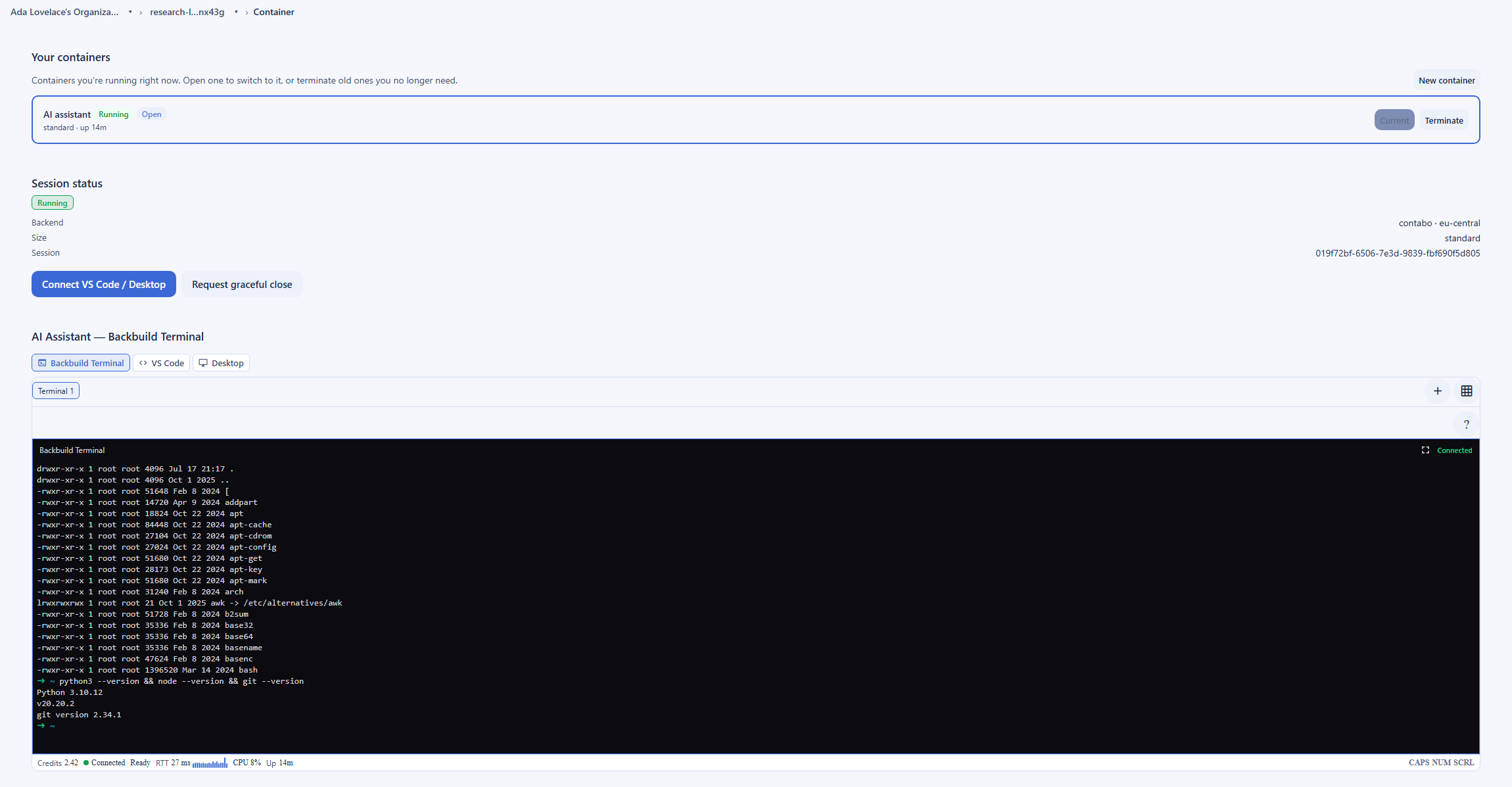
Reviewers note that Operator was browser-only and could not run a terminal or desktop applications, and that even after ChatGPT Agent added a text terminal it is still oriented around a cloud browser. A Backbuild Virtual Worker drives a full Linux desktop, a browser, and a terminal with the complete Linux tool suite, and a person can watch the live desktop and take over, so it operates installed applications and command-line tools, not only the web.
Constant permission prompts on a self-serve run
A recurring complaint is that the agent stops frequently to ask permission and is inconsistent on long real-world tasks. A Backbuild Virtual Worker gives a multi-step job the deterministic, reviewable states of a finite-state-machine skill, and an autonomy dial with a non-overridable approval floor lets you set how much runs unattended while irreversible actions still require a person.
Where the credentials and the data live
ChatGPT Agent signs in through takeover mode and read-access connectors, and OpenAI has been public that prompt injection is a risk it works to reduce rather than one it considers solved. Backbuild keeps a worker's credentials in an encrypted, zero-knowledge vault the model never reads in plaintext, runs each session under a revocable token behind a default-deny gate, and lets you run inference under your own AI provider agreement rather than a bundled model.
Locked to OpenAI models on a paid plan
ChatGPT Agent runs on OpenAI models only and is a paid feature, not on the free plan. Backbuild lets a team bring its own AI provider and model so inference runs at the provider rate, includes Virtual Workers on a free plan with one usage-credit pool and idle time free, and provides roles and audit on every plan rather than gating governance to a paid tier.
Which tool wins, by use case
Solo knowledge workers automating web tasks and deliverables
This is the largest audience, and it splits on surface and governance rather than raw capability. If you want a frontier-model agent to research a topic, act across the web, and hand back a polished report or deck inside ChatGPT, agent mode is fast and genuinely good at it. If the same work has to touch a terminal or an installed application, run under credentials your organization governs, or use your own model, a Backbuild Virtual Worker runs the task on a full desktop and terminal under governed credentials, free to start.
Researchers, analysts, and consultants
This is where OpenAI's computer-using agent fits best today. Deep web research on frontier models, data analysis, and one-step report and slide generation are exactly what ChatGPT Agent does well, turning a finding into a deliverable quickly. Backbuild competes here where the research must operate a gated internal tool or a terminal, or where the output should live as a collaborative workspace document rather than a one-off file, but for broad self-serve research on the best available model, ChatGPT Agent is the faster fit.
Developers and technical teams
This use case exposes the design difference most clearly. A Virtual Worker is driven through native Model Context Protocol tools and the public REST API on every plan, bounded by exactly the caller access, and it runs on a real computer with a terminal, a browser, and a full desktop under vault-governed secrets and governed skills, with the model of your choice. OpenAI exposes its computer-use capability to developers through the Agents SDK, which is a strong building block, but that is a model tool rather than a governed platform API over a workspace, and it is locked to OpenAI models.
Operations teams automating multi-tool work
For a process that runs across several tools, the deciding factors are surface, credentials, and where the automation lives. ChatGPT Agent can operate web tools in its cloud browser and pull context from its read-access connectors. Backbuild answers the same work with a worker that operates real systems, web and desktop and terminal, under vault-governed credentials, runs on a schedule or an event trigger, and lives next to the data it acts on in an all-in-one workspace, with roles and audit on every plan.
Security and compliance evaluation
Because a computer-using agent logs in and acts on real systems, the sharpest evaluation of this category is a security one, and it turns on a short list of criteria: where credentials live and who can read them, how tightly a session is scoped and how fast it can be stopped, whether governance and audit are present or gated to a top tier, exposure to prompt injection, and the vendor's own posture and attestations. Both products should be measured against those, not against a feature count.
On credentials, the two take different designs. ChatGPT Agent uses takeover mode, where a person types the login into the browser with screenshots off, and read-access connectors that hold live access to Gmail, Drive, and GitHub. Takeover mode genuinely keeps a password from the model, which is a real strength, but it needs a human present for each sign-in, and the connectors hold standing access. Backbuild keeps credentials in an encrypted, zero-knowledge vault the model never reads in plaintext: no tool returns a plaintext value, and a trusted path substitutes the real credential at the point of use, so a worker signs in unattended without ever handling the secret. For a reviewer who treats every agent as a privileged non-human identity, that difference is the center of the evaluation.
On blast radius and control, Backbuild runs each session in an isolated, disposable container under a scoped, signed delegated token that is least-privilege, time-limited, and checked against a server-side revocation list on every use, so tearing down a session is a real kill switch that fails closed on error, and the code a worker runs is held to a default-deny allowlist that excludes secrets, roles, billing, and administration. A non-overridable approval floor keeps two actions, sending external email and pushing code, always requiring a person. The operation stream itself is post-quantum encrypted. Backbuild also provides per-organization roles, single sign-on, SCIM 2.0 provisioning, and tamper-evident audit on every plan, where OpenAI places its admin, audit, single sign-on, and SCIM on its Business and Enterprise tiers. On prompt injection, OpenAI has been candid that hidden instructions on a web page are a risk it works to reduce rather than one it considers solved, a factor any organization letting an agent browse should weigh.
On vendor posture the honest picture runs both ways. OpenAI carries independent enterprise compliance attestations such as SOC 2 today, which Backbuild does not yet hold, and that is a genuine advantage for a buyer who requires an attested vendor now. At the same time, Backbuild offers a stronger structural posture for credentialed autonomy: a governed vault, per-session isolation, a revocable token, a default-deny gate, and governance on every plan rather than only on the top tier. The bottom line for a security evaluation is that OpenAI leads on independent attestations and frontier-model safety investment, while Backbuild leads on the credential design and the control set for autonomous work under organization governance.
The economics for a finance buyer
A finance evaluation of a computer-using agent is about total, predictable cost rather than a sticker price. The criteria are the entry cost, how the meter behaves as usage grows, and whether the spend can be forecast month to month across a team.
On entry cost, the two differ at the door. ChatGPT agent mode is a paid feature, not on the free plan, with paid tiers observed in 2026 from about 20 US dollars a month for Plus up to about 200 for Pro, Business at about 25 US dollars per seat, and Enterprise at about 60 US dollars per seat on a seat minimum, plus agent-mode message caps on some tiers. Backbuild has a free plan that includes Virtual Workers with no separate per-worker subscription, folds worker work into one universal usage-credit pool with idle time free, and lets a team bring its own AI provider and model so inference runs at the provider rate rather than a bundled markup.
The tradeoff a finance buyer should weigh is that Backbuild is usage-metered too: heavy worker work and larger container sizes draw more credits, so a demanding, always-busy workload is not free, and a team should size its credit budget against real usage rather than the free entry point. Against that, OpenAI pricing bundles a frontier model and a large product, which is a straightforward line item for a team already standardized on ChatGPT. The bottom line: Backbuild is the lower-entry, lower-lock-in cost structure with a model you can bring yourself and governance included, while ChatGPT Agent is a predictable per-seat subscription that bundles a frontier model but locks you to OpenAI and gates agent mode behind a paid tier with message caps.
Rolling it out across a team
For the person who has to put a computer-using agent into a real team daily process, the evaluation is about time-to-first-result, how the tool behaves when a run goes wrong, and whether governance scales with the team without forcing a top-tier upgrade. These are operational criteria, and the two products lead on different ones.
On time-to-first-result, ChatGPT Agent is usually ahead for a self-contained web task: it lives inside ChatGPT that many teams already use, so standing up a useful run is quick, and that speed is real and worth crediting. Backbuild trades some of that immediacy for surface and governance, because you direct a worker with prompts and governed skills on a full computer, but it makes a multi-step job states deterministic and reviewable and every action attributed and audited from the first run rather than only on a paid plan.
On governance at scale, the difference is where the controls live. OpenAI gates single sign-on, SCIM, an admin console, and audit logs to its Business and Enterprise tiers, so a growing team reaches for a paid upgrade to get them. Backbuild provides single sign-on and SCIM 2.0 provisioning and per-organization roles, data isolation, and a tamper-evident audit trail on every plan, including Free, and each session runs under a revocable token that makes a run that goes wrong visible and stoppable. The honest counterpoint is that a governed-skill approach on a full computer asks more of the person setting it up than a turnkey browser agent does. The bottom line for a rollout: ChatGPT Agent is the faster first win on a self-serve web task, and Backbuild is the more governable and auditable foundation as the number of automated processes and the size of the team grow.
Strategic fit and vendor risk
An executive sponsor is evaluating fit and risk more than features: what the tool consolidates or fragments, how much it locks the organization in, and whether the vendor is a safe multi-year bet. Each product presents a different strategic shape.
OpenAI's strategic case is model leadership and reach. ChatGPT Agent is a frontier-model agent inside the most widely used AI product, with independent compliance attestations and enormous momentum, so it is a low-friction way to give individuals a capable agent. The risks an executive should weigh are that agent mode locks the organization to OpenAI models, that it delivers into whatever apps the team already runs rather than consolidating them, and that letting an agent browse carries a prompt-injection exposure OpenAI itself does not consider solved.
Backbuild's strategic case is consolidation, model choice, and governed reach. The worker lives inside an all-in-one workspace spanning Mail, Chat, Meetings, Calendar, Contacts, Docs, Sheets, Slides, Diagrams, and Photos, with dedicated photo, video, training video, audio, and music editors, Files, Backbuild Finances, a built-in help desk, and the Secrets vault, it operates real systems under governed credentials with full audit on every plan, and it runs on the AI model of your choice. That reduces the number of vendors, avoids single-model lock-in, and puts the automation next to the data it acts on. The risk an executive should weigh in the other direction is that Backbuild is newer and pre-launch in parts, trading OpenAI frontier-model quality, ecosystem, and named attestations for a full computer, governed credentials, model choice, workspace consolidation, and governance on every plan. The bottom line: choose ChatGPT Agent for a frontier-model browser agent inside the OpenAI ecosystem, and Backbuild for a consolidated workspace whose AI worker operates a full computer under organization governance with the model you choose.
Frequently asked questions
What is the best OpenAI Operator alternative?
It depends on what the computer-using agent has to do and who governs it. OpenAI Operator, whose capability now ships inside ChatGPT Agent, is a strong choice for a frontier-model agent that operates a real browser in a cloud virtual machine to research, act on the web, and generate editable reports, slides, and sheets. Backbuild Virtual Workers are the closer fit when the work has to run under credentials your organization governs, on more than a browser, and inside controls a security team can sign off on: a worker drives a full Linux desktop, a browser, and a terminal on an isolated container, uses secrets from an encrypted vault the model never reads in plaintext, runs as governed finite-state-machine skills, and is attributed and audited on every plan. Backbuild also lets you bring your own AI model rather than locking you to OpenAI, and it puts the worker inside an all-in-one workspace exposed over a public REST API and native Model Context Protocol tools.
Does OpenAI Operator still exist as a product?
Not as a standalone product. Operator launched in January 2025 as a research preview that ran a browser in a cloud virtual machine, and OpenAI shut the standalone Operator preview down on August 31, 2025. Its computer-using capability now ships as ChatGPT Agent, the agent mode bundled into paid ChatGPT tiers, and the underlying Computer-Using Agent model is exposed to developers through the OpenAI Agents SDK. So a comparison today is between the OpenAI computer-using agent, as delivered in ChatGPT Agent, and Backbuild Virtual Workers, both covering the same job of an AI that operates a computer to do work.
Can OpenAI Operator run a terminal or desktop applications?
The original Operator was browser-only: it drove a web browser in a cloud virtual machine and could not touch a terminal, local files, or installed desktop applications. ChatGPT Agent added a text terminal and code execution alongside the browser, so it can now run commands, but it is still oriented around a cloud browser rather than a full graphical desktop that operates installed applications. A Backbuild Virtual Worker drives a full Linux desktop, a browser, and a terminal with the complete Linux tool suite, and a person can watch the live desktop and take over, so its surface is broader than a browser and a shell.
Is there a free OpenAI Operator alternative, and is Backbuild cheaper?
ChatGPT agent mode is a paid feature: it is available on the Plus, Pro, Business, and Enterprise tiers, not on the free ChatGPT plan, with paid tiers observed in 2026 running from about 20 US dollars a month up to about 200, and agent-mode message caps on some tiers. Backbuild has a free plan and includes Virtual Workers on it, with no separate per-worker subscription: worker work draws on one universal usage-credit pool as it runs, larger containers draw more, and idle time is not metered, and you can bring your own AI provider so inference runs at your provider rate rather than a bundled markup. So Backbuild has a genuinely free entry point for autonomous computer-using work, where OpenAI puts agent mode behind a paid subscription.
How does a Backbuild Virtual Worker use my passwords without exposing them?
Credentials live in your organization vault, an encrypted, zero-knowledge vault, not in the worker prompt. The model that drives a worker never receives a plaintext secret, because no tool returns one: an assistant can check that a vault is set up, list the names and target sites of items, and generate a new password into a named slot, but it cannot read a value back. When a secret is actually needed to act, a trusted path substitutes the real value at the moment of use and keeps it out of the model context, its results, and the logs, with no human required to type it. ChatGPT Agent takes a different approach: takeover mode pauses the agent so a person types the credential into the browser with screenshots off, which keeps the password from the model but requires a human present each time, and its connectors to Gmail, Drive, and GitHub hold live access to those accounts.
Is ChatGPT Agent safe to let into my company systems?
That is the right question for any computer-using agent, and it has two parts: the vendor and the controls. On the vendor, OpenAI carries independent enterprise compliance attestations such as SOC 2 and offers admin controls on ChatGPT Enterprise, which is a genuine strength Backbuild does not yet match. On the controls, ChatGPT Agent authenticates through takeover mode and read-access connectors, and OpenAI has said publicly that prompt injection, where hidden instructions on a web page try to hijack the agent, is a risk it works to reduce rather than one it considers solved. Backbuild answers with grant-based vault credentials the model never reads, a per-session isolated container under a scoped, revocable delegated token, a default-deny capability gate that excludes secrets, roles, billing, and administration, a non-overridable approval floor on irreversible actions, and per-organization roles and tamper-evident audit on every plan. A security reviewer should weigh both the attestations and the control set for each product.
What does OpenAI Operator do better than Backbuild Virtual Workers?
Several things. It runs on OpenAI frontier models, which are widely regarded as best in class for reasoning, and Backbuild lets you bring those same models but does not build them. It lives inside ChatGPT, the most widely used AI product, with its ecosystem, brand, and momentum. It ships a built-in deep research mode and one-step generators that turn a research task into an editable report, slide deck, or sheet quickly. And OpenAI carries independent enterprise compliance attestations today, where Backbuild is newer and not yet independently audited. Where a task fits a self-serve, frontier-model research-and-deliverable agent that operates a browser, ChatGPT Agent is fast and capable; where it needs to operate a full desktop and terminal, run under governed credentials with governance on every plan, and use your own model inside a workspace, Backbuild fits better.
Try Backbuild Virtual Workers free
Put an autonomous AI worker on a real computer: a full Linux desktop, a browser, and a terminal it drives to do work, using credentials from an encrypted vault the model never sees in plaintext, on an isolated container inside an all-in-one workspace, with the AI model of your choice, free to start with worker work on usage credits and governance on every plan. If your first requirement is a frontier-model browser agent inside ChatGPT with independent compliance attestations today, OpenAI Operator, now ChatGPT Agent, is the stronger choice.
Get started free